

4.3 Modern Examples, Sedimentary History
179
FOLD/THRUST BELT
PROGRADING
FLUVIO-DELTAIC
COMPLEX
SALT DOME ISL ANDS AND HIGHS
BIOGENIC CARBONATE SANDS
(PARTIALLY RELlCS)
CALCAREOUS OOIDS
SUPRATIDAL COASTAL SABKHAS
(EVAPORITES)
S = 40 -50
S > 50
INTERTIDAL CARBONATES
(INCLUDING ARAGONITE)
SAND DUNES
PRESENT HIGH SEA LEVEL
_ J ______ _ __ ___ ,
10-30 mI
HOLOCENE ---_....:~ ..,../ CARBONATE SAND, MUD. OR MARL
;{'::':>;:<- ~ REWORKED CARBONATE AND SAND
LAST LOWSTAND ---~DUNES, CARBONATE -CEMENTED
i~l1~l~ ::~:: :~C;l:V::~ ::D:, O~~::UM
~~T.. {~ SHELF CARBONATES AND EVAPORITES
PLEISTOCENE
PLiOCENE
MIOCENE
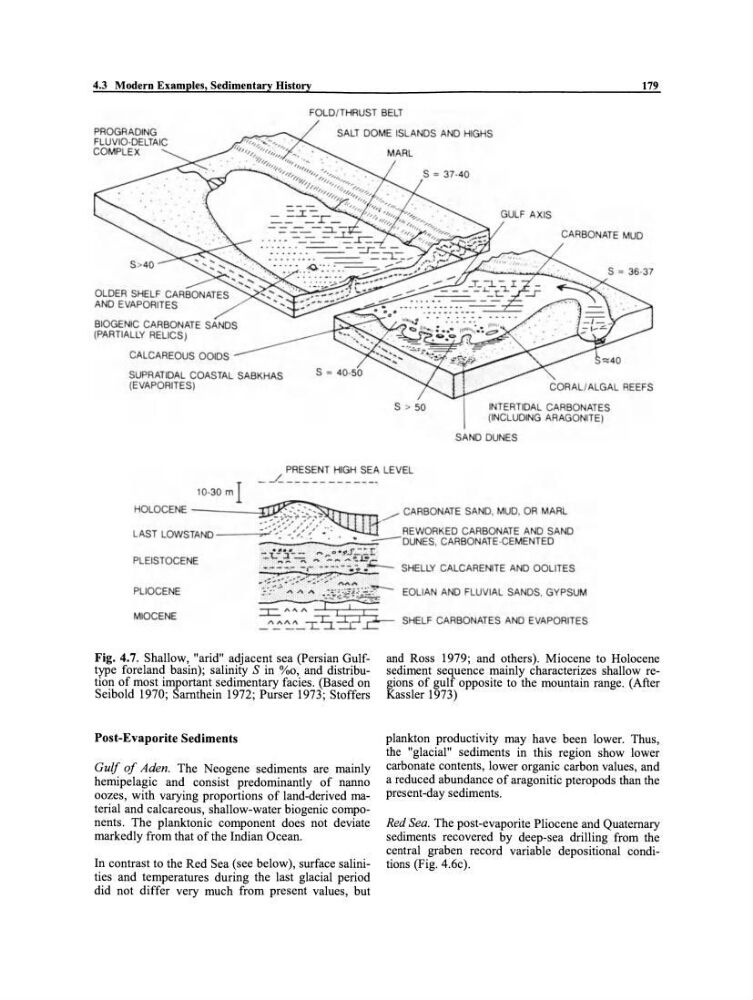
Fig. 4.7. Shallow, "arid" adjacent sea (Persian Gulftype foreland basin); salinity S in %0, and distribution of most important sedimentary facies. (Based on
Seibold 1970; Samthein 1972; Purser 1973; Stoffers
Post-Evaporite Sediments
Gulf of Aden. The Neogene sediments are mainly
hemipelagic and consist predominantly of nanno
oozes, with varying proportions of land-derived material and calcareous, shallow-water biogenic components. The planktonic component does not deviate
markedly from that of the Indian Ocean.
In contrast to the Red Sea (see below), surface salinities and temperatures during the last glacial period
did not differ very much from present values, but
and Ross 1979; and others). Miocene to Holocene
sediment sequence mainly characterizes shallow regions of gulf opposite to the mountain range. (After
Kassler 1973)
plankton productivity may have been lower. Thus,
the "glacial" sediments in this region show lower
carbonate contents, lower organic carbon values, and
a reduced abundance of aragonitic pteropods than the
present-day sediments.
Red Sea. The post-evaporite Pliocene and Quatemary
sediments recovered by deep-sea drilling from the
central graben record variable depositional conditions (Fig. 4.6c).
179
FOLD/THRUST BELT
PROGRADING
FLUVIO-DELTAIC
COMPLEX
SALT DOME ISL ANDS AND HIGHS
BIOGENIC CARBONATE SANDS
(PARTIALLY RELlCS)
CALCAREOUS OOIDS
SUPRATIDAL COASTAL SABKHAS
(EVAPORITES)
S = 40 -50
S > 50
INTERTIDAL CARBONATES
(INCLUDING ARAGONITE)
SAND DUNES
PRESENT HIGH SEA LEVEL
_ J ______ _ __ ___ ,
10-30 mI
HOLOCENE ---_....:~ ..,../ CARBONATE SAND, MUD. OR MARL
;{'::':>;:<- ~ REWORKED CARBONATE AND SAND
LAST LOWSTAND ---~DUNES, CARBONATE -CEMENTED
i~l1~l~ ::~:: :~C;l:V::~ ::D:, O~~::UM
~~T.. {~ SHELF CARBONATES AND EVAPORITES
PLEISTOCENE
PLiOCENE
MIOCENE
Fig. 4.7. Shallow, "arid" adjacent sea (Persian Gulftype foreland basin); salinity S in %0, and distribution of most important sedimentary facies. (Based on
Seibold 1970; Samthein 1972; Purser 1973; Stoffers
Post-Evaporite Sediments
Gulf of Aden. The Neogene sediments are mainly
hemipelagic and consist predominantly of nanno
oozes, with varying proportions of land-derived material and calcareous, shallow-water biogenic components. The planktonic component does not deviate
markedly from that of the Indian Ocean.
In contrast to the Red Sea (see below), surface salinities and temperatures during the last glacial period
did not differ very much from present values, but
and Ross 1979; and others). Miocene to Holocene
sediment sequence mainly characterizes shallow regions of gulf opposite to the mountain range. (After
Kassler 1973)
plankton productivity may have been lower. Thus,
the "glacial" sediments in this region show lower
carbonate contents, lower organic carbon values, and
a reduced abundance of aragonitic pteropods than the
present-day sediments.
Red Sea. The post-evaporite Pliocene and Quatemary
sediments recovered by deep-sea drilling from the
central graben record variable depositional conditions (Fig. 4.6c).