

168
VERTICALLY
MIXED
HIGHLY
STRATIFIED
d
±FRESH WATER
lARGE INFLOW
~ ~\
- - ;-;:;"T WEDGE
~~ __ ~ ESTUARY
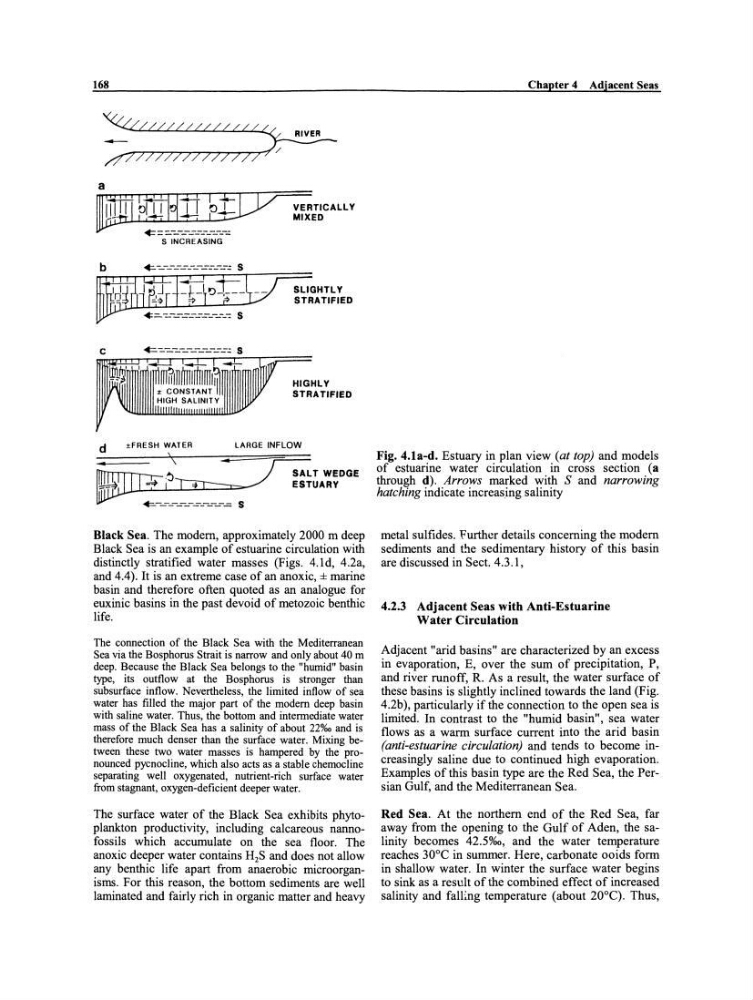
Black Sea. The modem, approximately 2000 m deep
Black Sea is an example of estuarine circulation with
distinctly stratified water masses (Figs. 4.1d, 4.2a,
and 4.4). It is an extreme case of an anoxie, ± marine
basin and therefore often quoted as an analogue for
euxinic basins in the past devoid of metozoic benthic
life.
The connection of the Black Sea with the Mediterranean
Sea via the Bosphorus Strait is narrow and only about 40 m
deep. Because the Black Sea belongs to the "humid" basin
type, its outflow at the Bosphorus is stronger than
subsurface inflow. Nevertheless, the limited inflow of sea
water has filled the major part of the modern deep basin
with saline water. Thus, the bottom and interrnediate water
mass of the Black Sea has a salinity of about 22%0 and is
therefore much denser than the surface water. Mixing between these two water masses is hampered by the pronounced pycnocline, which also acts as a stable chemocline
separating weil oxygenated, nutrient-rich surface water
from stagnant, oxygen-deficient deeper water.
The surface water of the Black Sea exhibits phytoplankton productivity, including calcareous nannofossils which accumulate on the sea floor. The
anoxie deeper water contains H 2 S and does not allow
any benthic life apart from anaerobic microorganisms. For this reason, the bottom sediments are weIl
laminated and fairly rich in organic matter and heavy
Chapter 4 Adjacent Seas
Fig. 4.1a-d. Estuary in plan view (at top) and models
of estuarine water circulation in cross section (a
through d). Arrows marked with Sand narrowing
hatching indicate increasing salinity
metal sulfides. further details conceming the modem
sediments and t!J.e sedimentary his tory of this basin
are discussed in Sect. 4.3.1,
4.2.3 Adjacent Seas with Anti-Estuarine
Water Circulation
Adjacent "arid basins" are characterized by an excess
in evaporation, E, over the sum of precipitation, P,
and river runoff, R. As a result, the water surface of
these basins is slightly inclined towards the land (Fig.
4.2b), particularly if the connection to the open sea is
lirnited. In contrast to the "humid basin", sea water
flows as a warm surface current into the arid basin
(anti-estuarine circulation) and tends to become increasingly saline due to continued high evaporation.
Examples of this basin type are the Red Sea, the Persian Gulf, and the Mediterranean Sea.
Red Sea. At the northem end of the Red Sea, far
away from the opening to the Gulf of Aden, the salinity becomes 42.5%0, and the water temperature
reaches 30°C in summer. Here, carbonate ooids form
in shallow water. In winter the surface water begins
to sink as a result of the combined effect of increased
salinity and falling temperature (about 20°e). Thus,
VERTICALLY
MIXED
HIGHLY
STRATIFIED
d
±FRESH WATER
lARGE INFLOW
~ ~\
- - ;-;:;"T WEDGE
~~ __ ~ ESTUARY
Black Sea. The modem, approximately 2000 m deep
Black Sea is an example of estuarine circulation with
distinctly stratified water masses (Figs. 4.1d, 4.2a,
and 4.4). It is an extreme case of an anoxie, ± marine
basin and therefore often quoted as an analogue for
euxinic basins in the past devoid of metozoic benthic
life.
The connection of the Black Sea with the Mediterranean
Sea via the Bosphorus Strait is narrow and only about 40 m
deep. Because the Black Sea belongs to the "humid" basin
type, its outflow at the Bosphorus is stronger than
subsurface inflow. Nevertheless, the limited inflow of sea
water has filled the major part of the modern deep basin
with saline water. Thus, the bottom and interrnediate water
mass of the Black Sea has a salinity of about 22%0 and is
therefore much denser than the surface water. Mixing between these two water masses is hampered by the pronounced pycnocline, which also acts as a stable chemocline
separating weil oxygenated, nutrient-rich surface water
from stagnant, oxygen-deficient deeper water.
The surface water of the Black Sea exhibits phytoplankton productivity, including calcareous nannofossils which accumulate on the sea floor. The
anoxie deeper water contains H 2 S and does not allow
any benthic life apart from anaerobic microorganisms. For this reason, the bottom sediments are weIl
laminated and fairly rich in organic matter and heavy
Chapter 4 Adjacent Seas
Fig. 4.1a-d. Estuary in plan view (at top) and models
of estuarine water circulation in cross section (a
through d). Arrows marked with Sand narrowing
hatching indicate increasing salinity
metal sulfides. further details conceming the modem
sediments and t!J.e sedimentary his tory of this basin
are discussed in Sect. 4.3.1,
4.2.3 Adjacent Seas with Anti-Estuarine
Water Circulation
Adjacent "arid basins" are characterized by an excess
in evaporation, E, over the sum of precipitation, P,
and river runoff, R. As a result, the water surface of
these basins is slightly inclined towards the land (Fig.
4.2b), particularly if the connection to the open sea is
lirnited. In contrast to the "humid basin", sea water
flows as a warm surface current into the arid basin
(anti-estuarine circulation) and tends to become increasingly saline due to continued high evaporation.
Examples of this basin type are the Red Sea, the Persian Gulf, and the Mediterranean Sea.
Red Sea. At the northem end of the Red Sea, far
away from the opening to the Gulf of Aden, the salinity becomes 42.5%0, and the water temperature
reaches 30°C in summer. Here, carbonate ooids form
in shallow water. In winter the surface water begins
to sink as a result of the combined effect of increased
salinity and falling temperature (about 20°e). Thus,