

3.4 Carbonates
149
VERTICAl GROWTH
SUBSIDENCE
Sl-RISE
co
.::L.
-- E E
Cf)
LlJ
I<{
CI:
RECENT REEF CORALS
I
n !
HOLOCENE:
REEFS
I
OOLITES
~
: § TIDALITES
~COOL TO COLD
COOLING
CRUST
1
HIGH-FREQUENCY,
HIGH-AMPLITUDE
• (E.G. HOlaCENE)
I ,
,
I
• •
•
I • •
PlATFORM
CARBONATES
LONG-TERM
SUBSIDENCE,
E.G. BAHAMAS
LOW-FREQUENCY,
3RD ORDER
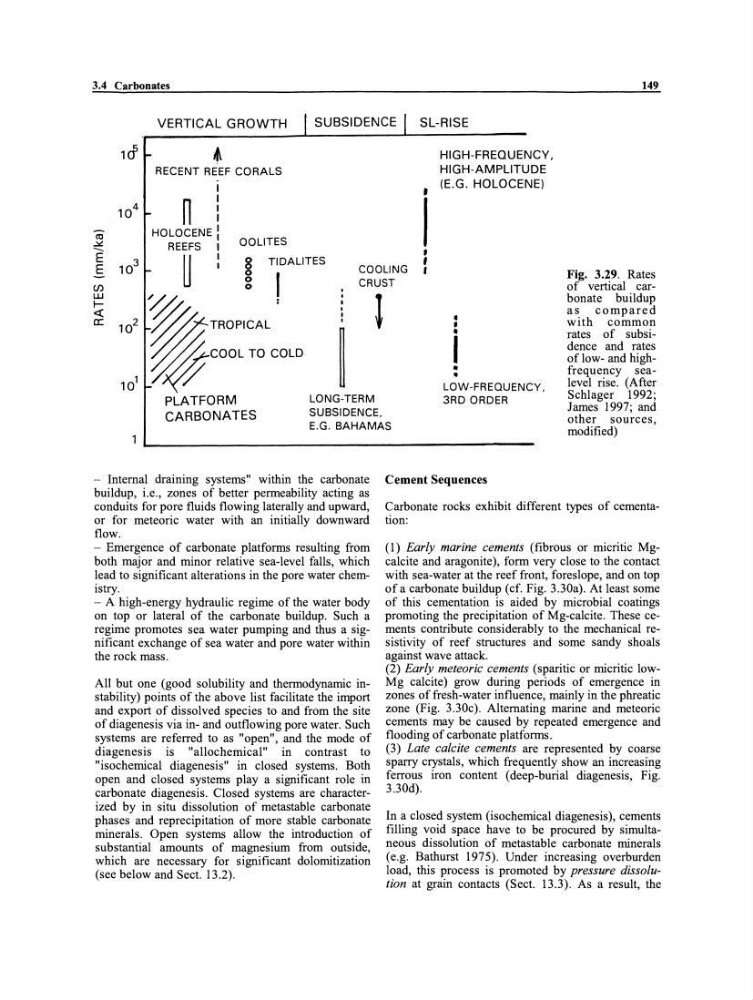
Fig. 3.29. Rates
of vertical carbonate buildup
as compared
with common
rates of subsidence and rates
of low- and highfrequency sealevel rise. (After
Schlager 1992;
J ames 1997; and
other sources,
modified)
- Internal draining systems" within the carbonate
buildup, i.e., zones of better permeability acting as
conduits for pore fluids flowing laterally and upward,
or for meteoric water with an initially downward
flow.
- Emergence of carbonate platforms resulting from
both major and minor relative sea-level falls, which
lead to significant alterations in the pore water chemistry.
- A high-energy hYdraulic regime of the water body
on top or lateral of the carbonate buildup. Such a
regime prornotes sea water pumping and thus a significant exchange of sea water and pore water within
the rock mass.
All but one (good solubility and thermodynamic instability) points of the above list facilitate the import
and export of dissolved species to and from the site
of diagenesis via in- and outflowing pore water. Such
systems are referred to as "open", and the mode of
diagenesis is "allochemical" in contrast to
"isochemical diagenesis" in elosed systems. Both
open and elosed systems play a significant role in
carbonate diagenesis. Closed systems are characterized by in situ dissolution of metastable carbonate
phases and reprecipitation of more stable carbonate
minerals. Open systems allow the introduction of
substantial amounts of magnesium from outside,
which are necessary for significant dolomitization
(see below and Sect. 13.2).
Cement Sequences
Carbonate rocks exhibit different types of cementation:
(1) Early marine cements (fibrous or micritic Mgcalcite and aragonite), form very elose to the contact
with sea-water at the reef front, foreslope, and on top
of a carbonate buildup (cf. Fig. 3.30a). At least some
of this cementation is aided by microbial coatings
promoting the precipitation of Mg-calcite. These cements contribute considerably to the mechanical resistivity of reef structures and some sandy shoals
against wave attack.
(2) Early meteoric cements (sparitic or micritic lowMg calcite) grow during periods of emergence in
zones of fresh-water influence, mainly in the phreatic
zone (Fig. 3.30c). Alternating marine and meteoric
cements may be caused by repeated emergence and
flooding of carbonate platforrns.
(3) Late calcite cements are represented by coarse
sparry crystals, which frequently show an increasing
ferrous iron content (deep-burial diagenesis, Fig.
3.30d).
In a elosed system (isochemical diagenesis), cements
filling void space have to be procured by simultaneous dissolution of metastable carbonate minerals
(e.g. Bathurst 1975). Under increasing overburden
load, this process is promoted by press ure dissolution at grain contacts (Sect. 13.3). As a result, the
149
VERTICAl GROWTH
SUBSIDENCE
Sl-RISE
co
.::L.
-- E E
Cf)
LlJ
I<{
CI:
RECENT REEF CORALS
I
n !
HOLOCENE:
REEFS
I
OOLITES
~
: § TIDALITES
~COOL TO COLD
COOLING
CRUST
1
HIGH-FREQUENCY,
HIGH-AMPLITUDE
• (E.G. HOlaCENE)
I ,
,
I
• •
•
I • •
PlATFORM
CARBONATES
LONG-TERM
SUBSIDENCE,
E.G. BAHAMAS
LOW-FREQUENCY,
3RD ORDER
Fig. 3.29. Rates
of vertical carbonate buildup
as compared
with common
rates of subsidence and rates
of low- and highfrequency sealevel rise. (After
Schlager 1992;
J ames 1997; and
other sources,
modified)
- Internal draining systems" within the carbonate
buildup, i.e., zones of better permeability acting as
conduits for pore fluids flowing laterally and upward,
or for meteoric water with an initially downward
flow.
- Emergence of carbonate platforms resulting from
both major and minor relative sea-level falls, which
lead to significant alterations in the pore water chemistry.
- A high-energy hYdraulic regime of the water body
on top or lateral of the carbonate buildup. Such a
regime prornotes sea water pumping and thus a significant exchange of sea water and pore water within
the rock mass.
All but one (good solubility and thermodynamic instability) points of the above list facilitate the import
and export of dissolved species to and from the site
of diagenesis via in- and outflowing pore water. Such
systems are referred to as "open", and the mode of
diagenesis is "allochemical" in contrast to
"isochemical diagenesis" in elosed systems. Both
open and elosed systems play a significant role in
carbonate diagenesis. Closed systems are characterized by in situ dissolution of metastable carbonate
phases and reprecipitation of more stable carbonate
minerals. Open systems allow the introduction of
substantial amounts of magnesium from outside,
which are necessary for significant dolomitization
(see below and Sect. 13.2).
Cement Sequences
Carbonate rocks exhibit different types of cementation:
(1) Early marine cements (fibrous or micritic Mgcalcite and aragonite), form very elose to the contact
with sea-water at the reef front, foreslope, and on top
of a carbonate buildup (cf. Fig. 3.30a). At least some
of this cementation is aided by microbial coatings
promoting the precipitation of Mg-calcite. These cements contribute considerably to the mechanical resistivity of reef structures and some sandy shoals
against wave attack.
(2) Early meteoric cements (sparitic or micritic lowMg calcite) grow during periods of emergence in
zones of fresh-water influence, mainly in the phreatic
zone (Fig. 3.30c). Alternating marine and meteoric
cements may be caused by repeated emergence and
flooding of carbonate platforrns.
(3) Late calcite cements are represented by coarse
sparry crystals, which frequently show an increasing
ferrous iron content (deep-burial diagenesis, Fig.
3.30d).
In a elosed system (isochemical diagenesis), cements
filling void space have to be procured by simultaneous dissolution of metastable carbonate minerals
(e.g. Bathurst 1975). Under increasing overburden
load, this process is promoted by press ure dissolution at grain contacts (Sect. 13.3). As a result, the