

3.1 Beach and Shoreface Sediments
Rhizocorallium
(Rh)
Planolites
Thalassinoides
(Th)
BIOTURBA TION
' IN MUDDY HOST
SEDIMENT
~
... . " "
--' ';:: ''';' .
Rh - - ".
'.: .", : .:'
·5. :' a.: .. . "
, a.~ • •
-:: . 4
SHALLOW
a
STORM-INDUCED
TRUNCATION
AND CASTING
DEEP
b
105
Planolites
ICHNOFACIES OF
HOST SEDIMENT
AND TEMPESTITE
A r&>rl,r,nlll'A
Zoophycos
Diplocratenon
EROSIONAL BASE
c
BIOLOGICAL
TEMPESTITE
DESTRUCTION
FLAT · PEBBLE
CONGLOMERATE II~~I~I~~
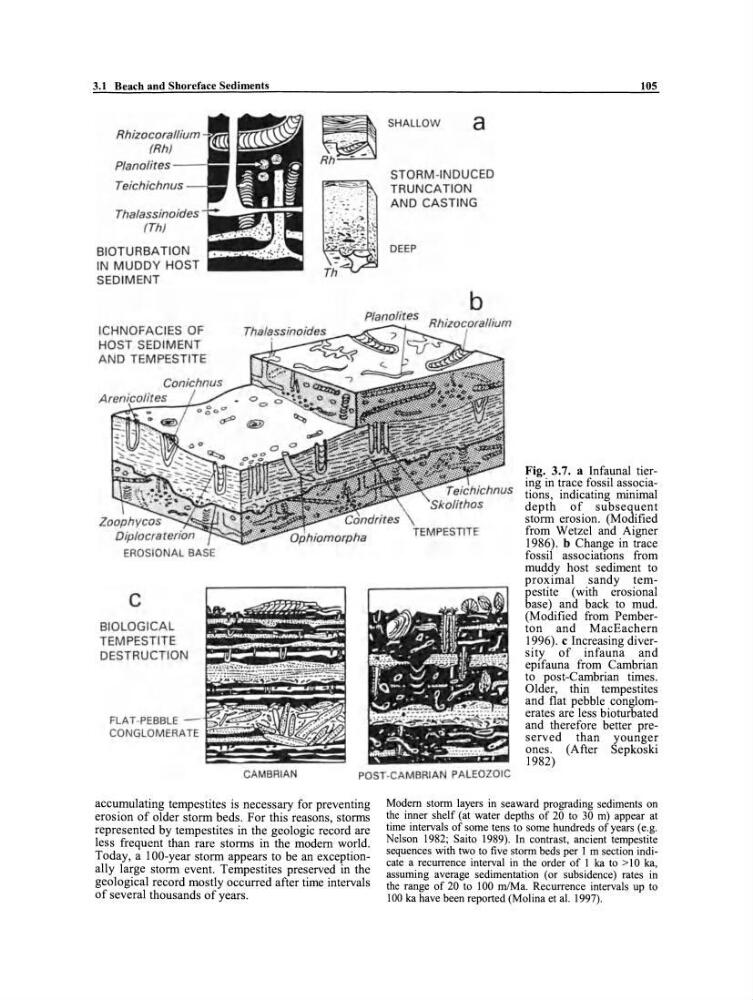
Fig. 3.7. a Infaunal tiering in trace fossil associations, indicating minimal
depth of subsequent
storm erosion. (Modified
from Wetzel and Aigner
1986). b Change in trace
fossil associations from
muddy host sediment to
proximal sandy tempestite (with erosional
base) and back to mud.
(Modified from Pemberton and MacEachern
1996). c Increasing diversity of infauna and
epifauna from Cambrian
to post-Cambrian times.
Older, thin tempestites
and flat pebble eonglomerates are less bioturbated
and therefore better preserved than younger
ones. (After Sepkoski
1982)
CAMBRIAN
POST-CAMBRIAN PALEOZOIC
aeeumulating tempestites is neeessary for preventing
erosion of older storm beds. For this reasons, storms
represented by tempestites in the geologie reeord are
less frequent than rare storms in the modern world.
Today, a 100-year storm appears to be an exeeptionally large storm event. Tempestites preserved in the
geologieal reeord mostly oeeurred after time intervals
of several thousands of years.
Modern storm layers in seaward prograding sediments on
the inner she\f (at water depths of 20 to 30 m) appear at
time intervals ofsome tens to some hundreds ofyears (e.g.
Nelson 1982; Saito 1989). In contrast, ancient tempestite
sequences with two to five storm beds per 1 m section indicate a recurrence interval in the order of I ka to > 1 0 ka,
assuming average sedimentation (or subsidence) rates in
the range of 20 to 100 mlMa. Recurrence intervals up to
100 ka have been reported (Molina et al. 1997).
Rhizocorallium
(Rh)
Planolites
Thalassinoides
(Th)
BIOTURBA TION
' IN MUDDY HOST
SEDIMENT
~
... . " "
--' ';:: ''';' .
Rh - - ".
'.: .", : .:'
·5. :' a.: .. . "
, a.~ • •
-:: . 4
SHALLOW
a
STORM-INDUCED
TRUNCATION
AND CASTING
DEEP
b
105
Planolites
ICHNOFACIES OF
HOST SEDIMENT
AND TEMPESTITE
A r&>rl,r,nlll'A
Zoophycos
Diplocratenon
EROSIONAL BASE
c
BIOLOGICAL
TEMPESTITE
DESTRUCTION
FLAT · PEBBLE
CONGLOMERATE II~~I~I~~
Fig. 3.7. a Infaunal tiering in trace fossil associations, indicating minimal
depth of subsequent
storm erosion. (Modified
from Wetzel and Aigner
1986). b Change in trace
fossil associations from
muddy host sediment to
proximal sandy tempestite (with erosional
base) and back to mud.
(Modified from Pemberton and MacEachern
1996). c Increasing diversity of infauna and
epifauna from Cambrian
to post-Cambrian times.
Older, thin tempestites
and flat pebble eonglomerates are less bioturbated
and therefore better preserved than younger
ones. (After Sepkoski
1982)
CAMBRIAN
POST-CAMBRIAN PALEOZOIC
aeeumulating tempestites is neeessary for preventing
erosion of older storm beds. For this reasons, storms
represented by tempestites in the geologie reeord are
less frequent than rare storms in the modern world.
Today, a 100-year storm appears to be an exeeptionally large storm event. Tempestites preserved in the
geologieal reeord mostly oeeurred after time intervals
of several thousands of years.
Modern storm layers in seaward prograding sediments on
the inner she\f (at water depths of 20 to 30 m) appear at
time intervals ofsome tens to some hundreds ofyears (e.g.
Nelson 1982; Saito 1989). In contrast, ancient tempestite
sequences with two to five storm beds per 1 m section indicate a recurrence interval in the order of I ka to > 1 0 ka,
assuming average sedimentation (or subsidence) rates in
the range of 20 to 100 mlMa. Recurrence intervals up to
100 ka have been reported (Molina et al. 1997).