

3.1 Beach and Shoreface Sediments
a
INTERNAL STRUCTURES OF
PROXIMAL SILICICL. TEMPESTITE
103
WAVE RIPP LES
dm
SOLE MARKS
(OCCASIONALLY BIPOLAR)
MASSIVE, GRADED DIVISION
d
C
b
DISTAL
MUD TEMPESTITE
PROXIMAL TEMP .
(BIOCL. CARBONATE)
AMALGAMATION BY
SUCCESSIVE STORMS
M ~:{\~J~ TOP
'P ' .. ..,~
. r~rf~Y BIOTURBATED
'W:p ;t;
0.1
m
S ":.):'\,::1'. gm MUD TEMP.,
'! i ,
FAUNA DIS·
PlACED
M SHELF MUD,
FAUNA IN
PlACE
gm
M
M
CARBO·
NATE
SAND
AND
SHEllS
MUD
ClAST
ized by thorough bioturbation in the long time intervals between large storms (Fig. 3.7b). Sole marks at
the base of sandy tempestites indicate a trace fossil
association characteristic of shallow-marine environments.
Burrows exhumed and partly washed out by storm action
are subsequently filled with settling sediment. The erosional depth range of storm action can be determined from
these casts of animal burrows which were shaped just prior
to the storm event (Fig. 3.7a; Wetzel and Aigner 1986).
However, burrow-fill sedimentation can also occur without
the formation of a storm deposit (Wanless et al 1988).
The pre-event bioturbation in muddy host sediment is
caused by a mixed, deposit-feeding and grazing SkolithosCruziana association of high diversity (Fig. 3.7.b; Pemberton and MacEachem 1996).
t
3
hc
11
gr
am
,,-n
am
1
gr
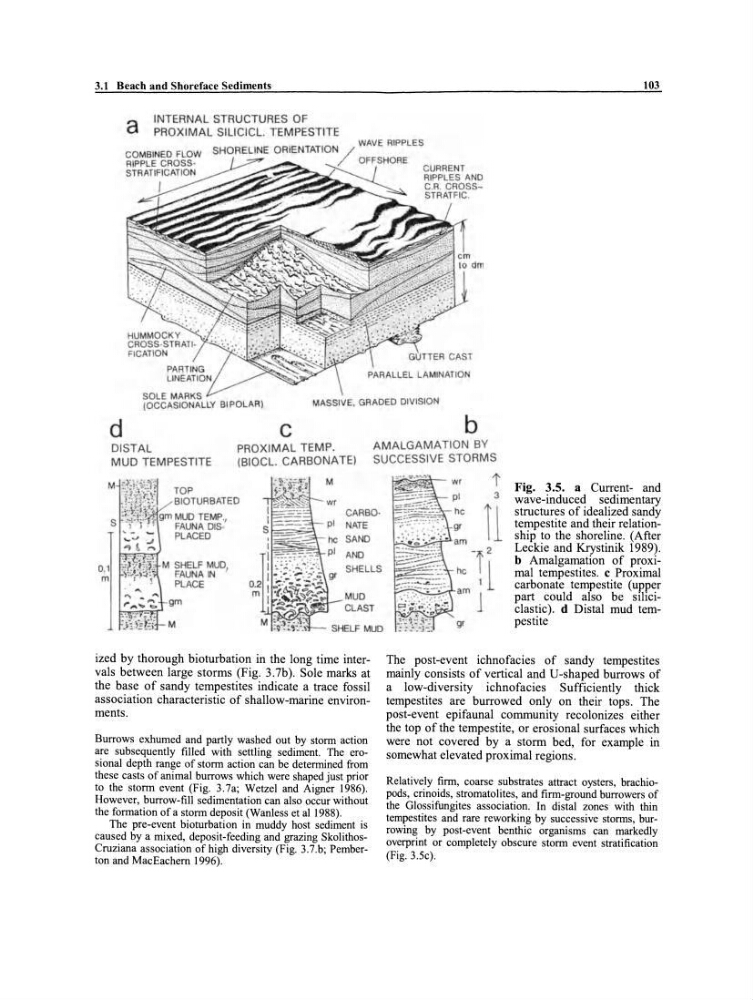
Fig. 3.5. a Current- and
wave-induced sedimentary
structures of idealized sandy
tempestite and their relationship to the shoreline. (After
Leckie and Krystinik 1989).
b Amalgamation of proximal tempestites. c Proximal
carbonate tempestite (upper
part could also be siliciclastic). d Distal mud tempestite
The post-event ichnofacies of sandy tempestites
mainly consists of vertical and U-shaped burrows of
a low-diversity ichnofacies Sufficiently thick
tempestites are burrowed only on their tops. The
post-event epifaunal community recolonizes either
the top of the tempestite, or erosional surfaces which
were not covered by a storm bed, for example in
somewhat elevated proximal regions.
Relatively firm, coarse substrates attract oysters, brachiopods, crinoids, stromatolites, and firm-ground burrowers of
the Glossifungites association. In distal zones with thin
tempestites and rare reworking by successive storms, burrowing by post-event benthic organisms can markedly
overprint or completely obscure storm event stratification
(Fig. 3.5c).
a
INTERNAL STRUCTURES OF
PROXIMAL SILICICL. TEMPESTITE
103
WAVE RIPP LES
dm
SOLE MARKS
(OCCASIONALLY BIPOLAR)
MASSIVE, GRADED DIVISION
d
C
b
DISTAL
MUD TEMPESTITE
PROXIMAL TEMP .
(BIOCL. CARBONATE)
AMALGAMATION BY
SUCCESSIVE STORMS
M ~:{\~J~ TOP
'P ' .. ..,~
. r~rf~Y BIOTURBATED
'W:p ;t;
0.1
m
S ":.):'\,::1'. gm MUD TEMP.,
'! i ,
FAUNA DIS·
PlACED
M SHELF MUD,
FAUNA IN
PlACE
gm
M
M
CARBO·
NATE
SAND
AND
SHEllS
MUD
ClAST
ized by thorough bioturbation in the long time intervals between large storms (Fig. 3.7b). Sole marks at
the base of sandy tempestites indicate a trace fossil
association characteristic of shallow-marine environments.
Burrows exhumed and partly washed out by storm action
are subsequently filled with settling sediment. The erosional depth range of storm action can be determined from
these casts of animal burrows which were shaped just prior
to the storm event (Fig. 3.7a; Wetzel and Aigner 1986).
However, burrow-fill sedimentation can also occur without
the formation of a storm deposit (Wanless et al 1988).
The pre-event bioturbation in muddy host sediment is
caused by a mixed, deposit-feeding and grazing SkolithosCruziana association of high diversity (Fig. 3.7.b; Pemberton and MacEachem 1996).
t
3
hc
11
gr
am
,,-n
am
1
gr
Fig. 3.5. a Current- and
wave-induced sedimentary
structures of idealized sandy
tempestite and their relationship to the shoreline. (After
Leckie and Krystinik 1989).
b Amalgamation of proximal tempestites. c Proximal
carbonate tempestite (upper
part could also be siliciclastic). d Distal mud tempestite
The post-event ichnofacies of sandy tempestites
mainly consists of vertical and U-shaped burrows of
a low-diversity ichnofacies Sufficiently thick
tempestites are burrowed only on their tops. The
post-event epifaunal community recolonizes either
the top of the tempestite, or erosional surfaces which
were not covered by a storm bed, for example in
somewhat elevated proximal regions.
Relatively firm, coarse substrates attract oysters, brachiopods, crinoids, stromatolites, and firm-ground burrowers of
the Glossifungites association. In distal zones with thin
tempestites and rare reworking by successive storms, burrowing by post-event benthic organisms can markedly
overprint or completely obscure storm event stratification
(Fig. 3.5c).