

3,1 Beach and Shoreface Sediments
95
a
r --- SHOREFACE
DUNE
,
L
I
I
Ä
- -ur~ I
SHALLOW-WATER
l
;.;-'U~_ 'I
WAVES CL'cL: H',.H) I SWASH
. L / 2 :
I
o ,
'
J BREAKER AND I
, WAVE BASE
1-- BUILDUP - ... SURF ZONE - -1
- - . - - - ' - - - - - - -
I OF WAVES I
I
I
I
I
DEEP-WATER
I
WAVES
I
I
HEAVY
ONNER)
MINERALS
I
PLANAR
:
(
R) I
~ ZONE - ~
'" ZONE -'1
I
PLANAR :
I I
ETRIC
;
.... r..,
RIPPLES. LAND -
I
ON HIGH-ENERGY BEACH:
SYMMETRICAl
__ ~ARD IRREG~~~:TE ME~A('NNER1
1
ROUGH ZONE
RIPPLES, BIO TURBATED
1+- RIPPLES .oI
I
I
b
ASYMM, RIPPLES
_~i~: . ~~~~~~;~~
LUNA TE RIPPLES
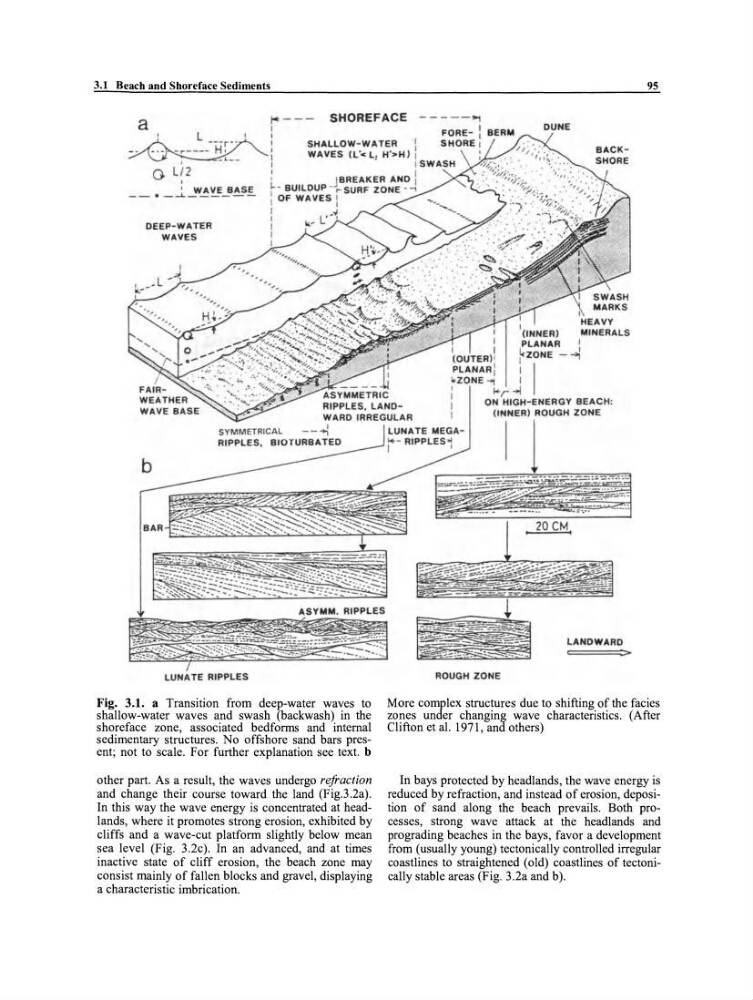
Fig, 3,1. a Transition from deep-water waves to
shallow-water waves and swash (backwash) in the
shoreface zone, associated bedforms and internal
sedimentary structures. No offshore sand bars present; not to scale. For further explanation see text. b
other part. As a result, the waves undergo refraction
and change their course toward the land (Fig.3.2a).
In this way the wave energy is concentrated at headlands, where it promotes strong erosion, exhibited by
cliffs and a wave-cut platform slightly below mean
sea level (Fig. 3.2c). In an advanced, and at times
inactive state of cliff erosion, the beach zone may
consist mainly of fallen blocks and gravel, displaying
a characteristic imbrication.
~.l!l
ROUGH ZONE
20 CM I
LANDWARD
:>
More complex structures due to shifting of the facies
zones under changing wave characteristics. (After
Clifton et al. 1971, and others)
In bays protected by headlands, the wave energy is
reduced by refraction, and instead of erosion, deposition of sand along the beach prevails. Both proces ses, strong wave attack at the headlands and
prograding beaches in the bays, favor a development
from (usually young) tectonically controlled irregular
coastlines to straightened (old) coastlines of tectonically stable areas (Fig. 3.2a and b).
95
a
r --- SHOREFACE
DUNE
,
L
I
I
Ä
- -ur~ I
SHALLOW-WATER
l
;.;-'U~_ 'I
WAVES CL'cL: H',.H) I SWASH
. L / 2 :
I
o ,
'
J BREAKER AND I
, WAVE BASE
1-- BUILDUP - ... SURF ZONE - -1
- - . - - - ' - - - - - - -
I OF WAVES I
I
I
I
I
DEEP-WATER
I
WAVES
I
I
HEAVY
ONNER)
MINERALS
I
PLANAR
:
(
R) I
~ ZONE - ~
'" ZONE -'1
I
PLANAR :
I I
ETRIC
;
.... r..,
RIPPLES. LAND -
I
ON HIGH-ENERGY BEACH:
SYMMETRICAl
__ ~ARD IRREG~~~:TE ME~A('NNER1
1
ROUGH ZONE
RIPPLES, BIO TURBATED
1+- RIPPLES .oI
I
I
b
ASYMM, RIPPLES
_~i~: . ~~~~~~;~~
LUNA TE RIPPLES
Fig, 3,1. a Transition from deep-water waves to
shallow-water waves and swash (backwash) in the
shoreface zone, associated bedforms and internal
sedimentary structures. No offshore sand bars present; not to scale. For further explanation see text. b
other part. As a result, the waves undergo refraction
and change their course toward the land (Fig.3.2a).
In this way the wave energy is concentrated at headlands, where it promotes strong erosion, exhibited by
cliffs and a wave-cut platform slightly below mean
sea level (Fig. 3.2c). In an advanced, and at times
inactive state of cliff erosion, the beach zone may
consist mainly of fallen blocks and gravel, displaying
a characteristic imbrication.
~.l!l
ROUGH ZONE
20 CM I
LANDWARD
:>
More complex structures due to shifting of the facies
zones under changing wave characteristics. (After
Clifton et al. 1971, and others)
In bays protected by headlands, the wave energy is
reduced by refraction, and instead of erosion, deposition of sand along the beach prevails. Both proces ses, strong wave attack at the headlands and
prograding beaches in the bays, favor a development
from (usually young) tectonically controlled irregular
coastlines to straightened (old) coastlines of tectonically stable areas (Fig. 3.2a and b).