

17 In Situ Settling Velocities and Concentrations of Suspended Sediment in Spill Plumes
17.4.3
Accumulation
187
Fine-grained sediment is assumed to be deposited in the 0resund region because the
deeper areas are known to act as sinks for suspended matter (Madsen and Larsen 1986).
Accumulation of spilled sediment was monitored based on a hindcast scenario (see
Fig. 17.4) for the whole dredging period 19 October 1995 to 12 December 1996. A total of
181000 tons of material was spilled up to this date (Bernitt and Simonsen 1997). Samples were collected at 14 sites chosen to be representative of areas of accumulation on
the basis of the scenario. The locations of the sites were chosen such that they would
cover the potentially highest accumulation areas. Accumulated material, which was
concluded to originate from dredging spill based on colour and texture, was found only
at three of the 14 sites; the sites in question are marked as HAP 06, HAP 07 and HAP 12.
These localities were found within the high accumulation areas predicted by the model.
They are situated in areas sheltered from wind and wave action at water depths below
10-15 m where fine sediments are known to be deposited (Pejrup and Larsen 1994).
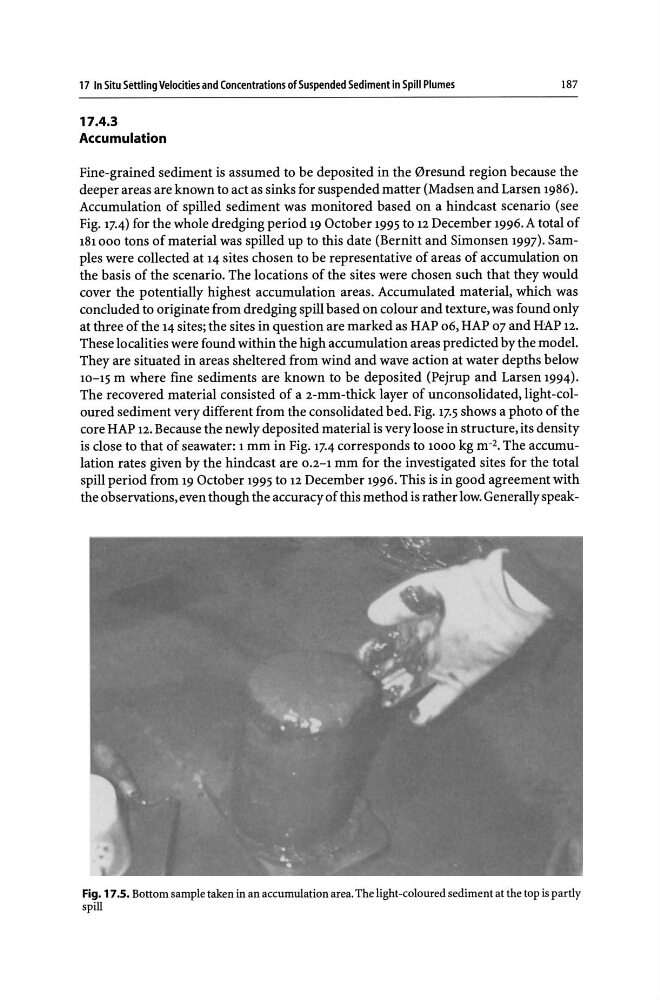
The recovered material consisted of a 2-mm-thick layer of unconsolidated, light-coloured sediment very different from the consolidated bed. Fig. 17.5 shows a photo of the
core HAP 12. Because the newly deposited material is very loose in structure, its density
is close to that of seawater: 1 mm in Fig. 17.4 corresponds to 1000 kg m- 2 • The accumulation rates given by the hindcast are 0.2-1 mm for the investigated sites for the total
spill period from 19 October 1995 to 12 December 1996. This is in good agreement with
the observations, even though the accuracy of this method is rather low. Generally speakFig. 17.5. Bottom sample taken in an accumulation area. The light-coloured sediment at the top is partly
spill
17.4.3
Accumulation
187
Fine-grained sediment is assumed to be deposited in the 0resund region because the
deeper areas are known to act as sinks for suspended matter (Madsen and Larsen 1986).
Accumulation of spilled sediment was monitored based on a hindcast scenario (see
Fig. 17.4) for the whole dredging period 19 October 1995 to 12 December 1996. A total of
181000 tons of material was spilled up to this date (Bernitt and Simonsen 1997). Samples were collected at 14 sites chosen to be representative of areas of accumulation on
the basis of the scenario. The locations of the sites were chosen such that they would
cover the potentially highest accumulation areas. Accumulated material, which was
concluded to originate from dredging spill based on colour and texture, was found only
at three of the 14 sites; the sites in question are marked as HAP 06, HAP 07 and HAP 12.
These localities were found within the high accumulation areas predicted by the model.
They are situated in areas sheltered from wind and wave action at water depths below
10-15 m where fine sediments are known to be deposited (Pejrup and Larsen 1994).
The recovered material consisted of a 2-mm-thick layer of unconsolidated, light-coloured sediment very different from the consolidated bed. Fig. 17.5 shows a photo of the
core HAP 12. Because the newly deposited material is very loose in structure, its density
is close to that of seawater: 1 mm in Fig. 17.4 corresponds to 1000 kg m- 2 • The accumulation rates given by the hindcast are 0.2-1 mm for the investigated sites for the total
spill period from 19 October 1995 to 12 December 1996. This is in good agreement with
the observations, even though the accuracy of this method is rather low. Generally speakFig. 17.5. Bottom sample taken in an accumulation area. The light-coloured sediment at the top is partly
spill