

16 Embankments and Their Ecological Impacts
175
16.3.3
Timber and Bamboo Pile Bulkheads
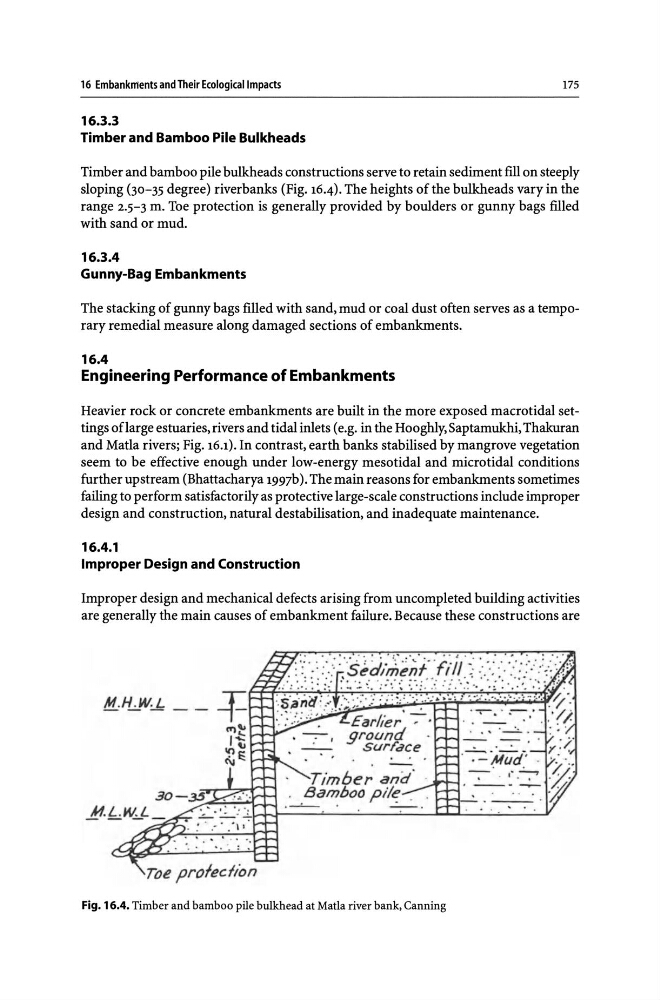
Timber and bamboo pile bulkheads constructions serve to retain sediment fill on steeply
sloping (30-35 degree) riverbanks (Fig. 16.4). The heights of the bulkheads vary in the
range 2.5-3 m. Toe protection is generally provided by boulders or gunny bags filled
with sand or mud.
16.3.4
Gunny-Bag Embankments
The stacking of gunny bags filled with sand, mud or coal dust often serves as a temporary remedial measure along damaged sections of embankments.
16.4
Engineering Performance of Embankments
Heavier rock or concrete embankments are built in the more exposed macrotidal settings oflarge estuaries, rivers and tidal inlets (e.g. in the Hooghiy, Saptamukhi, Thakuran
and Matla rivers; Fig. 16.1). In contrast, earth banks stabilised by mangrove vegetation
seem to be effective enough under low-energy mesotidal and microtidal conditions
further upstream (Bhattacharya 1997b). The main reasons for embankments sometimes
failing to perform satisfactorily as protective large-scale constructions include improper
design and construction, natural destabilisation, and inadequate maintenance.
16.4.1
Improper Design and Construction
Improper design and mechanical defects arising from uncompleted building activities
are generally the main causes of embankment failure. Because these constructions are
-
Timber anci
Bamboo ptle .
. - ' -
.
Fig. 16.4. Timber and bamboo pile bulkhead at Matla river bank, Canning
175
16.3.3
Timber and Bamboo Pile Bulkheads
Timber and bamboo pile bulkheads constructions serve to retain sediment fill on steeply
sloping (30-35 degree) riverbanks (Fig. 16.4). The heights of the bulkheads vary in the
range 2.5-3 m. Toe protection is generally provided by boulders or gunny bags filled
with sand or mud.
16.3.4
Gunny-Bag Embankments
The stacking of gunny bags filled with sand, mud or coal dust often serves as a temporary remedial measure along damaged sections of embankments.
16.4
Engineering Performance of Embankments
Heavier rock or concrete embankments are built in the more exposed macrotidal settings oflarge estuaries, rivers and tidal inlets (e.g. in the Hooghiy, Saptamukhi, Thakuran
and Matla rivers; Fig. 16.1). In contrast, earth banks stabilised by mangrove vegetation
seem to be effective enough under low-energy mesotidal and microtidal conditions
further upstream (Bhattacharya 1997b). The main reasons for embankments sometimes
failing to perform satisfactorily as protective large-scale constructions include improper
design and construction, natural destabilisation, and inadequate maintenance.
16.4.1
Improper Design and Construction
Improper design and mechanical defects arising from uncompleted building activities
are generally the main causes of embankment failure. Because these constructions are
-
Timber anci
Bamboo ptle .
. - ' -
.
Fig. 16.4. Timber and bamboo pile bulkhead at Matla river bank, Canning