

142
R.K. Thrner
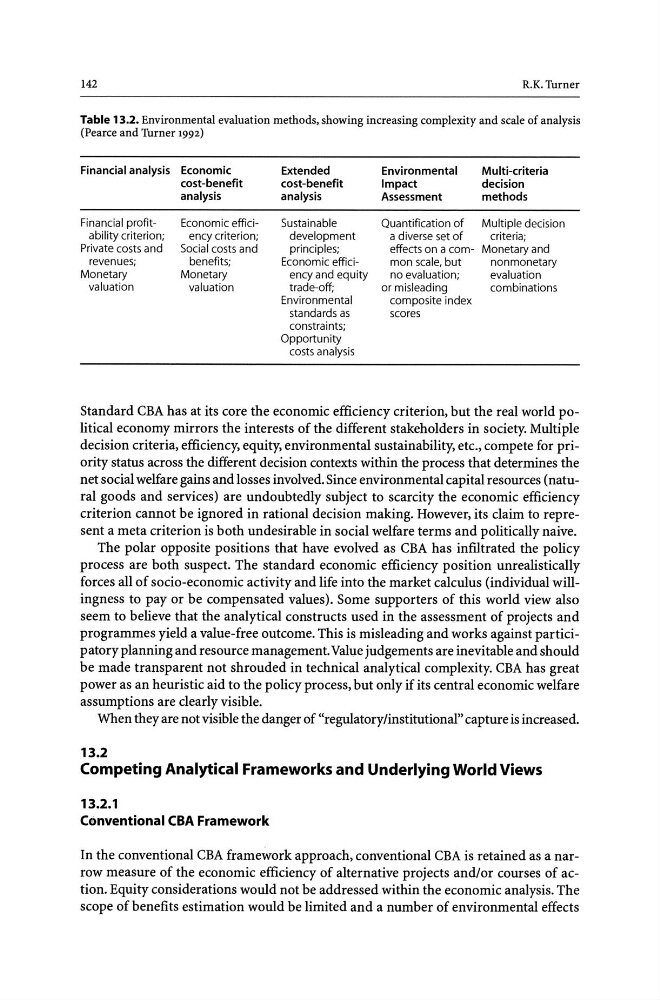
Table 13.2. Environmental evaluation methods, showing increasing complexity and scale of analysis
(Pearce and Turner 1992)
Financial analysis Economic
Extended
Environmental
Multi-criteria
cost-benefit
cost-benefit
Impact
decision
analysis
analysis
Assessment
methods
Financial profitEconomic efficiSustainable
Quantification of
Multiple decision
ability criterion;
ency criterion;
development
a diverse set of
criteria;
Private costs and
Social costs and
principles;
effects on a com- Monetary and
revenues;
benefits;
Economic efficimon scale, but
nonmonetary
Monetary
Monetary
ency and equity
no evaluation;
evaluation
valuation
valuation
trade-off;
or misleading
combinations
Environmental
composite index
standards as
scores
constraints;
Opportunity
costs analysis
Standard CBA has at its core the economic efficiency criterion, but the real world political economy mirrors the interests of the different stakeholders in society. Multiple
decision criteria, efficiency, equity, environmental sustain ability, etc., compete for priority status across the different decision contexts within the process that determines the
net social welfare gains and losses involved. Since environmental capital resources (natural goods and services) are undoubtedly subject to scarcity the economic efficiency
criterion cannot be ignored in rational decision making. However, its claim to represent a meta criterion is both undesirable in social welfare terms and politically naive.
The polar opposite positions that have evolved as CBA has infIltrated the policy
process are both suspect. The standard economic efficiency position unrealistically
forces all of socio-economic activity and life into the market calculus (individual willingness to payor be compensated values). Some supporters of this world view also
seem to believe that the analytical constructs used in the assessment of projects and
programmes yield a value-free outcome. This is misleading and works against participatory planning and resource management. Value judgements are inevitable and should
be made transparent not shrouded in technical analytical complexity. CBA has great
power as an heuristic aid to the policy process, but only if its central economic welfare
assumptions are clearly visible.
When they are not visible the danger of "regulatory/institutional" capture is increased.
13.2
Competing Analytical Frameworks and Underlying World Views
13.2.1
Conventional CBA Framework
In the conventional CBA framework approach, conventional CBA is retained as a narrow measure of the economic efficiency of alternative projects and/or courses of action. Equity considerations would not be addressed within the economic analysis. The
scope of benefits estimation would be limited and a number of environmental effects
R.K. Thrner
Table 13.2. Environmental evaluation methods, showing increasing complexity and scale of analysis
(Pearce and Turner 1992)
Financial analysis Economic
Extended
Environmental
Multi-criteria
cost-benefit
cost-benefit
Impact
decision
analysis
analysis
Assessment
methods
Financial profitEconomic efficiSustainable
Quantification of
Multiple decision
ability criterion;
ency criterion;
development
a diverse set of
criteria;
Private costs and
Social costs and
principles;
effects on a com- Monetary and
revenues;
benefits;
Economic efficimon scale, but
nonmonetary
Monetary
Monetary
ency and equity
no evaluation;
evaluation
valuation
valuation
trade-off;
or misleading
combinations
Environmental
composite index
standards as
scores
constraints;
Opportunity
costs analysis
Standard CBA has at its core the economic efficiency criterion, but the real world political economy mirrors the interests of the different stakeholders in society. Multiple
decision criteria, efficiency, equity, environmental sustain ability, etc., compete for priority status across the different decision contexts within the process that determines the
net social welfare gains and losses involved. Since environmental capital resources (natural goods and services) are undoubtedly subject to scarcity the economic efficiency
criterion cannot be ignored in rational decision making. However, its claim to represent a meta criterion is both undesirable in social welfare terms and politically naive.
The polar opposite positions that have evolved as CBA has infIltrated the policy
process are both suspect. The standard economic efficiency position unrealistically
forces all of socio-economic activity and life into the market calculus (individual willingness to payor be compensated values). Some supporters of this world view also
seem to believe that the analytical constructs used in the assessment of projects and
programmes yield a value-free outcome. This is misleading and works against participatory planning and resource management. Value judgements are inevitable and should
be made transparent not shrouded in technical analytical complexity. CBA has great
power as an heuristic aid to the policy process, but only if its central economic welfare
assumptions are clearly visible.
When they are not visible the danger of "regulatory/institutional" capture is increased.
13.2
Competing Analytical Frameworks and Underlying World Views
13.2.1
Conventional CBA Framework
In the conventional CBA framework approach, conventional CBA is retained as a narrow measure of the economic efficiency of alternative projects and/or courses of action. Equity considerations would not be addressed within the economic analysis. The
scope of benefits estimation would be limited and a number of environmental effects