

CHAPTER 13
Economics and Project Management
in the Coastal Zone
R. Kerry Turner
13.1
Introduction
The proliferation of large-scale construction projects in coastal zones reflects the increasing environmental pressures being exerted on such areas (both biophysical and
socio-economic systems) by population growth/migration, urbanisation, industrial
development and the globalisation of economic/trading activities, as well as tourism.
Around 37% (2.07 billion) of the 1994 world population (of 5.62 billion) live within
100 km of a coastline and 44% within 150 km of a coastline (Cohen et al. 1997). These
trends seem set to continue.
The aggregate effect of these pressures has been to generate multiple and often conflicting resource usage trends in coastal zones. The mitigation of these resource conflict problems through the practical adoption of the sustainable development policy
objective, which politicians have signed up to, requires both underpinning comprehensive resource assessment (including resource valuation) methods/techniques and
institutional procedures such as integrated coastal zone planning and management
(Bower and Turner 1998).
Since the 1960s the use of cost benefit-analysis (CBA) and its attendant monetary
valuation methods and techniques has been extended to cover a wide spectrum of
projects, policies and programmes. This has inevitably led to relative valuations of a
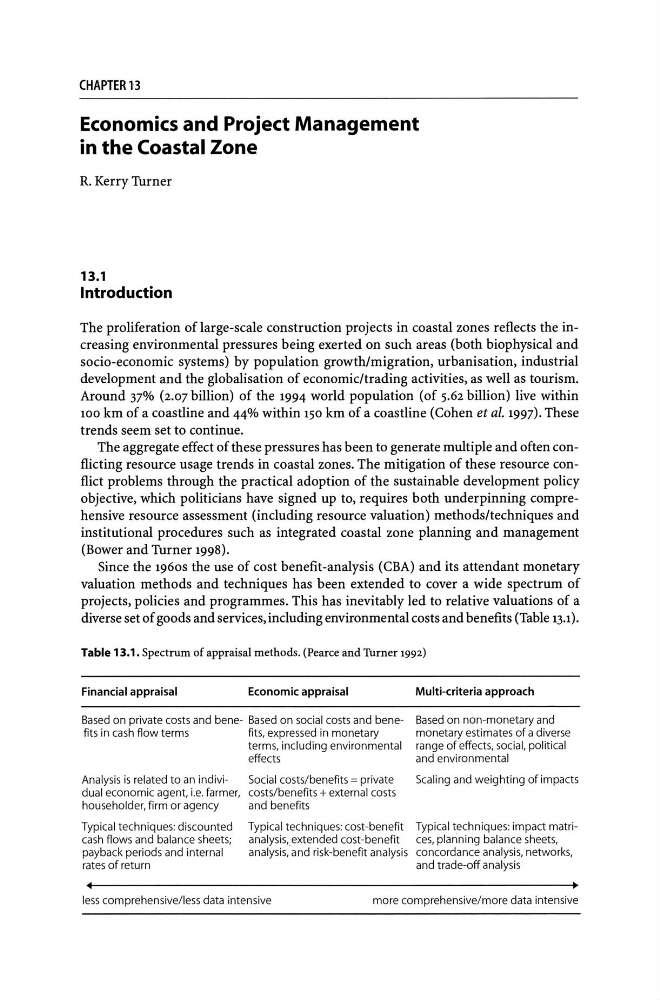
diverse set of goods and services, including environmental costs and benefits (Table 13.1).
Table 13.1. Spectrum of appraisal methods. (Pearce and 'furner 1992)
Financial appraisal
Economic appraisal
Based on private costs and bene- Based on social costs and benefits in cash flow terms
fits, expressed in monetary
terms, including environmental
effects
Analysis is related to an indiviSocial costs/benefits = private
dual economic agent, i.e. farmer, costs/benefits + extemal costs
householder, firm or agency
and benefits
Typical techniques: discounted
cash flows and balance sheets;
payback periods and intemal
rates of retum
Typical techniques: cost-benefit
analysis,extended cost-benefit
analysis, and risk-benefit analysis
Multi-criteria approach
Based on non-monetary and
monetary estimates of a diverse
range of effects, social, political
and environmental
Scaling and weighting of impacts
Typical techniques: impact matrices, planning balance sheets,
concordance analysis, networks,
and trade-off analysis
less comprehensive/less data intensive
more comprehensive/more data intensive
Economics and Project Management
in the Coastal Zone
R. Kerry Turner
13.1
Introduction
The proliferation of large-scale construction projects in coastal zones reflects the increasing environmental pressures being exerted on such areas (both biophysical and
socio-economic systems) by population growth/migration, urbanisation, industrial
development and the globalisation of economic/trading activities, as well as tourism.
Around 37% (2.07 billion) of the 1994 world population (of 5.62 billion) live within
100 km of a coastline and 44% within 150 km of a coastline (Cohen et al. 1997). These
trends seem set to continue.
The aggregate effect of these pressures has been to generate multiple and often conflicting resource usage trends in coastal zones. The mitigation of these resource conflict problems through the practical adoption of the sustainable development policy
objective, which politicians have signed up to, requires both underpinning comprehensive resource assessment (including resource valuation) methods/techniques and
institutional procedures such as integrated coastal zone planning and management
(Bower and Turner 1998).
Since the 1960s the use of cost benefit-analysis (CBA) and its attendant monetary
valuation methods and techniques has been extended to cover a wide spectrum of
projects, policies and programmes. This has inevitably led to relative valuations of a
diverse set of goods and services, including environmental costs and benefits (Table 13.1).
Table 13.1. Spectrum of appraisal methods. (Pearce and 'furner 1992)
Financial appraisal
Economic appraisal
Based on private costs and bene- Based on social costs and benefits in cash flow terms
fits, expressed in monetary
terms, including environmental
effects
Analysis is related to an indiviSocial costs/benefits = private
dual economic agent, i.e. farmer, costs/benefits + extemal costs
householder, firm or agency
and benefits
Typical techniques: discounted
cash flows and balance sheets;
payback periods and intemal
rates of retum
Typical techniques: cost-benefit
analysis,extended cost-benefit
analysis, and risk-benefit analysis
Multi-criteria approach
Based on non-monetary and
monetary estimates of a diverse
range of effects, social, political
and environmental
Scaling and weighting of impacts
Typical techniques: impact matrices, planning balance sheets,
concordance analysis, networks,
and trade-off analysis
less comprehensive/less data intensive
more comprehensive/more data intensive