

12 Managing the Ecology and Economy of Modified Estuaries
133
conducted a campaign to raise awareness of the need to protect the area's outstanding
natural resources and its unique tidal habitats, including the extensive shellfish industry (Smies and Huiskes 1981; Knoester 1984). This led to the Dutch government deciding to change the design of the dam in 1974. In 1976, after 2 years of desk studies, the
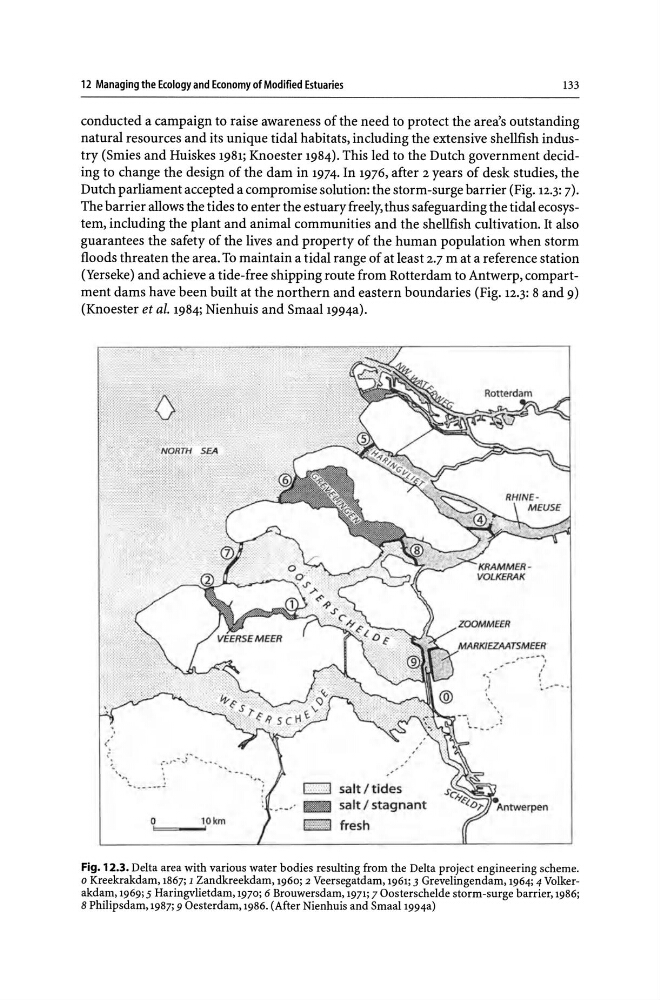
Dutch parliament accepted a compromise solution: the storm-surge barrier (Fig. 12·3: 7).
The barrier allows the tides to enter the estuary freely, thus safeguarding the tidal ecosystem, including the plant and animal communities and the shellfish cultivation. It also
guarantees the safety of the lives and property of the human population when storm
floods threaten the area. To maintain a tidal range of at least 2.7 m at a reference station
(Yerseke) and achieve a tide-free shipping route from Rotterdam to Antwerp, compartment dams have been built at the northern and eastern boundaries (Fig. 12.3: 8 and 9)
(Knoester et al. 1984; Nienhuis and Smaal1994a).
..
,-. , ....... ~
........ ~ ----o
10km
===-_ ... .
E:::J
~
I:::.::.:,:.:; . .-::j
salt/tides
salt / stagnant
fresh
',
,
,
...... - .
Fig. 12.3. Delta area with various water bodies resulting from the Delta project engineering scheme.
o Kreekrakdam, 1867; 1 Zandkreekdam, 1960; 2 Veersegatdam, 1961; 3 Grevelingendam, 1964; 4 Volkerakdam, 1969; 5 Haringvlietdam, 1970; 6 Brouwersdam, 1971; 7 Oosterschelde storm-surge barrier, 1986;
8 Philipsdam, 1987; 9 Oesterdam, 1986. (After Nienhuis and Smaa11994a)
133
conducted a campaign to raise awareness of the need to protect the area's outstanding
natural resources and its unique tidal habitats, including the extensive shellfish industry (Smies and Huiskes 1981; Knoester 1984). This led to the Dutch government deciding to change the design of the dam in 1974. In 1976, after 2 years of desk studies, the
Dutch parliament accepted a compromise solution: the storm-surge barrier (Fig. 12·3: 7).
The barrier allows the tides to enter the estuary freely, thus safeguarding the tidal ecosystem, including the plant and animal communities and the shellfish cultivation. It also
guarantees the safety of the lives and property of the human population when storm
floods threaten the area. To maintain a tidal range of at least 2.7 m at a reference station
(Yerseke) and achieve a tide-free shipping route from Rotterdam to Antwerp, compartment dams have been built at the northern and eastern boundaries (Fig. 12.3: 8 and 9)
(Knoester et al. 1984; Nienhuis and Smaal1994a).
..
,-. , ....... ~
........ ~ ----o
10km
===-_ ... .
E:::J
~
I:::.::.:,:.:; . .-::j
salt/tides
salt / stagnant
fresh
',
,
,
...... - .
Fig. 12.3. Delta area with various water bodies resulting from the Delta project engineering scheme.
o Kreekrakdam, 1867; 1 Zandkreekdam, 1960; 2 Veersegatdam, 1961; 3 Grevelingendam, 1964; 4 Volkerakdam, 1969; 5 Haringvlietdam, 1970; 6 Brouwersdam, 1971; 7 Oosterschelde storm-surge barrier, 1986;
8 Philipsdam, 1987; 9 Oesterdam, 1986. (After Nienhuis and Smaa11994a)