

126
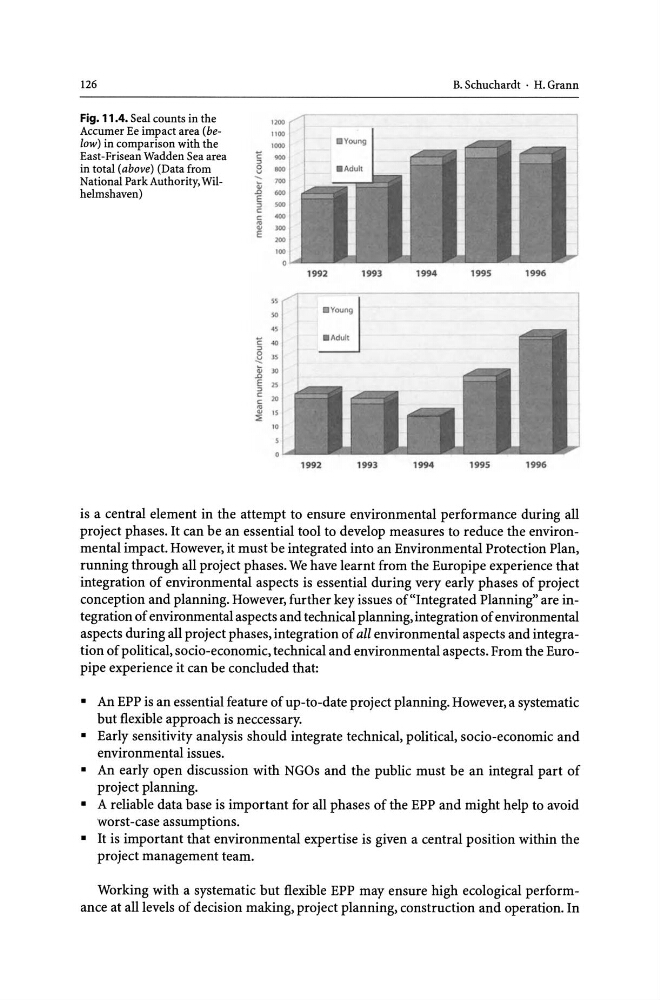
Fig. 11.4. Seal counts in the
Accumer Ee impact area (below) in comparison with the
East-Frisean Wadden Sea area
in total (above) (Data from
National Park Authority, Wilhelmshaven)
C
::>
0
v
....
. .
.0
E
::>
c:
c:
. .
.. E
1>00
11 00
1000
900
800
700
600
500
...,
)00
200
100
S>
50
.,
c: ..
::>
..@ lS
1i ' "
E "
::>
~ 20
~ 15
B. Schuchardt . H. Grann
1992
1993
1994
1995
1996
1992
1993
1994
1995
1996
is a central element in the attempt to ensure environmental performance during all
project phases. It can be an essential tool to develop measures to reduce the environmental impact. However, it must be integrated into an Environmental Protection Plan,
running through all project phases. We have learnt from the Europipe experience that
integration of environmental aspects is essential during very early phases of project
conception and planning. However, further key issues of "Integrated Planning" are integration of environmental aspects and technical planning, integration of environmental
aspects during all project phases, integration of all environmental aspects and integration of political, socio-economic, technical and environmental aspects. From the Europipe experience it can be concluded that:
• An EPP is an essential feature of up-to-date project planning. However, a systematic
but flexible approach is neccessary.
• Early sensitivity analysis should integrate technical, political, socio-economic and
environmental issues.
• An early open discussion with NGOs and the public must be an integral part of
project planning.
• A reliable data base is important for all phases of the EPP and might help to avoid
worst-case assumptions.
• It is important that environmental expertise is given a central position within the
project management team.
Working with a systematic but flexible EPP may ensure high ecological performance at all levels of decision making, project planning, construction and operation. In
Fig. 11.4. Seal counts in the
Accumer Ee impact area (below) in comparison with the
East-Frisean Wadden Sea area
in total (above) (Data from
National Park Authority, Wilhelmshaven)
C
::>
0
v
....
. .
.0
E
::>
c:
c:
. .
.. E
1>00
11 00
1000
900
800
700
600
500
...,
)00
200
100
S>
50
.,
c: ..
::>
..@ lS
1i ' "
E "
::>
~ 20
~ 15
B. Schuchardt . H. Grann
1992
1993
1994
1995
1996
1992
1993
1994
1995
1996
is a central element in the attempt to ensure environmental performance during all
project phases. It can be an essential tool to develop measures to reduce the environmental impact. However, it must be integrated into an Environmental Protection Plan,
running through all project phases. We have learnt from the Europipe experience that
integration of environmental aspects is essential during very early phases of project
conception and planning. However, further key issues of "Integrated Planning" are integration of environmental aspects and technical planning, integration of environmental
aspects during all project phases, integration of all environmental aspects and integration of political, socio-economic, technical and environmental aspects. From the Europipe experience it can be concluded that:
• An EPP is an essential feature of up-to-date project planning. However, a systematic
but flexible approach is neccessary.
• Early sensitivity analysis should integrate technical, political, socio-economic and
environmental issues.
• An early open discussion with NGOs and the public must be an integral part of
project planning.
• A reliable data base is important for all phases of the EPP and might help to avoid
worst-case assumptions.
• It is important that environmental expertise is given a central position within the
project management team.
Working with a systematic but flexible EPP may ensure high ecological performance at all levels of decision making, project planning, construction and operation. In