

124
B. Schuchardt . H. Grann
11.8
Ecological Monitoring Programme
An extensive Ecological Monitoring Programme, aimed at the identification and documentation of the main impacts on the environment, was an important part of the EPP
of the Europipe project. This programme, required by the approval authority, covered
several disciplines including hydrodynamics, morphodynamics, sedimentology and
biological aspects such as zoobenthos, fish and birds (for overview see Vollmer 1997).
However, the limitations of such a programme should be mentioned: it is and it will be
very difficult and partly impossible to identify relatively weak and temporal effects and
to distinguish between the natural variability and the project's impact in thi~ highly
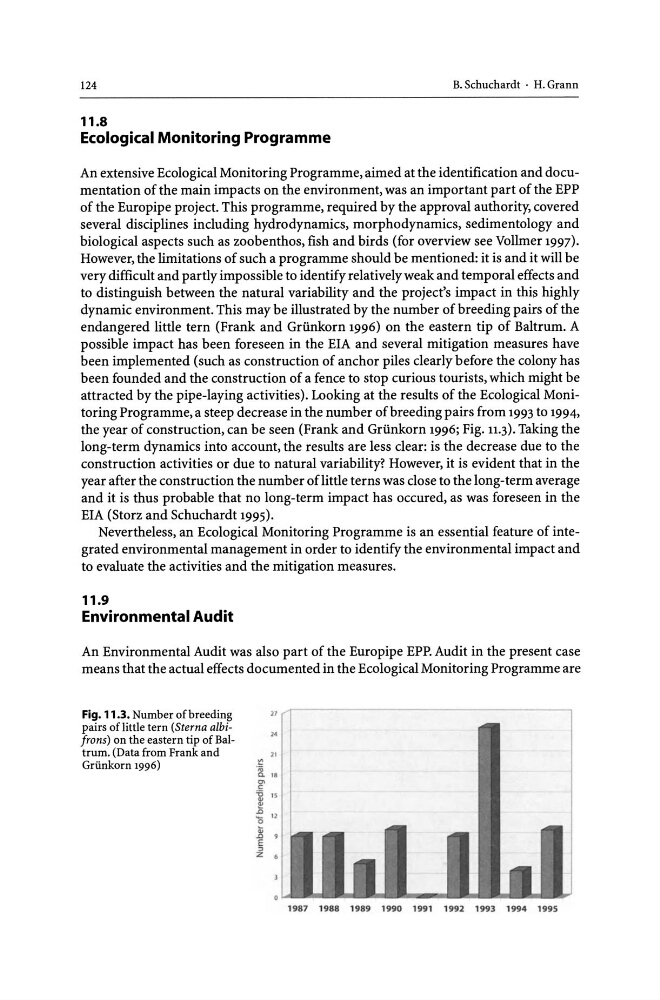
dynamic environment. This may be illustrated by the number of breeding pairs of the
endangered little tern (Frank and Griinkorn 1996) on the eastern tip of Baltrum. A
possible impact has been foreseen in the EIA and several mitigation measures have
been implemented (such as construction of anchor piles clearly before the colony has
been founded and the construction of a fence to stop curious tourists, which might be
attracted by the pipe-laying activities). Looking at the results of the Ecological Monitoring Programme, a steep decrease in the number of breeding pairs from 1993 to 1994,
the year of construction, can be seen (Frank and Griinkorn 1996; Fig. n .3). Taking the
long-term dynamics into account, the results are less clear: is the decrease due to the
construction activities or due to natural variability? However, it is evident that in the
year after the construction the number oflittle terns was close to the long-term average
and it is thus probable that no long-term impact has occured, as was foreseen in the
EIA (Storz and Schuchardt 1995).
Nevertheless, an Ecological Monitoring Programme is an essential feature of integrated environmental management in order to identify the environmental impact and
to evaluate the activities and the mitigation measures.
11.9
Environmental Audit
An Environmental Audit was also part of the Europipe EPP. Audit in the present case
means that the actual effects documented in the Ecological Monitoring Programme are
Fig. 11.3. Number of breeding
pairs oflittle tern (Sterna albifrons) on the eastern tip of Baltrurn. (Data from Frank and
Griinkorn 1996)
l? ~------------------------------------'
,.
II
~
.~ , .
'" c:
l IS
:a 12
Z •
E
:>
Z
6
1987 1988 1989 1990 1991 1992 1993 1994 1995
B. Schuchardt . H. Grann
11.8
Ecological Monitoring Programme
An extensive Ecological Monitoring Programme, aimed at the identification and documentation of the main impacts on the environment, was an important part of the EPP
of the Europipe project. This programme, required by the approval authority, covered
several disciplines including hydrodynamics, morphodynamics, sedimentology and
biological aspects such as zoobenthos, fish and birds (for overview see Vollmer 1997).
However, the limitations of such a programme should be mentioned: it is and it will be
very difficult and partly impossible to identify relatively weak and temporal effects and
to distinguish between the natural variability and the project's impact in thi~ highly
dynamic environment. This may be illustrated by the number of breeding pairs of the
endangered little tern (Frank and Griinkorn 1996) on the eastern tip of Baltrum. A
possible impact has been foreseen in the EIA and several mitigation measures have
been implemented (such as construction of anchor piles clearly before the colony has
been founded and the construction of a fence to stop curious tourists, which might be
attracted by the pipe-laying activities). Looking at the results of the Ecological Monitoring Programme, a steep decrease in the number of breeding pairs from 1993 to 1994,
the year of construction, can be seen (Frank and Griinkorn 1996; Fig. n .3). Taking the
long-term dynamics into account, the results are less clear: is the decrease due to the
construction activities or due to natural variability? However, it is evident that in the
year after the construction the number oflittle terns was close to the long-term average
and it is thus probable that no long-term impact has occured, as was foreseen in the
EIA (Storz and Schuchardt 1995).
Nevertheless, an Ecological Monitoring Programme is an essential feature of integrated environmental management in order to identify the environmental impact and
to evaluate the activities and the mitigation measures.
11.9
Environmental Audit
An Environmental Audit was also part of the Europipe EPP. Audit in the present case
means that the actual effects documented in the Ecological Monitoring Programme are
Fig. 11.3. Number of breeding
pairs oflittle tern (Sterna albifrons) on the eastern tip of Baltrurn. (Data from Frank and
Griinkorn 1996)
l? ~------------------------------------'
,.
II
~
.~ , .
'" c:
l IS
:a 12
Z •
E
:>
Z
6
1987 1988 1989 1990 1991 1992 1993 1994 1995