

100
T.H5pner
the bottom current runs mainly along the Arabian coast. The circulation is strong enough
to allow an annual exchange of one third of the Gulf's water body.
For the Gulf as a whole, brine discharge is absolutely negligible because the natural
evaporation is by several magnitudes higher. This conclusion is also valid regionally
since the salinity increases by evaporation are highest within the shallow coastal zones
where the brine discharge takes place. The discharges of additives and corrosion products, however, may accumulate within the counterclockwise current. Deposition in the
sediments is to be expected downstream of the points of emission. Local examinations
must show whether a coastal water strip exists which is not a part of this Gulf-wide
circulation and how wide it is. Salinity records are expected to be a suitable means to
assess it.
Is it possible that there is a limit for the number and the power of desalination plants
within a defined sea area? This question is discussed best with the example of the Arabian Gulf which bears the greatest accumulation of number and power of desalination
plants worldwide. Regardless of the sizes, the number of thermal plants is about 277,
the number of RO plants 112. The combined power is about 5 800 000 m 3 freshwater per
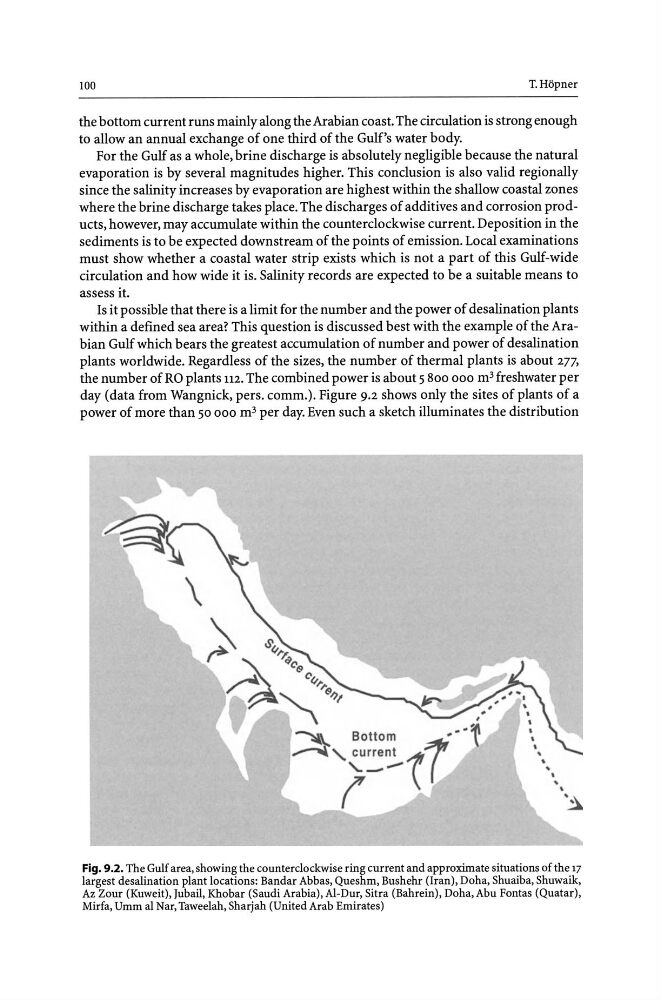
day (data from Wangnick, pers. comm.). Figure 9.2 shows only the sites of plants of a
power of more than 50 000 m 3 per day. Even such a sketch illuminates the distribution
Fig. 9.2. The Gulf area, showing the counterclockwise ring current and approximate situations of the 17
largest desalination plant locations: Bandar Abbas, Queshm, Bushehr (Iran), Doha, Shuaiba, Shuwaik,
Az Zour (Kuweit), Jubail, Khobar (Saudi Arabia), AI-Dur, Sitra (Bahrein), Doha, Abu Fontas (Quatar),
Mirfa, Umm al Nar, TaweelalI, SharjalI (United Arab Emirates)
T.H5pner
the bottom current runs mainly along the Arabian coast. The circulation is strong enough
to allow an annual exchange of one third of the Gulf's water body.
For the Gulf as a whole, brine discharge is absolutely negligible because the natural
evaporation is by several magnitudes higher. This conclusion is also valid regionally
since the salinity increases by evaporation are highest within the shallow coastal zones
where the brine discharge takes place. The discharges of additives and corrosion products, however, may accumulate within the counterclockwise current. Deposition in the
sediments is to be expected downstream of the points of emission. Local examinations
must show whether a coastal water strip exists which is not a part of this Gulf-wide
circulation and how wide it is. Salinity records are expected to be a suitable means to
assess it.
Is it possible that there is a limit for the number and the power of desalination plants
within a defined sea area? This question is discussed best with the example of the Arabian Gulf which bears the greatest accumulation of number and power of desalination
plants worldwide. Regardless of the sizes, the number of thermal plants is about 277,
the number of RO plants 112. The combined power is about 5 800 000 m 3 freshwater per
day (data from Wangnick, pers. comm.). Figure 9.2 shows only the sites of plants of a
power of more than 50 000 m 3 per day. Even such a sketch illuminates the distribution
Fig. 9.2. The Gulf area, showing the counterclockwise ring current and approximate situations of the 17
largest desalination plant locations: Bandar Abbas, Queshm, Bushehr (Iran), Doha, Shuaiba, Shuwaik,
Az Zour (Kuweit), Jubail, Khobar (Saudi Arabia), AI-Dur, Sitra (Bahrein), Doha, Abu Fontas (Quatar),
Mirfa, Umm al Nar, TaweelalI, SharjalI (United Arab Emirates)