

66
Y. Fouquet
Shallow-Water Mineral Deposits
All mineral substances concentrated by geological processes and which could be
used by man can be considered to be mineral resources. Eight main types of mineral
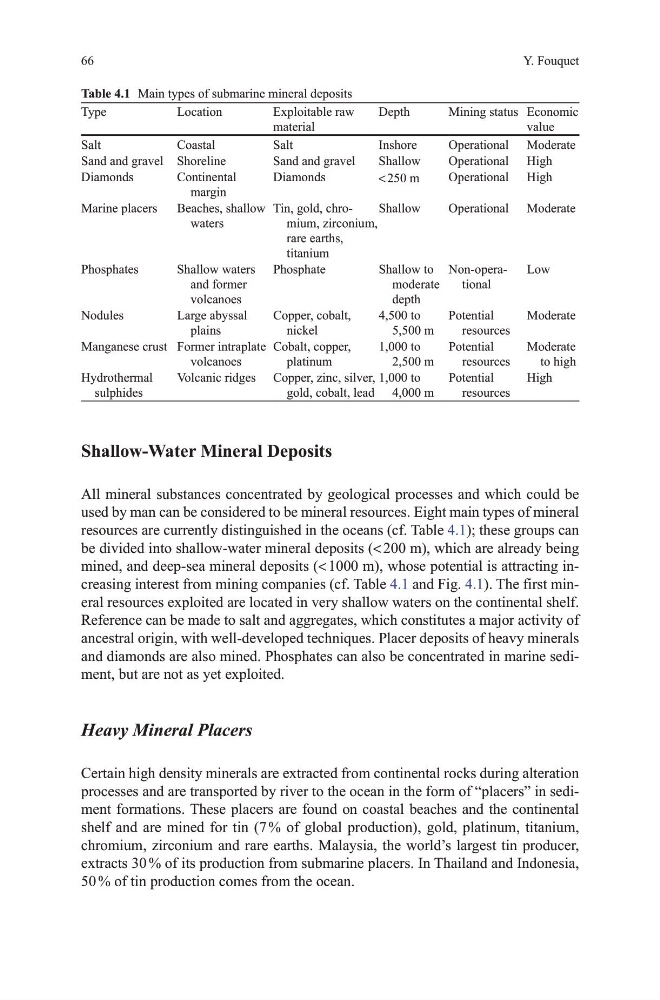
resources are currently distinguished in the oceans (cf. Table 4.1); these groups can
be divided into shallow-water mineral deposits (< 200 m), which are already being
mined, and deep-sea mineral deposits (< 1000 m), whose potential is attracting increasing interest from mining companies (cf. Table 4.1 and Fig. 4.1). The first mineral resources exploited are located in very shallow waters on the continental shelf.
Reference can be made to salt and aggregates, which constitutes a major activity of
ancestral origin, with well-developed techniques. Placer deposits of heavy minerals
and diamonds are also mined. Phosphates can also be concentrated in marine sediment, but are not as yet exploited.
Heavy Mineral Placers
Certain high density minerals are extracted from continental rocks during alteration
processes and are transported by river to the ocean in the form of “placers” in sediment formations. These placers are found on coastal beaches and the continental
shelf and are mined for tin (7 % of global production), gold, platinum, titanium,
chromium, zirconium and rare earths. Malaysia, the world’s largest tin producer,
extracts 30 % of its production from submarine placers. In Thailand and Indonesia,
50 % of tin production comes from the ocean.
Type
Location
Exploitable raw
material
Depth
Mining status Economic
value
Salt
Coastal
Salt
Inshore
Operational Moderate
Sand and gravel Shoreline
Sand and gravel
Shallow
Operational High
Diamonds
Continental
margin
Diamonds
< 250 m
Operational High
Marine placers
Beaches, shallow
waters
Tin, gold, chromium, zirconium,
rare earths,
titanium
Shallow
Operational Moderate
Phosphates
Shallow waters
and former
volcanoes
Phosphate
Shallow to
moderate
depth
Non-operational
Low
Nodules
Large abyssal
plains
Copper, cobalt,
nickel
4,500 to
5,500 m
Potential
resources
Moderate
Manganese crust Former intraplate
volcanoes
Cobalt, copper,
platinum
1,000 to
2,500 m
Potential
resources
Moderate
to high
Hydrothermal
sulphides
Volcanic ridges Copper, zinc, silver,
gold, cobalt, lead
1,000 to
4,000 m
Potential
resources
High
Table 4.1 Main types of submarine mineral deposits
Y. Fouquet
Shallow-Water Mineral Deposits
All mineral substances concentrated by geological processes and which could be
used by man can be considered to be mineral resources. Eight main types of mineral
resources are currently distinguished in the oceans (cf. Table 4.1); these groups can
be divided into shallow-water mineral deposits (< 200 m), which are already being
mined, and deep-sea mineral deposits (< 1000 m), whose potential is attracting increasing interest from mining companies (cf. Table 4.1 and Fig. 4.1). The first mineral resources exploited are located in very shallow waters on the continental shelf.
Reference can be made to salt and aggregates, which constitutes a major activity of
ancestral origin, with well-developed techniques. Placer deposits of heavy minerals
and diamonds are also mined. Phosphates can also be concentrated in marine sediment, but are not as yet exploited.
Heavy Mineral Placers
Certain high density minerals are extracted from continental rocks during alteration
processes and are transported by river to the ocean in the form of “placers” in sediment formations. These placers are found on coastal beaches and the continental
shelf and are mined for tin (7 % of global production), gold, platinum, titanium,
chromium, zirconium and rare earths. Malaysia, the world’s largest tin producer,
extracts 30 % of its production from submarine placers. In Thailand and Indonesia,
50 % of tin production comes from the ocean.
Type
Location
Exploitable raw
material
Depth
Mining status Economic
value
Salt
Coastal
Salt
Inshore
Operational Moderate
Sand and gravel Shoreline
Sand and gravel
Shallow
Operational High
Diamonds
Continental
margin
Diamonds
< 250 m
Operational High
Marine placers
Beaches, shallow
waters
Tin, gold, chromium, zirconium,
rare earths,
titanium
Shallow
Operational Moderate
Phosphates
Shallow waters
and former
volcanoes
Phosphate
Shallow to
moderate
depth
Non-operational
Low
Nodules
Large abyssal
plains
Copper, cobalt,
nickel
4,500 to
5,500 m
Potential
resources
Moderate
Manganese crust Former intraplate
volcanoes
Cobalt, copper,
platinum
1,000 to
2,500 m
Potential
resources
Moderate
to high
Hydrothermal
sulphides
Volcanic ridges Copper, zinc, silver,
gold, cobalt, lead
1,000 to
4,000 m
Potential
resources
High
Table 4.1 Main types of submarine mineral deposits