

63
interpreting in two main areas: primary deposits for zinc (Ge, In, Cd), copper (Te,
Se, Au, Ag) and nickel (Pd, Au, Co) and secondary deposits for aluminium (Ga, Se)
in bauxites and laterites and heavy rare earths in clay and associated mineral ores.
Rare Metals and Marine Mineral Resources
Rare metal concentrations can be rather contrasting according to mineral deposits, but also according to the environments in which they are formed. Rare metals
have not always been detected in samples collected over the past decades. A major
analysis effort will need to be made on existing collections, in order to determine
fluctuations in concentrations of rare elements and to understand concentration processes in the richest samples. However, the knowledge gained shows that several
rare metals are concentrated in oceanic mineral deposits.
The base metals contained in nodules are iron (7–23 %), manganese (7–26 %),
copper (292–10,200 ppm), nickel (2,600–12,800 ppm) and cobalt (2,400–8,054 ppm).
These are the metals that have thus far been considered in economic estimations.
Copper is found at concentrations on average twice as high as those of large copper
mines operated in the Andes. Nevertheless, several studies show that nodules can be
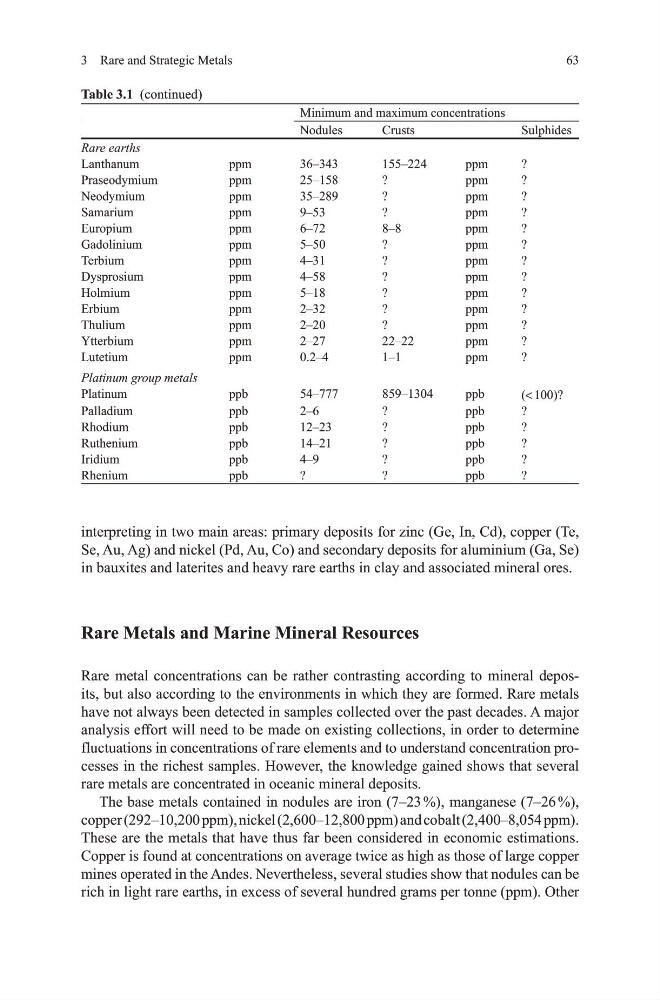
rich in light rare earths, in excess of several hundred grams per tonne (ppm). Other
Minimum and maximum concentrations
Nodules
Crusts
Sulphides
Rare earths
Lanthanum
ppm
36–343
155–224
ppm
?
Praseodymium
ppm
25–158
?
ppm
?
Neodymium
ppm
35–289
?
ppm
?
Samarium
ppm
9–53
?
ppm
?
Europium
ppm
6–72
8–8
ppm
?
Gadolinium
ppm
5–50
?
ppm
?
Terbium
ppm
4–31
?
ppm
?
Dysprosium
ppm
4–58
?
ppm
?
Holmium
ppm
5–18
?
ppm
?
Erbium
ppm
2–32
?
ppm
?
Thulium
ppm
2–20
?
ppm
?
Ytterbium
ppm
2–27
22–22
ppm
?
Lutetium
ppm
0.2–4
1–1
ppm
?
Platinum group metals
Platinum
ppb
54–777
859–1304
ppb
(< 100)?
Palladium
ppb
2–6
?
ppb
?
Rhodium
ppb
12–23
?
ppb
?
Ruthenium
ppb
14–21
?
ppb
?
Iridium
ppb
4–9
?
ppb
?
Rhenium
ppb
?
?
ppb
?
Table 3.1 (continued)
3 Rare and Strategic Metals
interpreting in two main areas: primary deposits for zinc (Ge, In, Cd), copper (Te,
Se, Au, Ag) and nickel (Pd, Au, Co) and secondary deposits for aluminium (Ga, Se)
in bauxites and laterites and heavy rare earths in clay and associated mineral ores.
Rare Metals and Marine Mineral Resources
Rare metal concentrations can be rather contrasting according to mineral deposits, but also according to the environments in which they are formed. Rare metals
have not always been detected in samples collected over the past decades. A major
analysis effort will need to be made on existing collections, in order to determine
fluctuations in concentrations of rare elements and to understand concentration processes in the richest samples. However, the knowledge gained shows that several
rare metals are concentrated in oceanic mineral deposits.
The base metals contained in nodules are iron (7–23 %), manganese (7–26 %),
copper (292–10,200 ppm), nickel (2,600–12,800 ppm) and cobalt (2,400–8,054 ppm).
These are the metals that have thus far been considered in economic estimations.
Copper is found at concentrations on average twice as high as those of large copper
mines operated in the Andes. Nevertheless, several studies show that nodules can be
rich in light rare earths, in excess of several hundred grams per tonne (ppm). Other
Minimum and maximum concentrations
Nodules
Crusts
Sulphides
Rare earths
Lanthanum
ppm
36–343
155–224
ppm
?
Praseodymium
ppm
25–158
?
ppm
?
Neodymium
ppm
35–289
?
ppm
?
Samarium
ppm
9–53
?
ppm
?
Europium
ppm
6–72
8–8
ppm
?
Gadolinium
ppm
5–50
?
ppm
?
Terbium
ppm
4–31
?
ppm
?
Dysprosium
ppm
4–58
?
ppm
?
Holmium
ppm
5–18
?
ppm
?
Erbium
ppm
2–32
?
ppm
?
Thulium
ppm
2–20
?
ppm
?
Ytterbium
ppm
2–27
22–22
ppm
?
Lutetium
ppm
0.2–4
1–1
ppm
?
Platinum group metals
Platinum
ppb
54–777
859–1304
ppb
(< 100)?
Palladium
ppb
2–6
?
ppb
?
Rhodium
ppb
12–23
?
ppb
?
Ruthenium
ppb
14–21
?
ppb
?
Iridium
ppb
4–9
?
ppb
?
Rhenium
ppb
?
?
ppb
?
Table 3.1 (continued)
3 Rare and Strategic Metals