

46
Hydrothermal Vent Ecosystems
The first hot vents were discovered in the Pacific towards the end of the 1970s, at
a depth of around 2,500 m. Since then, many hydrothermal vents have been and
continue to be discovered on mid-ocean ridges, but also in back-arc basins, volcanic
arcs or on active intraplate volcanoes. The exceedingly hot fluid (up to 400 °C) that
is expelled contains large quantities of reduced chemical elements, such as hydrogen sulphide or methane.These compounds act as a foundation for an original and
highly productive food chain, based on bacterial chemosynthesis. Organic matter
is synthesised by bacteria which use chemical energy, rather than light energy as is
the case for green plants in photosynthesis. A wide range of microbes colonise these
environments from the hottest areas to the periphery, where the temperature is low.
Alongside these microbes which use sulphides and inorganic carbon, animal communities develop, proliferating in the area where hot fluid mixes with cold seawater,
despite the toxicity of this mixture. They are made up of dense colonies of “engineer”
species which provide a habitat for several hundred related species. Each “unit” gathering hydrothermal vents shelters a few characteristic “engineer” species. For instance,
on the East Pacific Rise, four species dominate the hydrothermal ecosystem: the giant
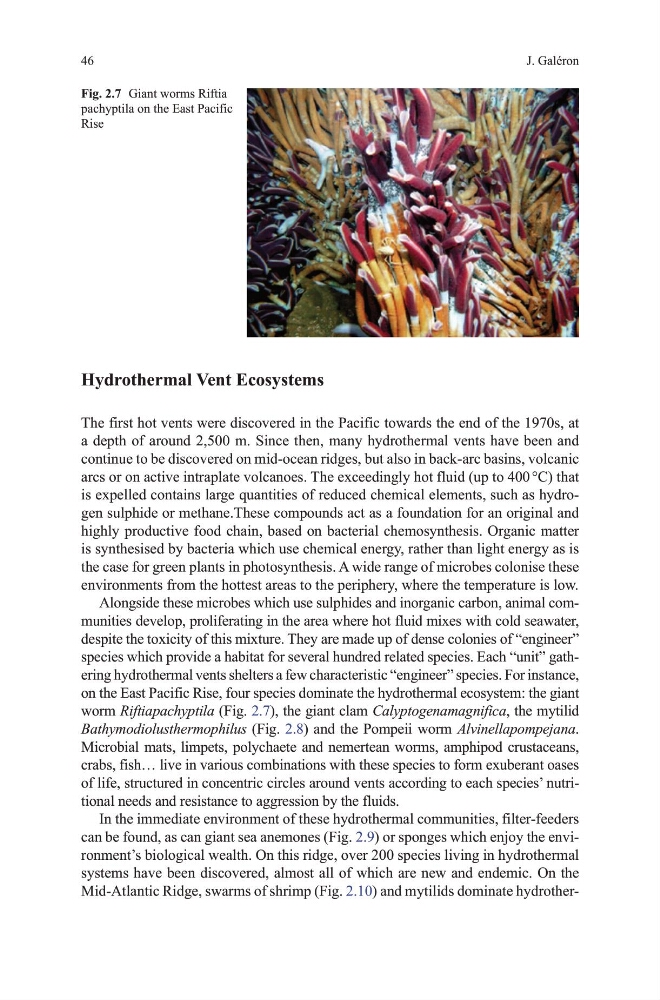
worm Riftiapachyptila (Fig. 2.7), the giant clam Calyptogenamagnifica, the mytilid
Bathymodiolusthermophilus (Fig. 2.8) and the Pompeii worm Alvinellapompejana.
Microbial mats, limpets, polychaete and nemertean worms, amphipod crustaceans,
crabs, fish… live in various combinations with these species to form exuberant oases
of life, structured in concentric circles around vents according to each species’ nutritional needs and resistance to aggression by the fluids.
In the immediate environment of these hydrothermal communities, filter-feeders
can be found, as can giant sea anemones (Fig. 2.9) or sponges which enjoy the environment’s biological wealth. On this ridge, over 200 species living in hydrothermal
systems have been discovered, almost all of which are new and endemic. On the
Mid-Atlantic Ridge, swarms of shrimp (Fig. 2.10) and mytilids dominate hydrotherFig. 2.7 Giant worms Riftia
pachyptila on the East Pacific
Rise
J. Galéron
Hydrothermal Vent Ecosystems
The first hot vents were discovered in the Pacific towards the end of the 1970s, at
a depth of around 2,500 m. Since then, many hydrothermal vents have been and
continue to be discovered on mid-ocean ridges, but also in back-arc basins, volcanic
arcs or on active intraplate volcanoes. The exceedingly hot fluid (up to 400 °C) that
is expelled contains large quantities of reduced chemical elements, such as hydrogen sulphide or methane.These compounds act as a foundation for an original and
highly productive food chain, based on bacterial chemosynthesis. Organic matter
is synthesised by bacteria which use chemical energy, rather than light energy as is
the case for green plants in photosynthesis. A wide range of microbes colonise these
environments from the hottest areas to the periphery, where the temperature is low.
Alongside these microbes which use sulphides and inorganic carbon, animal communities develop, proliferating in the area where hot fluid mixes with cold seawater,
despite the toxicity of this mixture. They are made up of dense colonies of “engineer”
species which provide a habitat for several hundred related species. Each “unit” gathering hydrothermal vents shelters a few characteristic “engineer” species. For instance,
on the East Pacific Rise, four species dominate the hydrothermal ecosystem: the giant
worm Riftiapachyptila (Fig. 2.7), the giant clam Calyptogenamagnifica, the mytilid
Bathymodiolusthermophilus (Fig. 2.8) and the Pompeii worm Alvinellapompejana.
Microbial mats, limpets, polychaete and nemertean worms, amphipod crustaceans,
crabs, fish… live in various combinations with these species to form exuberant oases
of life, structured in concentric circles around vents according to each species’ nutritional needs and resistance to aggression by the fluids.
In the immediate environment of these hydrothermal communities, filter-feeders
can be found, as can giant sea anemones (Fig. 2.9) or sponges which enjoy the environment’s biological wealth. On this ridge, over 200 species living in hydrothermal
systems have been discovered, almost all of which are new and endemic. On the
Mid-Atlantic Ridge, swarms of shrimp (Fig. 2.10) and mytilids dominate hydrotherFig. 2.7 Giant worms Riftia
pachyptila on the East Pacific
Rise
J. Galéron