

45
small size of organisms and the small (and constantly falling) number of taxonomists on a global scale.
Several recent studies have shown that over 90 % of animal species collected in
the abyss are unknown; as for bacterial diversity, there is an even greater lack of
knowledge.
Despite these difficulties, scientists have been able to show that the biological diversity of abyssal sediments on a local scale is very high. Several hundred species of
protozoan and metazoan invertebrates can be found in an area measuring quarter of a
square metre. These estimates are considered to be minimal, as recent progress in the
field of molecular taxonomy appears to indicate that this local diversity is in fact higher. Furthermore, few data are available, and it is therefore very difficult to correctly
assess species’ geographic distribution and the global diversity of the abyssal sediment
community. However, the living environment of these sediments is now considered to
be an exceptional source of biodiversity, comparable to that of rainforests.
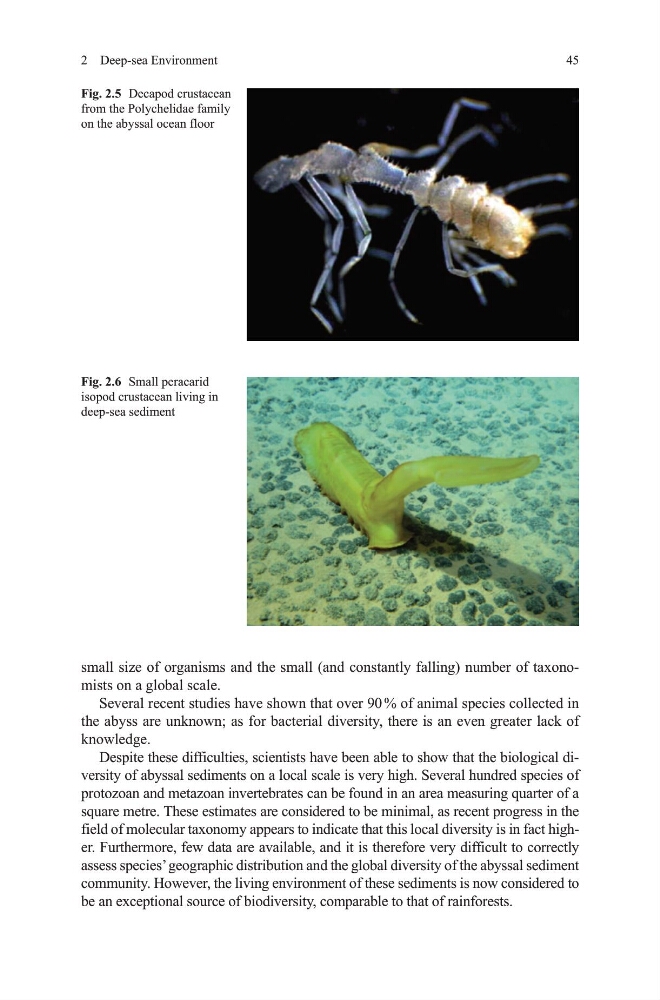
Fig. 2.5 Decapod crustacean
from the Polychelidae family
on the abyssal ocean floor
Fig. 2.6 Small peracarid
isopod crustacean living in
deep-sea sediment
2 Deep-sea Environment
small size of organisms and the small (and constantly falling) number of taxonomists on a global scale.
Several recent studies have shown that over 90 % of animal species collected in
the abyss are unknown; as for bacterial diversity, there is an even greater lack of
knowledge.
Despite these difficulties, scientists have been able to show that the biological diversity of abyssal sediments on a local scale is very high. Several hundred species of
protozoan and metazoan invertebrates can be found in an area measuring quarter of a
square metre. These estimates are considered to be minimal, as recent progress in the
field of molecular taxonomy appears to indicate that this local diversity is in fact higher. Furthermore, few data are available, and it is therefore very difficult to correctly
assess species’ geographic distribution and the global diversity of the abyssal sediment
community. However, the living environment of these sediments is now considered to
be an exceptional source of biodiversity, comparable to that of rainforests.
Fig. 2.5 Decapod crustacean
from the Polychelidae family
on the abyssal ocean floor
Fig. 2.6 Small peracarid
isopod crustacean living in
deep-sea sediment
2 Deep-sea Environment