

126
Appendices
sets and objective probabilities) or “uncertain environments” (several possible situations, more or less comprehensive, subjective probabilities). They are also able
to incorporate major trends, as was the case for changes in the environment and
context. As for the development of marine mineral resources, work focused on the
pooling and comparison of knowledge and prospects within the group and with
various players met, through an inductive approach (from the heart of the system to
its environment and not the opposite): investigation of the characteristics of marine
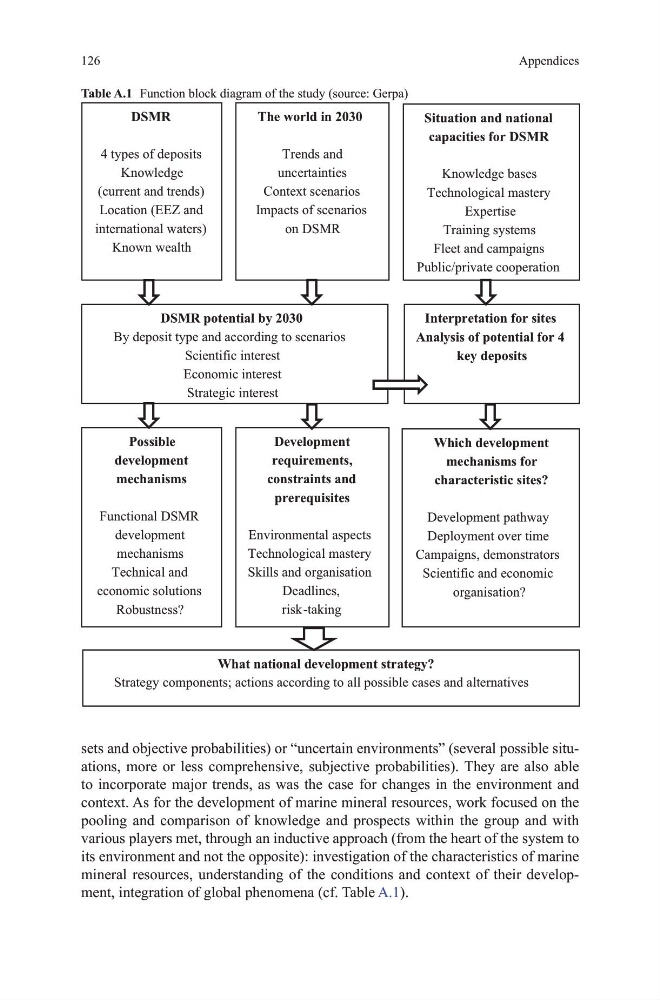
mineral resources, understanding of the conditions and context of their development, integration of global phenomena (cf. Table A.1).
DSMR
4 types of deposits
Knowledge
(current and trends)
Location (EEZ and
international waters)
Known wealth
The world in 2030
Trends and
uncertainties
Context scenarios
Impacts of scenarios
on DSMR
Situation and national
capacities for DSMR
Knowledge bases
Technological mastery
Expertise
Training systems
Fleet and campaigns
Public/private cooperation
Interpretation for sites
Analysis of potential for 4
key deposits
DSMR potential by 2030
By deposit type and according to scenarios
Scientific interest
Economic interest
Strategic interest
Possible
development
mechanisms
Functional DSMR
development
mechanisms
Technical and
economic solutions
Robustness?
Development
requirements,
constraints and
prerequisites
Environmental aspects
Technological mastery
Skills and organisation
Deadlines,
risk-taking
Which development
mechanisms for
characteristic sites?
Development pathway
Deployment over time
Campaigns, demonstrators
Scientific and economic
organisation?
What national development strategy?
Strategy components; actions according to all possible cases and alternatives
Table A.1 Function block diagram of the study (source: Gerpa)
Appendices
sets and objective probabilities) or “uncertain environments” (several possible situations, more or less comprehensive, subjective probabilities). They are also able
to incorporate major trends, as was the case for changes in the environment and
context. As for the development of marine mineral resources, work focused on the
pooling and comparison of knowledge and prospects within the group and with
various players met, through an inductive approach (from the heart of the system to
its environment and not the opposite): investigation of the characteristics of marine
mineral resources, understanding of the conditions and context of their development, integration of global phenomena (cf. Table A.1).
DSMR
4 types of deposits
Knowledge
(current and trends)
Location (EEZ and
international waters)
Known wealth
The world in 2030
Trends and
uncertainties
Context scenarios
Impacts of scenarios
on DSMR
Situation and national
capacities for DSMR
Knowledge bases
Technological mastery
Expertise
Training systems
Fleet and campaigns
Public/private cooperation
Interpretation for sites
Analysis of potential for 4
key deposits
DSMR potential by 2030
By deposit type and according to scenarios
Scientific interest
Economic interest
Strategic interest
Possible
development
mechanisms
Functional DSMR
development
mechanisms
Technical and
economic solutions
Robustness?
Development
requirements,
constraints and
prerequisites
Environmental aspects
Technological mastery
Skills and organisation
Deadlines,
risk-taking
Which development
mechanisms for
characteristic sites?
Development pathway
Deployment over time
Campaigns, demonstrators
Scientific and economic
organisation?
What national development strategy?
Strategy components; actions according to all possible cases and alternatives
Table A.1 Function block diagram of the study (source: Gerpa)