

J.-L. Charlou et al.
92
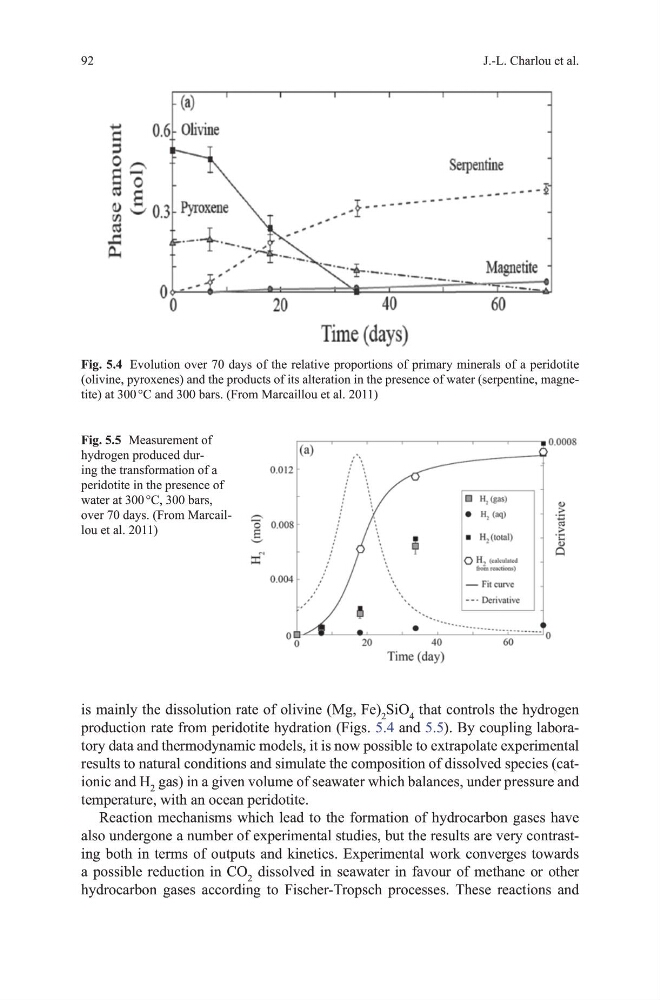
is mainly the dissolution rate of olivine (Mg, Fe) 2 SiO 4 that controls the hydrogen
production rate from peridotite hydration (Figs. 5.4 and 5.5). By coupling laboratory data and thermodynamic models, it is now possible to extrapolate experimental
results to natural conditions and simulate the composition of dissolved species (cationic and H 2 gas) in a given volume of seawater which balances, under pressure and
temperature, with an ocean peridotite.
Reaction mechanisms which lead to the formation of hydrocarbon gases have
also undergone a number of experimental studies, but the results are very contrasting both in terms of outputs and kinetics. Experimental work converges towards
a possible reduction in CO 2 dissolved in seawater in favour of methane or other
hydrocarbon gases according to Fischer-Tropsch processes. These reactions and
Fig. 5.5 Measurement of
hydrogen produced during the transformation of a
peridotite in the presence of
water at 300 °C, 300 bars,
over 70 days. (From Marcaillou et al. 2011)
Fig. 5.4 Evolution over 70 days of the relative proportions of primary minerals of a peridotite
(olivine, pyroxenes) and the products of its alteration in the presence of water (serpentine, magnetite) at 300 °C and 300 bars. (From Marcaillou et al. 2011)
92
is mainly the dissolution rate of olivine (Mg, Fe) 2 SiO 4 that controls the hydrogen
production rate from peridotite hydration (Figs. 5.4 and 5.5). By coupling laboratory data and thermodynamic models, it is now possible to extrapolate experimental
results to natural conditions and simulate the composition of dissolved species (cationic and H 2 gas) in a given volume of seawater which balances, under pressure and
temperature, with an ocean peridotite.
Reaction mechanisms which lead to the formation of hydrocarbon gases have
also undergone a number of experimental studies, but the results are very contrasting both in terms of outputs and kinetics. Experimental work converges towards
a possible reduction in CO 2 dissolved in seawater in favour of methane or other
hydrocarbon gases according to Fischer-Tropsch processes. These reactions and
Fig. 5.5 Measurement of
hydrogen produced during the transformation of a
peridotite in the presence of
water at 300 °C, 300 bars,
over 70 days. (From Marcaillou et al. 2011)
Fig. 5.4 Evolution over 70 days of the relative proportions of primary minerals of a peridotite
(olivine, pyroxenes) and the products of its alteration in the presence of water (serpentine, magnetite) at 300 °C and 300 bars. (From Marcaillou et al. 2011)