

74
S. LI, Z. CHENG, AND W.E WEEKS
in the size and the shape of the involved cell. This is also shown in Fig. 1, where Fig. Ie
represents the initial 5 x 5 km grid specified by the six initial positions of the six vectors shown in Fig.1B while Fig. ID shows the deformed grid specified by the final positions.
This slightly different, yet equivalent, view of deformation also clarifies the evaluation of the accuracy of deformation calculations in two ways: first, the difficulty in
assessing the accuracy of the absolute ice motion field can be bypassed, and, second,
only the accuracy in feature matching between the image pairs and the geometric fidelity of the SAR images, in terms of tlte relative positions of different objects witltin the
images, are of importance.
4.3
Algorithm Description
To extract ice deformation parameters from the G PS ice motion products, a special algorithm has been designed that calculates the change of tlte size and tlte shape of each
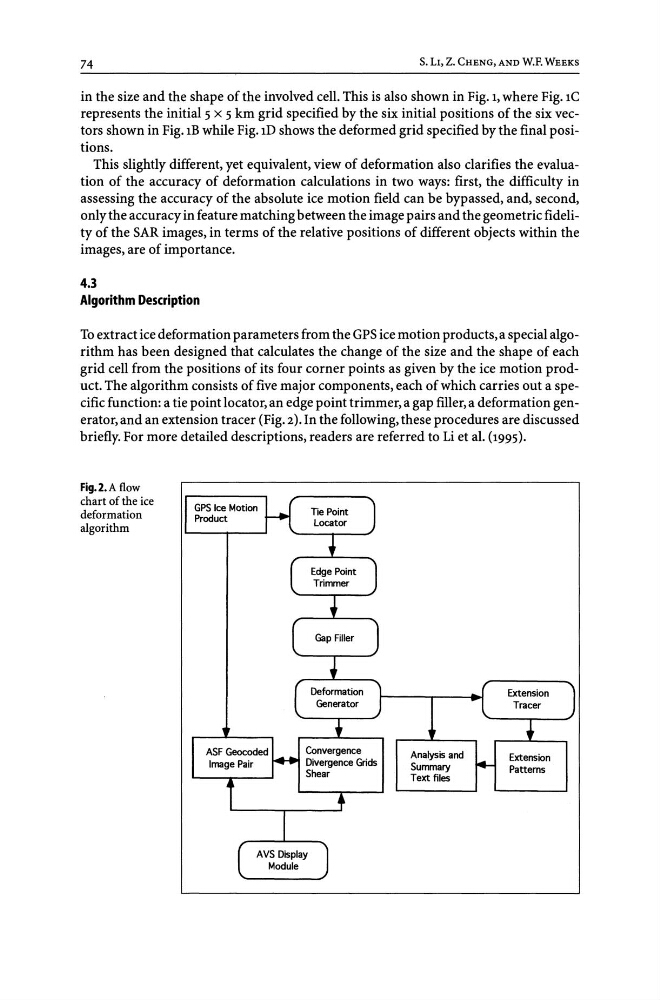
grid cell from tlte positions of its four corner points as given by the ice motion product. The algoritltm consists of five major components, each of which carries out a specific function: a tie point locator, an edge point trimmer, a gap filler, a deformation generator, and an extension tracer (Fig. 2). In the following, these procedures are discussed
briefly. For more detailed descriptions, readers are referred to Li et al. (1995).
Fig. 2. A flow
chart of the ice
deformation
algorithm
Analysis and
Summary
Text files
Extension
Pattems
S. LI, Z. CHENG, AND W.E WEEKS
in the size and the shape of the involved cell. This is also shown in Fig. 1, where Fig. Ie
represents the initial 5 x 5 km grid specified by the six initial positions of the six vectors shown in Fig.1B while Fig. ID shows the deformed grid specified by the final positions.
This slightly different, yet equivalent, view of deformation also clarifies the evaluation of the accuracy of deformation calculations in two ways: first, the difficulty in
assessing the accuracy of the absolute ice motion field can be bypassed, and, second,
only the accuracy in feature matching between the image pairs and the geometric fidelity of the SAR images, in terms of tlte relative positions of different objects witltin the
images, are of importance.
4.3
Algorithm Description
To extract ice deformation parameters from the G PS ice motion products, a special algorithm has been designed that calculates the change of tlte size and tlte shape of each
grid cell from tlte positions of its four corner points as given by the ice motion product. The algoritltm consists of five major components, each of which carries out a specific function: a tie point locator, an edge point trimmer, a gap filler, a deformation generator, and an extension tracer (Fig. 2). In the following, these procedures are discussed
briefly. For more detailed descriptions, readers are referred to Li et al. (1995).
Fig. 2. A flow
chart of the ice
deformation
algorithm
Analysis and
Summary
Text files
Extension
Pattems