

60
D.G. BARBER,A. THOMAS, AND T.N. PAPAKYRIAKOU
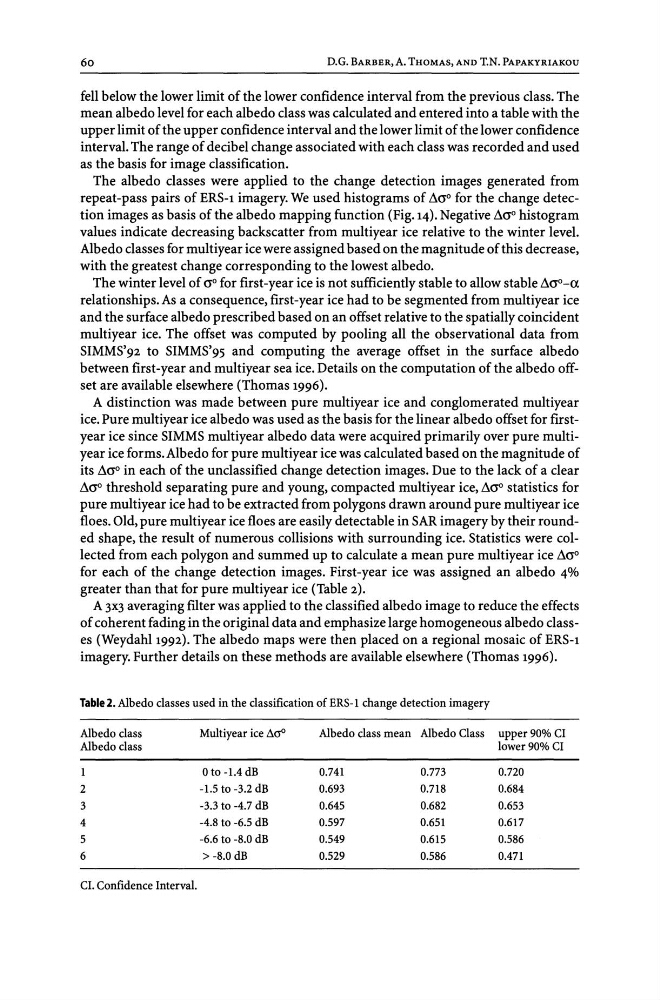
fell below the lower limit of the lower confidence interval from the previous class. The
mean albedo level for each albedo class was calculated and entered into a table with the
upper limit of the upper confidence interval and the lower limit of the lower confidence
interval. The range of decibel change associated with each class was recorded and used
as the basis for image classification.
The albedo classes were applied to the change detection images generated from
repeat-pass pairs of ERS-l imagery. We used histograms of Llao for the change detection images as basis of the albedo mapping function (Fig. 14). Negative Llao histogram
values indicate decreasing backscatter from multiyear ice relative to the winter level.
Albedo classes for multiyear ice were assigned based on the magnitude of this decrease,
with the greatest change corresponding to the lowest albedo.
The winter level of aO for first-year ice is not sufficiently stable to allow stable Llao-a
relationships. As a consequence, first-year ice had to be segmented from multiyear ice
and the surface albedo prescribed based on an offset relative to the spatially coincident
multiyear ice. The offset was computed by pooling all the observational data from
SIMMS'92 to SIMMS'95 and computing the average offset in the surface albedo
between first-year and multiyear sea ice. Details on the computation of the albedo offset are available elsewhere (Thomas 1996).
A distinction was made between pure multiyear ice and conglomerated multiyear
ice. Pure multiyear ice albedo was used as the basis for the linear albedo offset for firstyear ice since SIMMS multiyear albedo data were acquired primarily over pure multiyear ice forms. Albedo for pure multiyear ice was calculated based on the magnitude of
its Llao in each of the unclassified change detection images. Due to the lack of a clear
Llao threshold separating pure and young, compacted multiyear ice, Llao statistics for
pure multiyear ice had to be extracted from polygons drawn around pure multiyear ice
floes. Old, pure multiyear ice floes are easily detectable in SAR imagery by their rounded shape, the result of numerous collisions with surrounding ice. Statistics were collected from each polygon and summed up to calculate a mean pure multiyear ice Llao
for each of the change detection images. First-year ice was assigned an albedo 4%
greater than that for pure multiyear ice (Table 2).
A 3X3 averaging filter was applied to the classified albedo image to reduce the effects
of coherent fading in the original data and emphasize large homogeneous albedo classes (WeydahI1992). The albedo maps were then placed on a regional mosaic of ERS-l
imagery. Further details on these methods are available elsewhere (Thomas 1996).
Table 2. Albedo classes used in the classification of ERS-1 change detection imagery
Albedo class
Multiyear ice t.ao
Albedo class mean Albedo Class upper 90% CI
Albedo class
lower 90% CI
1
o to -l.4 dB
0.741
0.773
0.720
2
-l.5 to -3.2 dB
0.693
0.718
0.684
3
-3.3 to -4.7 dB
0.645
0.682
0.653
4
-4.8 to -6.5 dB
0.597
0.651
0.617
5
-6.6 to -8.0 dB
0.549
0.615
0.586
6
> -8.0 dB
0.529
0.586
0.471
CI. Confidence Interval.
D.G. BARBER,A. THOMAS, AND T.N. PAPAKYRIAKOU
fell below the lower limit of the lower confidence interval from the previous class. The
mean albedo level for each albedo class was calculated and entered into a table with the
upper limit of the upper confidence interval and the lower limit of the lower confidence
interval. The range of decibel change associated with each class was recorded and used
as the basis for image classification.
The albedo classes were applied to the change detection images generated from
repeat-pass pairs of ERS-l imagery. We used histograms of Llao for the change detection images as basis of the albedo mapping function (Fig. 14). Negative Llao histogram
values indicate decreasing backscatter from multiyear ice relative to the winter level.
Albedo classes for multiyear ice were assigned based on the magnitude of this decrease,
with the greatest change corresponding to the lowest albedo.
The winter level of aO for first-year ice is not sufficiently stable to allow stable Llao-a
relationships. As a consequence, first-year ice had to be segmented from multiyear ice
and the surface albedo prescribed based on an offset relative to the spatially coincident
multiyear ice. The offset was computed by pooling all the observational data from
SIMMS'92 to SIMMS'95 and computing the average offset in the surface albedo
between first-year and multiyear sea ice. Details on the computation of the albedo offset are available elsewhere (Thomas 1996).
A distinction was made between pure multiyear ice and conglomerated multiyear
ice. Pure multiyear ice albedo was used as the basis for the linear albedo offset for firstyear ice since SIMMS multiyear albedo data were acquired primarily over pure multiyear ice forms. Albedo for pure multiyear ice was calculated based on the magnitude of
its Llao in each of the unclassified change detection images. Due to the lack of a clear
Llao threshold separating pure and young, compacted multiyear ice, Llao statistics for
pure multiyear ice had to be extracted from polygons drawn around pure multiyear ice
floes. Old, pure multiyear ice floes are easily detectable in SAR imagery by their rounded shape, the result of numerous collisions with surrounding ice. Statistics were collected from each polygon and summed up to calculate a mean pure multiyear ice Llao
for each of the change detection images. First-year ice was assigned an albedo 4%
greater than that for pure multiyear ice (Table 2).
A 3X3 averaging filter was applied to the classified albedo image to reduce the effects
of coherent fading in the original data and emphasize large homogeneous albedo classes (WeydahI1992). The albedo maps were then placed on a regional mosaic of ERS-l
imagery. Further details on these methods are available elsewhere (Thomas 1996).
Table 2. Albedo classes used in the classification of ERS-1 change detection imagery
Albedo class
Multiyear ice t.ao
Albedo class mean Albedo Class upper 90% CI
Albedo class
lower 90% CI
1
o to -l.4 dB
0.741
0.773
0.720
2
-l.5 to -3.2 dB
0.693
0.718
0.684
3
-3.3 to -4.7 dB
0.645
0.682
0.653
4
-4.8 to -6.5 dB
0.597
0.651
0.617
5
-6.6 to -8.0 dB
0.549
0.615
0.586
6
> -8.0 dB
0.529
0.586
0.471
CI. Confidence Interval.