

3 Role of SAR in Surface Energy Flux Measurements Over Sea Ice
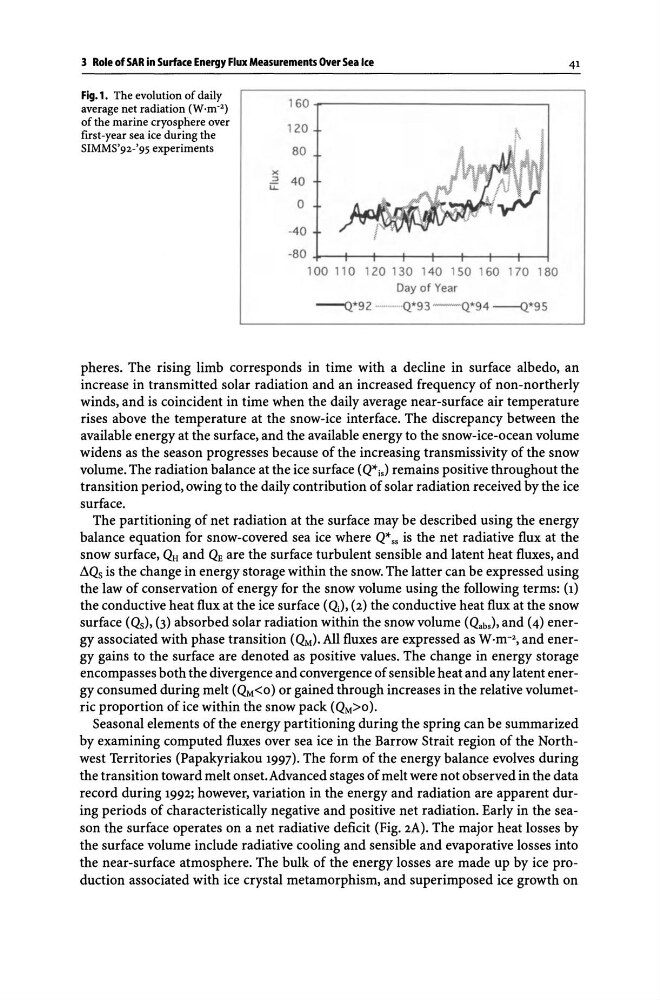
Fig.1. The evolution of daily
average net radiation (W·m-')
of the marine cryosphere over
first-year sea ice during the
SIMMS'92-'95 experiments
)(
160 ~------------------------~
120
80
~ 40
o
-40
-80 .p.----t---+--+----t---t---+----t----l
100 11 0 120 130 140 1 SO 160 170 180
Day of Year
--Q*92 ············Q*93 - -Q*94 ---Q*95
41
pheres. The rising limb corresponds in time with a decline in surface albedo, an
increase in transmitted solar radiation and an increased frequency of non-northerly
winds, and is coincident in time when the daily average near-surface air temperature
rises above the temperature at the snow-ice interface. The discrepancy between the
available energy at the surface, and the available energy to the snow-ice-ocean volume
widens as the season progresses because of the increasing transmissivity of the snow
volume. The radiation balance at the ice surface (Q\,) remains positive throughout the
transition period, owing to the daily contribution of solar radiation received by the ice
surface.
The partitioning of net radiation at the surface may be described using the energy
balance equation for snow-covered sea ice where Q* 55 is the net radiative flux at the
snow surface, QH and QE are the surface turbulent sensible and latent heat fluxes, and
LlQs is the change in energy storage within the snow. The latter can be expressed using
the law of conservation of energy for the snow volume using the following terms: (1)
the conductive heat flux at the ice surface (Qi)' (2) the conductive heat flux at the snow
surface (Qs), (3) absorbed solar radiation within the snow volume (Qab,)' and (4) energy associated with phase transition (QM)' All fluxes are expressed as W'm-" and energy gains to the surface are denoted as positive values. The change in energy storage
encompasses both the divergence and convergence of sensible heat and any latent energy consumed during melt (QMO).
Seasonal elements of the energy partitioning during the spring can be summarized
by examining computed fluxes over sea ice in the Barrow Strait region of the Northwest Territories (Papakyriakou 1997). The form of the energy balance evolves during
the transition toward melt onset. Advanced stages of melt were not observed in the data
record during 1992; however, variation in the energy and radiation are apparent during periods of characteristically negative and positive net radiation. Early in the season the surface operates on a net radiative deficit (Fig. 2A). The major heat losses by
the surface volume include radiative cooling and sensible and evaporative losses into
the near-surface atmosphere. The bulk of the energy losses are made up by ice production associated with ice crystal metamorphism, and superimposed ice growth on
Fig.1. The evolution of daily
average net radiation (W·m-')
of the marine cryosphere over
first-year sea ice during the
SIMMS'92-'95 experiments
)(
160 ~------------------------~
120
80
~ 40
o
-40
-80 .p.----t---+--+----t---t---+----t----l
100 11 0 120 130 140 1 SO 160 170 180
Day of Year
--Q*92 ············Q*93 - -Q*94 ---Q*95
41
pheres. The rising limb corresponds in time with a decline in surface albedo, an
increase in transmitted solar radiation and an increased frequency of non-northerly
winds, and is coincident in time when the daily average near-surface air temperature
rises above the temperature at the snow-ice interface. The discrepancy between the
available energy at the surface, and the available energy to the snow-ice-ocean volume
widens as the season progresses because of the increasing transmissivity of the snow
volume. The radiation balance at the ice surface (Q\,) remains positive throughout the
transition period, owing to the daily contribution of solar radiation received by the ice
surface.
The partitioning of net radiation at the surface may be described using the energy
balance equation for snow-covered sea ice where Q* 55 is the net radiative flux at the
snow surface, QH and QE are the surface turbulent sensible and latent heat fluxes, and
LlQs is the change in energy storage within the snow. The latter can be expressed using
the law of conservation of energy for the snow volume using the following terms: (1)
the conductive heat flux at the ice surface (Qi)' (2) the conductive heat flux at the snow
surface (Qs), (3) absorbed solar radiation within the snow volume (Qab,)' and (4) energy associated with phase transition (QM)' All fluxes are expressed as W'm-" and energy gains to the surface are denoted as positive values. The change in energy storage
encompasses both the divergence and convergence of sensible heat and any latent energy consumed during melt (QM
Seasonal elements of the energy partitioning during the spring can be summarized
by examining computed fluxes over sea ice in the Barrow Strait region of the Northwest Territories (Papakyriakou 1997). The form of the energy balance evolves during
the transition toward melt onset. Advanced stages of melt were not observed in the data
record during 1992; however, variation in the energy and radiation are apparent during periods of characteristically negative and positive net radiation. Early in the season the surface operates on a net radiative deficit (Fig. 2A). The major heat losses by
the surface volume include radiative cooling and sensible and evaporative losses into
the near-surface atmosphere. The bulk of the energy losses are made up by ice production associated with ice crystal metamorphism, and superimposed ice growth on