

40
D.G. BARBER, A. THOMAS, AND T.N. PAPAKYRIAKOU
The salinity of this ice drops rapidly after the initial freeze-up. After about a week (0.4
m thickness) the desalination stabilizes to a gentler (linear) desalination as the ice sheet
thickens. Throughout the growth process, surface and bottom salinities are higher than
those in the centre. Bulk salinities range from 5 to 15 ppt (Vant et al. 1978). This period
is considered to end when a significant fraction of the young ice has grown to first-year
ice thickness (>30 cm).
3.2.2
Energy Balance
The climatic character in the high latitudes is driven by the annual cycle of solar radiation. The spring period marks the transition from polar night to polar day. The seasonal increase in irradiance instigates a reversal in surface net radiation, ablation of
snow and ice and a northward shift in the major North American cyclonic trajectories,
with accompanying increases in cloud cover, precipitation and advection of southern
air masses. The form of the seasonal increase in net radiation is a strong function of its
synoptic setting, and therefore subject to interannual variability. It is this dynamic
structure which lends support to the notion of estimating surface characteristics and
energy flux conditions through the microwave interactions with snow-covered sea ice.
The net radiation of the snow/ice system can be described as follows:
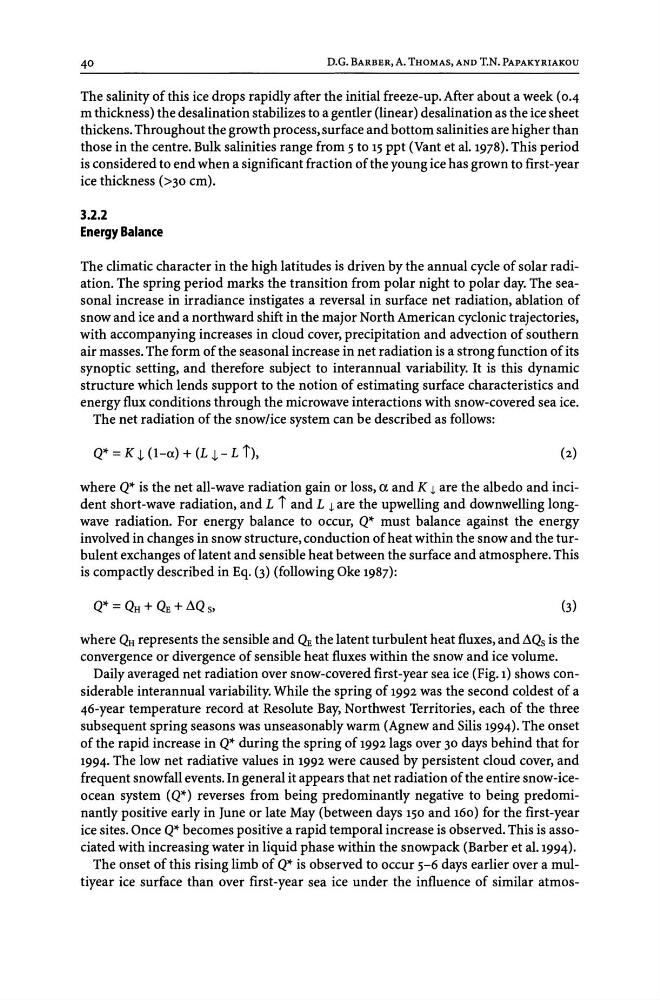
Q* = K.1.- (I -a) + (L .1.- - L i),
where Q* is the net all-wave radiation gain or loss, a and K J, are the albedo and incident short-wave radiation, and L i and L J, are the upwelling and downwelling longwave radiation. For energy balance to occur, Q* must balance against the energy
involved in changes in snow structure, conduction of heat within the snow and the turbulent exchanges oflatent and sensible heat between the surface and atmosphere. This
is compactly described in Eq. (3) (following Oke 1987):
Q* = QH + ~ + ~Q s,
where QH represents the sensible and QE the latent turbulent heat fluxes, and ~Qs is the
convergence or divergence of sensible heat fluxes within the snow and ice volume.
Daily averaged net radiation over snow-covered first-year sea ice (Fig. 1) shows considerable interannual variability. While the spring of 1992 was the second coldest of a
46-year temperature record at Resolute Bay, Northwest Territories, each of the three
subsequent spring seasons was unseasonably warm (Agnew and Silis 1994). The onset
of the rapid increase in Q* during the spring of 1992 lags over 30 days behind that for
1994. The low net radiative values in 1992 were caused by persistent cloud cover, and
frequent snowfall events. In general it appears that net radiation of the entire snow-iceocean system (Q*) reverses from being predominantly negative to being predominantly positive early in June or late May (between days 150 and 160) for the first-year
ice sites. Once Q* becomes positive a rapid temporal increase is observed. This is associated with increasing water in liquid phase within the snowpack (Barber et al. 1994).
The onset of this rising limb of Q* is observed to occur 5-6 days earlier over a multiyear ice surface than over first-year sea ice under the influence of similar atmos-
D.G. BARBER, A. THOMAS, AND T.N. PAPAKYRIAKOU
The salinity of this ice drops rapidly after the initial freeze-up. After about a week (0.4
m thickness) the desalination stabilizes to a gentler (linear) desalination as the ice sheet
thickens. Throughout the growth process, surface and bottom salinities are higher than
those in the centre. Bulk salinities range from 5 to 15 ppt (Vant et al. 1978). This period
is considered to end when a significant fraction of the young ice has grown to first-year
ice thickness (>30 cm).
3.2.2
Energy Balance
The climatic character in the high latitudes is driven by the annual cycle of solar radiation. The spring period marks the transition from polar night to polar day. The seasonal increase in irradiance instigates a reversal in surface net radiation, ablation of
snow and ice and a northward shift in the major North American cyclonic trajectories,
with accompanying increases in cloud cover, precipitation and advection of southern
air masses. The form of the seasonal increase in net radiation is a strong function of its
synoptic setting, and therefore subject to interannual variability. It is this dynamic
structure which lends support to the notion of estimating surface characteristics and
energy flux conditions through the microwave interactions with snow-covered sea ice.
The net radiation of the snow/ice system can be described as follows:
Q* = K.1.- (I -a) + (L .1.- - L i),
where Q* is the net all-wave radiation gain or loss, a and K J, are the albedo and incident short-wave radiation, and L i and L J, are the upwelling and downwelling longwave radiation. For energy balance to occur, Q* must balance against the energy
involved in changes in snow structure, conduction of heat within the snow and the turbulent exchanges oflatent and sensible heat between the surface and atmosphere. This
is compactly described in Eq. (3) (following Oke 1987):
Q* = QH + ~ + ~Q s,
where QH represents the sensible and QE the latent turbulent heat fluxes, and ~Qs is the
convergence or divergence of sensible heat fluxes within the snow and ice volume.
Daily averaged net radiation over snow-covered first-year sea ice (Fig. 1) shows considerable interannual variability. While the spring of 1992 was the second coldest of a
46-year temperature record at Resolute Bay, Northwest Territories, each of the three
subsequent spring seasons was unseasonably warm (Agnew and Silis 1994). The onset
of the rapid increase in Q* during the spring of 1992 lags over 30 days behind that for
1994. The low net radiative values in 1992 were caused by persistent cloud cover, and
frequent snowfall events. In general it appears that net radiation of the entire snow-iceocean system (Q*) reverses from being predominantly negative to being predominantly positive early in June or late May (between days 150 and 160) for the first-year
ice sites. Once Q* becomes positive a rapid temporal increase is observed. This is associated with increasing water in liquid phase within the snowpack (Barber et al. 1994).
The onset of this rising limb of Q* is observed to occur 5-6 days earlier over a multiyear ice surface than over first-year sea ice under the influence of similar atmos-