

24
WINTER
SPRING
Talr·15C
-15C
MULTIYEAR ICE
-10+---- 1d --=B-----<
dB
·12
-14 +_..:..TH;..:;I.=.CK~FI;..:;RS:..:T....;Y_=EA:..;;R~IC_=E _ _ __.\
t2dB
·16
WET SNOW
L.-K. SOH, C. TSATSOULIS, AND B. HOLT
SUMMER
TairOC
MELT ONSET
(SOUTH TO NORTH)
FALL
-SC
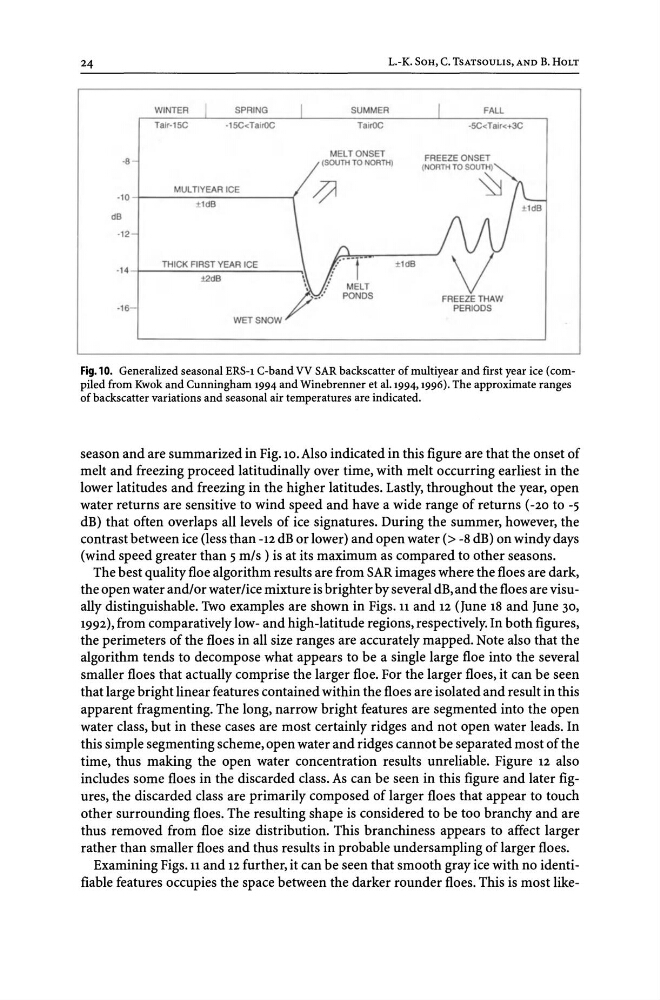
Fig. 10. Generalized seasonal ERS-1 C-band VV SAR backscatter of multiyear and first year ice (compiled from Kwok and Cunningham 1994 and Winebrenner et al. 1994, 1996). The approximate ranges
of backscatter variations and seasonal air temperatures are indicated.
season and are summarized in Fig. 10. Also indicated in this figure are that the onset of
melt and freezing proceed latitudinally over time, with melt occurring earliest in the
lower latitudes and freezing in the higher latitudes. Lastly, throughout the year, open
water returns are sensitive to wind speed and have a wide range of returns (-20 to -5
dB) that often overlaps all levels of ice signatures. During the summer, however, the
contrast between ice (less than -12dB or lower) and open water (> -8 dB) on windy days
(wind speed greater than 5 mls ) is at its maximum as compared to other seasons.
The best quality floe algorithm results are from SAR images where the floes are dark,
the open water andlor water lice mixture is brighter by several dB, and the floes are visually distinguishable. Two examples are shown in Figs. 11 and 12 (June 18 and June 30,
1992), from comparatively low- and high-latitude regions, respectively. In both figures,
the perimeters of the floes in all size ranges are accurately mapped. Note also that the
algorithm tends to decompose what appears to be a single large floe into the several
smaller floes that actually comprise the larger floe. For the larger floes, it can be seen
that large bright linear features contained within the floes are isolated and result in this
apparent fragmenting. The long, narrow bright features are segmented into the open
water class, but in these cases are most certainly ridges and not open water leads. In
this simple segmenting scheme, open water and ridges cannot be separated most of the
time, thus making the open water concentration results unreliable. Figure 12 also
includes some floes in the discarded class. As can be seen in this figure and later figures, the discarded class are primarily composed of larger floes that appear to touch
other surrounding floes. The resulting shape is considered to be too branchy and are
thus removed from floe size distribution. This branchiness appears to affect larger
rather than smaller floes and thus results in probable undersampling of larger floes.
Examining Figs. 11 and 12 further, it can be seen that smooth gray ice with no identifiable features occupies the space between the darker rounder floes. This is most like-
WINTER
SPRING
Talr·15C
-15C
MULTIYEAR ICE
-10+---- 1d --=B-----<
dB
·12
-14 +_..:..TH;..:;I.=.CK~FI;..:;RS:..:T....;Y_=EA:..;;R~IC_=E _ _ __.\
t2dB
·16
WET SNOW
L.-K. SOH, C. TSATSOULIS, AND B. HOLT
SUMMER
TairOC
MELT ONSET
(SOUTH TO NORTH)
FALL
-SC
Fig. 10. Generalized seasonal ERS-1 C-band VV SAR backscatter of multiyear and first year ice (compiled from Kwok and Cunningham 1994 and Winebrenner et al. 1994, 1996). The approximate ranges
of backscatter variations and seasonal air temperatures are indicated.
season and are summarized in Fig. 10. Also indicated in this figure are that the onset of
melt and freezing proceed latitudinally over time, with melt occurring earliest in the
lower latitudes and freezing in the higher latitudes. Lastly, throughout the year, open
water returns are sensitive to wind speed and have a wide range of returns (-20 to -5
dB) that often overlaps all levels of ice signatures. During the summer, however, the
contrast between ice (less than -12dB or lower) and open water (> -8 dB) on windy days
(wind speed greater than 5 mls ) is at its maximum as compared to other seasons.
The best quality floe algorithm results are from SAR images where the floes are dark,
the open water andlor water lice mixture is brighter by several dB, and the floes are visually distinguishable. Two examples are shown in Figs. 11 and 12 (June 18 and June 30,
1992), from comparatively low- and high-latitude regions, respectively. In both figures,
the perimeters of the floes in all size ranges are accurately mapped. Note also that the
algorithm tends to decompose what appears to be a single large floe into the several
smaller floes that actually comprise the larger floe. For the larger floes, it can be seen
that large bright linear features contained within the floes are isolated and result in this
apparent fragmenting. The long, narrow bright features are segmented into the open
water class, but in these cases are most certainly ridges and not open water leads. In
this simple segmenting scheme, open water and ridges cannot be separated most of the
time, thus making the open water concentration results unreliable. Figure 12 also
includes some floes in the discarded class. As can be seen in this figure and later figures, the discarded class are primarily composed of larger floes that appear to touch
other surrounding floes. The resulting shape is considered to be too branchy and are
thus removed from floe size distribution. This branchiness appears to affect larger
rather than smaller floes and thus results in probable undersampling of larger floes.
Examining Figs. 11 and 12 further, it can be seen that smooth gray ice with no identifiable features occupies the space between the darker rounder floes. This is most like-