

12 Towards Operational Monitoring of Arctic Sea Ice by SAR
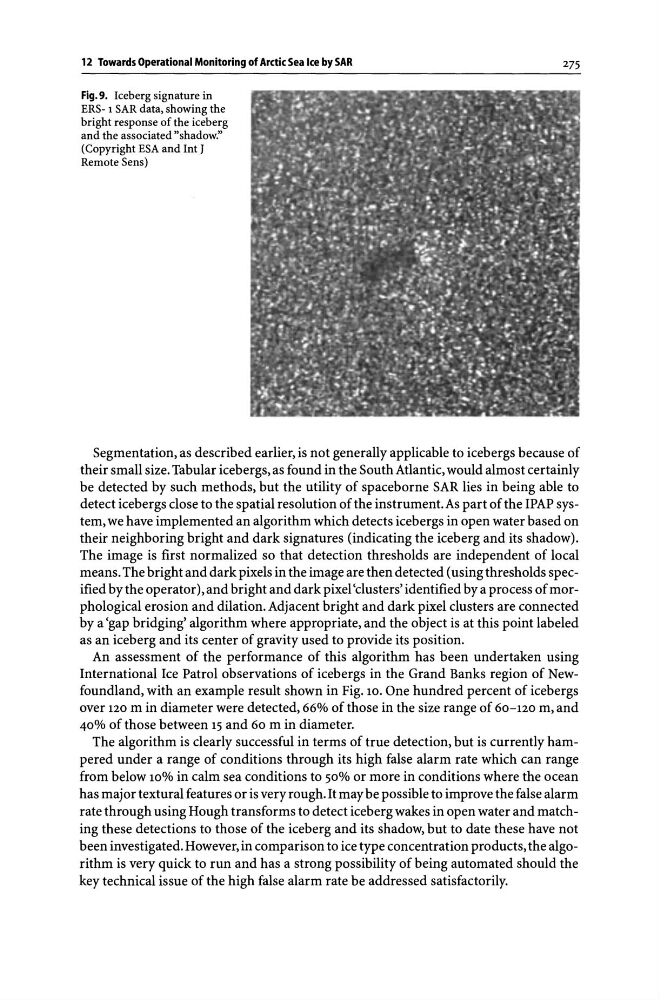
Fig.9. Iceberg signature in
ERS- 1 SAR data, showing the
bright response of the iceberg
and the associated" shadow;'
(Copyright ESA and lnt J
Remote Sens)
275
Segmentation, as described earlier, is not generally applicable to icebergs because of
their small size. Tabular icebergs, as found in the South Atlantic, would almost certainly
be detected by such methods, but the utility of spaceborne SAR lies in being able to
detect icebergs close to the spatial resolution of the instrument. As part of the IPAP system, we have implemented an algorithm which detects icebergs in open water based on
their neighboring bright and dark signatures (indicating the iceberg and its shadow).
The image is first normalized so that detection thresholds are independent of local
means. The bright and dark pixels in the image are then detected (using thresholds specified by the operator), and bright and dark pixel 'clusters' identified by a process of morphological erosion and dilation. Adjacent bright and dark pixel clusters are connected
by a 'gap bridging' algorithm where appropriate, and the object is at this point labeled
as an iceberg and its center of gravity used to provide its position.
An assessment of the performance of this algorithm has been undertaken using
International Ice Patrol observations of icebergs in the Grand Banks region of Newfoundland, with an example result shown in Fig. 10. One hundred percent of icebergs
over 120 m in diameter were detected, 66% of those in the size range of 60-120 m, and
40% of those between 15 and 60 m in diameter.
The algorithm is clearly successful in terms of true detection, but is currently hampered under a range of conditions through its high false alarm rate which can range
from below 10% in calm sea conditions to 50% or more in conditions where the ocean
has major textural features or is very rough. It may be possible to improve the false alarm
rate through using Hough transforms to detect iceberg wakes in open water and matching these detections to those of the iceberg and its shadow, but to date these have not
been investigated. However, in comparison to ice type concentration products, the algorithm is very quick to run and has a strong possibility of being automated should the
key technical issue of the high false alarm rate be addressed satisfactorily.
Fig.9. Iceberg signature in
ERS- 1 SAR data, showing the
bright response of the iceberg
and the associated" shadow;'
(Copyright ESA and lnt J
Remote Sens)
275
Segmentation, as described earlier, is not generally applicable to icebergs because of
their small size. Tabular icebergs, as found in the South Atlantic, would almost certainly
be detected by such methods, but the utility of spaceborne SAR lies in being able to
detect icebergs close to the spatial resolution of the instrument. As part of the IPAP system, we have implemented an algorithm which detects icebergs in open water based on
their neighboring bright and dark signatures (indicating the iceberg and its shadow).
The image is first normalized so that detection thresholds are independent of local
means. The bright and dark pixels in the image are then detected (using thresholds specified by the operator), and bright and dark pixel 'clusters' identified by a process of morphological erosion and dilation. Adjacent bright and dark pixel clusters are connected
by a 'gap bridging' algorithm where appropriate, and the object is at this point labeled
as an iceberg and its center of gravity used to provide its position.
An assessment of the performance of this algorithm has been undertaken using
International Ice Patrol observations of icebergs in the Grand Banks region of Newfoundland, with an example result shown in Fig. 10. One hundred percent of icebergs
over 120 m in diameter were detected, 66% of those in the size range of 60-120 m, and
40% of those between 15 and 60 m in diameter.
The algorithm is clearly successful in terms of true detection, but is currently hampered under a range of conditions through its high false alarm rate which can range
from below 10% in calm sea conditions to 50% or more in conditions where the ocean
has major textural features or is very rough. It may be possible to improve the false alarm
rate through using Hough transforms to detect iceberg wakes in open water and matching these detections to those of the iceberg and its shadow, but to date these have not
been investigated. However, in comparison to ice type concentration products, the algorithm is very quick to run and has a strong possibility of being automated should the
key technical issue of the high false alarm rate be addressed satisfactorily.