

20
L.-K. SOH, C. TSATSOULIS, AND B. HOLT
4. Floe Filtering. This stage filters out features that have low confidence as floes. For
example, ice conglomerates detected due to extremely poor image quality will not be
considered in the floe size distribution calculation. The filter first computes geometric
descriptions of each feature in the floe class and eliminates irregular features from the
set of valid floes. The irregularity of a feature f, Is, is defined as Pi / ai' where Pi is the
length of the perimeter of feature f, and ai is the area of feature f If the ratio is high, that
means the feature structurally consists of elongated, linear branches, and thus the feature
is not a floe. If the ratio is low, that means the feature is compact and thus valid as a floe.
5. Extraction of Water/Ice Mixture from Non-Floe Regions. To extract water/ice
mixture from nonfloe regions, we have designed a Laplacian-based local dynamic
thresholding technique - a variant of Laplacian filtering thresholding (Weszka et al.
1974) and gradient thresholding (Watanabe et al. 1974). Floe regions are masked from
further processing. Next, for each pixel (i,j), its Laplacian value (Marr and Hildreth 1980)
is computed as
L(i,j) = 4· g(i,j) - g(i-1,j) - g(i+ 1,j) - g(i,j-l) - g(i,j+ 1),
where L(i,j) is the Laplacian value, and g(i,j) is the intensity level of pixel (i,j). Third,
Laplacian histograms of local regions are generated and only histograms with high
"edginess" value qualify for further processing.
"Edginess" is defined as follows: Let H be a Laplacian histogram where the bin of the
histogram is bk> and k ranges from 0 to N-l, N being the number of intensity levels of
the image, and where the frequency of each bin bk is f( bk). Thus, the histogram of a region
m, H m, is defined as having its
fm(bk)= L ~L(i,j)).Count(g(i,j)A) J,
(i,j)E image
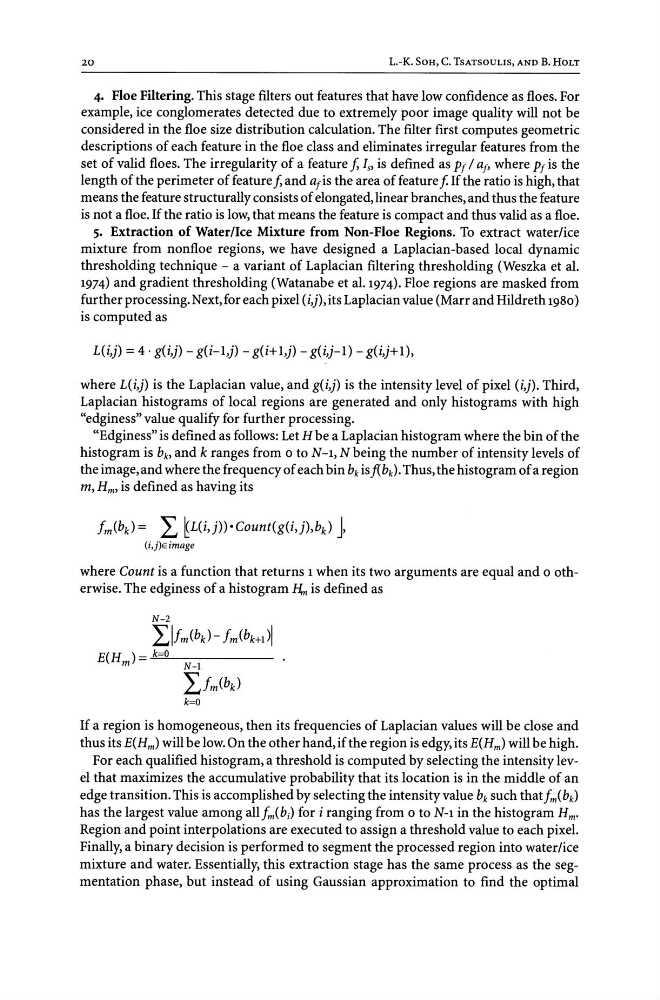
where Count is a function that returns 1 when its two arguments are equal and 0 otherwise. The edginess of a histogram Hm is defined as
N-2
Llfm(bk)- fm(bk+1)1
E(Hm) = 2>:k==O'---_ _ _ _ _
N-l
Lfm(bk)
k=O
If a region is homogeneous, then its frequencies of Laplacian values will be close and
thus its E(Hm) will be low. On the other hand, if the region is edgy, its E(Hm) will be high.
For each qualified histogram, a threshold is computed by selecting the intensity level that maximizes the accumulative probability that its location is in the middle of an
edge transition. This is accomplished by selecting the intensity value bk such that fm( bk)
has the largest value among allfm(bJ for i ranging from 0 to N-l in the histogram Hm.
Region and point interpolations are executed to assign a threshold value to each pixel.
Finally, a binary decision is performed to segment the processed region into water/ice
mixture and water. Essentially, this extraction stage has the same process as the segmentation phase, but instead of using Gaussian approximation to find the optimal
L.-K. SOH, C. TSATSOULIS, AND B. HOLT
4. Floe Filtering. This stage filters out features that have low confidence as floes. For
example, ice conglomerates detected due to extremely poor image quality will not be
considered in the floe size distribution calculation. The filter first computes geometric
descriptions of each feature in the floe class and eliminates irregular features from the
set of valid floes. The irregularity of a feature f, Is, is defined as Pi / ai' where Pi is the
length of the perimeter of feature f, and ai is the area of feature f If the ratio is high, that
means the feature structurally consists of elongated, linear branches, and thus the feature
is not a floe. If the ratio is low, that means the feature is compact and thus valid as a floe.
5. Extraction of Water/Ice Mixture from Non-Floe Regions. To extract water/ice
mixture from nonfloe regions, we have designed a Laplacian-based local dynamic
thresholding technique - a variant of Laplacian filtering thresholding (Weszka et al.
1974) and gradient thresholding (Watanabe et al. 1974). Floe regions are masked from
further processing. Next, for each pixel (i,j), its Laplacian value (Marr and Hildreth 1980)
is computed as
L(i,j) = 4· g(i,j) - g(i-1,j) - g(i+ 1,j) - g(i,j-l) - g(i,j+ 1),
where L(i,j) is the Laplacian value, and g(i,j) is the intensity level of pixel (i,j). Third,
Laplacian histograms of local regions are generated and only histograms with high
"edginess" value qualify for further processing.
"Edginess" is defined as follows: Let H be a Laplacian histogram where the bin of the
histogram is bk> and k ranges from 0 to N-l, N being the number of intensity levels of
the image, and where the frequency of each bin bk is f( bk). Thus, the histogram of a region
m, H m, is defined as having its
fm(bk)= L ~L(i,j)).Count(g(i,j)A) J,
(i,j)E image
where Count is a function that returns 1 when its two arguments are equal and 0 otherwise. The edginess of a histogram Hm is defined as
N-2
Llfm(bk)- fm(bk+1)1
E(Hm) = 2>:k==O'---_ _ _ _ _
N-l
Lfm(bk)
k=O
If a region is homogeneous, then its frequencies of Laplacian values will be close and
thus its E(Hm) will be low. On the other hand, if the region is edgy, its E(Hm) will be high.
For each qualified histogram, a threshold is computed by selecting the intensity level that maximizes the accumulative probability that its location is in the middle of an
edge transition. This is accomplished by selecting the intensity value bk such that fm( bk)
has the largest value among allfm(bJ for i ranging from 0 to N-l in the histogram Hm.
Region and point interpolations are executed to assign a threshold value to each pixel.
Finally, a binary decision is performed to segment the processed region into water/ice
mixture and water. Essentially, this extraction stage has the same process as the segmentation phase, but instead of using Gaussian approximation to find the optimal