

9 Alaska SAR Facility: The US Science (enter for Sea Ice SAR Data
193
9.1.3
Reception-Area Masks
ASF archives, processes, and distributes data from the two US SAR ground stations, at
Fairbanks, Alaska, and McMurdo Base, Antarctica, and is directly responsible for data
reception and recording at Fairbanks, while the NASA Wallops Flight Center manages
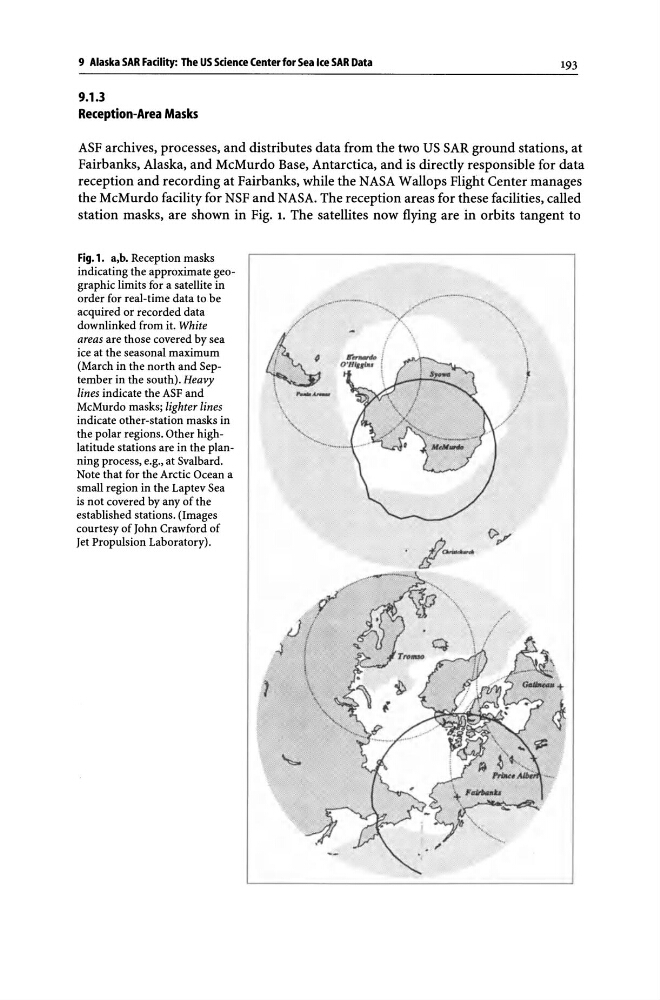
the McMurdo facility for NSF and NASA. The reception areas for these facilities, called
station masks, are shown in Fig. 1. The satellites now flying are in orbits tangent to
Fig.l. a,b. Reception masks
indicating the approximate geographic limits for a satellite in
order for real-time data to be
acquired or recorded data
downlinked from it. White
areas are those covered by sea
ice at the seasonal maximum
(March in the north and September in the south). Heavy
lines indicate the ASF and
McMurdo masks; lighter lines
indicate other-station masks in
the polar regions. Other highlatitude stations are in the planning process, e.g., at Svalbard.
Note that for the Arctic Ocean a
small region in the Laptev Sea
is not covered by any of the
established stations. (Images
courtesy of John Crawford of
Jet Propulsion Laboratory).
193
9.1.3
Reception-Area Masks
ASF archives, processes, and distributes data from the two US SAR ground stations, at
Fairbanks, Alaska, and McMurdo Base, Antarctica, and is directly responsible for data
reception and recording at Fairbanks, while the NASA Wallops Flight Center manages
the McMurdo facility for NSF and NASA. The reception areas for these facilities, called
station masks, are shown in Fig. 1. The satellites now flying are in orbits tangent to
Fig.l. a,b. Reception masks
indicating the approximate geographic limits for a satellite in
order for real-time data to be
acquired or recorded data
downlinked from it. White
areas are those covered by sea
ice at the seasonal maximum
(March in the north and September in the south). Heavy
lines indicate the ASF and
McMurdo masks; lighter lines
indicate other-station masks in
the polar regions. Other highlatitude stations are in the planning process, e.g., at Svalbard.
Note that for the Arctic Ocean a
small region in the Laptev Sea
is not covered by any of the
established stations. (Images
courtesy of John Crawford of
Jet Propulsion Laboratory).