

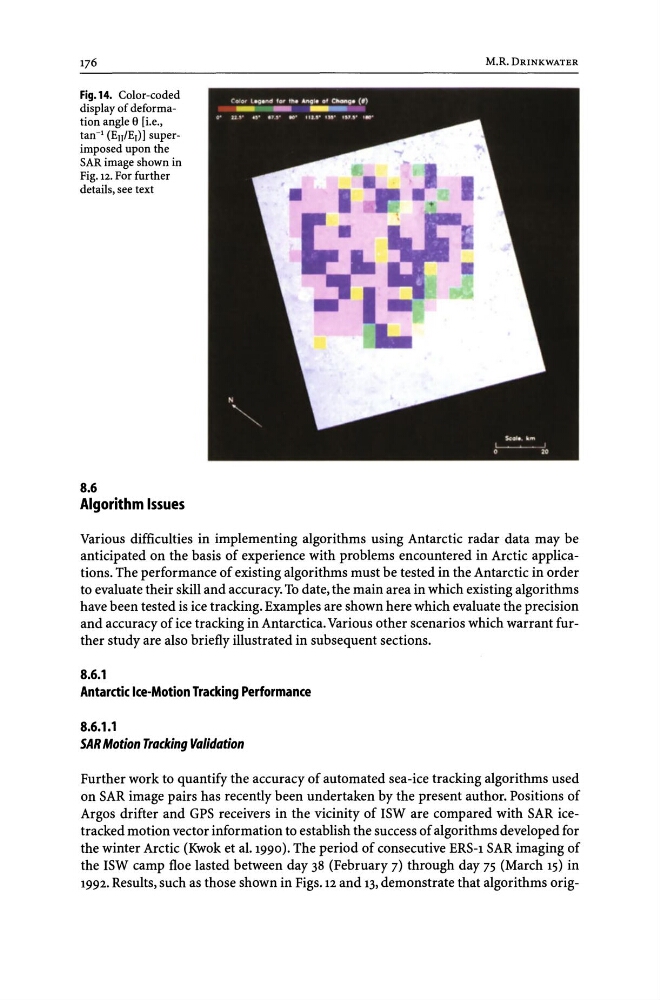
Fig. 14. Color-coded
display of deformation angle e [i.e.,
tan- 1 (En/EI) 1 superimposed upon the
SAR image shown in
Fig. 12. For further
details, see text
8.6
Algorithm Issues
M.R. DRINKWATER
Various difficulties in implementing algorithms using Antarctic radar data may be
anticipated on the basis of experience with problems encountered in Arctic applications. The performance of existing algorithms must be tested in the Antarctic in order
to evaluate their skill and accuracy. To date, the main area in which existing algorithms
have been tested is ice tracking. Examples are shown here which evaluate the precision
and accuracy of ice tracking in Antarctica. Various other scenarios which warrant further study are also briefly illustrated in subsequent sections.
8.6.1
Antarctic Ice-Motion Tracking Performance
8.6.1.1
SAR Motion Tracking Validation
Further work to quantify the accuracy of automated sea-ice tracking algorithms used
on SAR image pairs has recently been undertaken by the present author. Positions of
Argos drifter and GPS receivers in the vicinity of ISW are compared with SAR icetracked motion vector information to establish the success of algorithms developed for
the winter Arctic (Kwok et al.I990). The period of consecutive ERS-l SAR imaging of
the ISW camp floe lasted between day 38 (February 7) through day 75 (March 15) in
1992. Results, such as those shown in Figs. 12 and 13, demonstrate that algorithms orig-
display of deformation angle e [i.e.,
tan- 1 (En/EI) 1 superimposed upon the
SAR image shown in
Fig. 12. For further
details, see text
8.6
Algorithm Issues
M.R. DRINKWATER
Various difficulties in implementing algorithms using Antarctic radar data may be
anticipated on the basis of experience with problems encountered in Arctic applications. The performance of existing algorithms must be tested in the Antarctic in order
to evaluate their skill and accuracy. To date, the main area in which existing algorithms
have been tested is ice tracking. Examples are shown here which evaluate the precision
and accuracy of ice tracking in Antarctica. Various other scenarios which warrant further study are also briefly illustrated in subsequent sections.
8.6.1
Antarctic Ice-Motion Tracking Performance
8.6.1.1
SAR Motion Tracking Validation
Further work to quantify the accuracy of automated sea-ice tracking algorithms used
on SAR image pairs has recently been undertaken by the present author. Positions of
Argos drifter and GPS receivers in the vicinity of ISW are compared with SAR icetracked motion vector information to establish the success of algorithms developed for
the winter Arctic (Kwok et al.I990). The period of consecutive ERS-l SAR imaging of
the ISW camp floe lasted between day 38 (February 7) through day 75 (March 15) in
1992. Results, such as those shown in Figs. 12 and 13, demonstrate that algorithms orig-