

8 Satellite Microwave Radar Observations of Antarctic Sea Ice
153
angle and polarization. In support, detailed surface measurements were made within
the footprint of the shipborne radar, after each scan was performed, "surface information" comprising measurements of physical and chemical properties of snow and ice
together with structural information (Drinkwater and Haas 1994). The objective of the
1992 winter scatterometer measurements was to provide validation data for ERS-l SAR
observations and to obtain a detailed microwave backscattering catalogue of various
ice conditions. Overlapping data acquisitions were planned and made possible by the
GARS as part of the International Space Year Project (Lemke 1994).
The Ice Margin and Pancake Ice Floes
The Antarctic outer ice margin or marginal ice zone (MIZ) is typically characterized
as a high-energy wave environment, where wave propagation into the ice edge plays a
dominant role in determining the style of ice formation during winter ice advance and
the characteristics of floes during ice-edge recession. The MIZ is typically broad in its
extent during ice-edge advance. In 1992, during WWGS'92, a high amplitude swell was
experienced along the Greenwich meridian and frazil and pancake young-ice growth
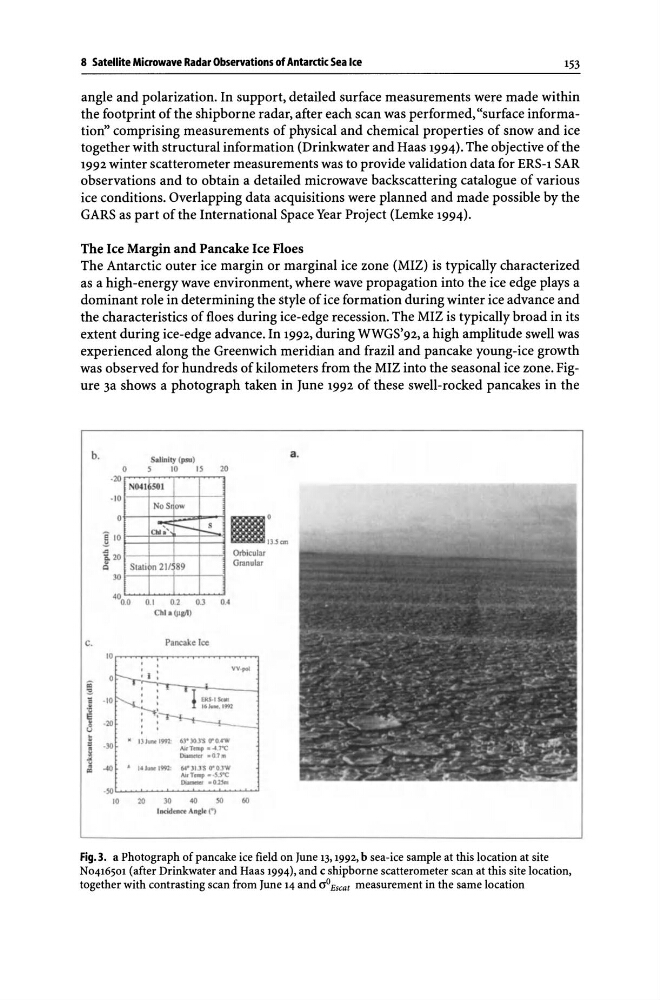
was observed for hundreds of kilometers from the MIZ into the seasonal ice zone. Figure 3a shows a photograph taken in June 1992 of these swell-rocked pancakes in the
b.
C.
...
E
.
-0
e
J
i
~
. .
o
.2Il
· 10
30
1'1041
Stati
Salinity 1.,...1
S
10
IS
20
SO)
No S ow
":""
r--r-!
ChI.'
n 2 11 89
1I11[5~
Or1>icul.,
Granular
40 0 ,0
0,1
0.2
OJ
0.'
Chl.~)
Pancake lee
10
:
vv.poI
, I
·10
.2Il
·30
IlJWlCI99'2- tiJ-lO.J'50"'O''W
AlITC1U9 .... 1"'C
~.o..lJII.
... 0
. !'JulWl99l: 6I: t JI.l'S OtOJW
AMT~ -.~
DiMllflCf . o~
. )0
10
2Il
30
40
)0
60
Irw:kll:n. ct And~ r)
a.
Fig.3. a Photograph of pancake ice field on June 13, 1992, b sea-ice sample at this location at site
N0416501 (after Drinkwater and Haas 1994), and c shipborne scatterometer scan at this site location,
together with contrasting scan from June 14 and croEscat measurement in the same location
153
angle and polarization. In support, detailed surface measurements were made within
the footprint of the shipborne radar, after each scan was performed, "surface information" comprising measurements of physical and chemical properties of snow and ice
together with structural information (Drinkwater and Haas 1994). The objective of the
1992 winter scatterometer measurements was to provide validation data for ERS-l SAR
observations and to obtain a detailed microwave backscattering catalogue of various
ice conditions. Overlapping data acquisitions were planned and made possible by the
GARS as part of the International Space Year Project (Lemke 1994).
The Ice Margin and Pancake Ice Floes
The Antarctic outer ice margin or marginal ice zone (MIZ) is typically characterized
as a high-energy wave environment, where wave propagation into the ice edge plays a
dominant role in determining the style of ice formation during winter ice advance and
the characteristics of floes during ice-edge recession. The MIZ is typically broad in its
extent during ice-edge advance. In 1992, during WWGS'92, a high amplitude swell was
experienced along the Greenwich meridian and frazil and pancake young-ice growth
was observed for hundreds of kilometers from the MIZ into the seasonal ice zone. Figure 3a shows a photograph taken in June 1992 of these swell-rocked pancakes in the
b.
C.
...
E
.
-0
e
J
i
~
. .
o
.2Il
· 10
30
1'1041
Stati
Salinity 1.,...1
S
10
IS
20
SO)
No S ow
":""
r--r-!
ChI.'
n 2 11 89
1I11[5~
Or1>icul.,
Granular
40 0 ,0
0,1
0.2
OJ
0.'
Chl.~)
Pancake lee
10
:
vv.poI
, I
·10
.2Il
·30
IlJWlCI99'2- tiJ-lO.J'50"'O''W
AlITC1U9 .... 1"'C
~.o..lJII.
... 0
. !'JulWl99l: 6I: t JI.l'S OtOJW
AMT~ -.~
DiMllflCf . o~
. )0
10
2Il
30
40
)0
60
Irw:kll:n. ct And~ r)
a.
Fig.3. a Photograph of pancake ice field on June 13, 1992, b sea-ice sample at this location at site
N0416501 (after Drinkwater and Haas 1994), and c shipborne scatterometer scan at this site location,
together with contrasting scan from June 14 and croEscat measurement in the same location