

106
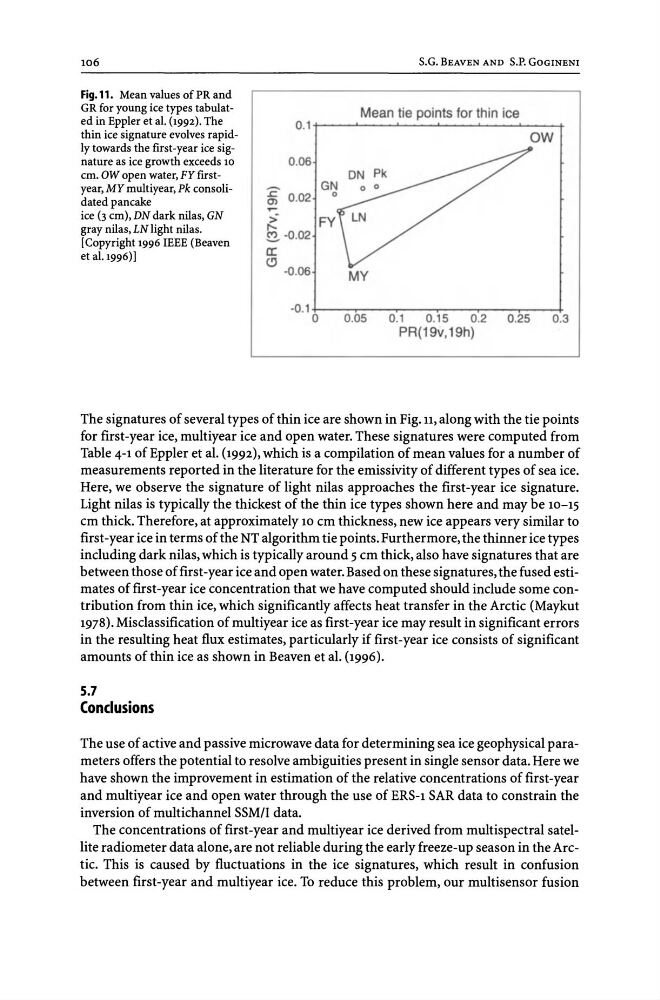
Fig.11. Mean values of PR and
GR for young ice types tabulated in Eppler et al. (1992). The
thin ice signature evolves rapidly towards the first-year ice signature as ice growth exceeds 10
cm. OW open water, FY firstyear, MY multiyear, Pk consolidated pancake
ice (3 cm), DN dark nilas, GN
gray nilas, LN light nilas.
[Copyright 1996 IEEE (Beaven
et aI.1996)]
S.G. BEAVEN AND S.P. GOGINENI
Mean tie points for thin ice
0.1 +---....... - - - ' - - - - ' - - - - - ' - - - - ' " - - - - +
ow
0.06
:2 Ol 0.02
~FY
£1 -0.02
a:
(!) -0.06
MY
-0.1 +--~~___:_..---~--.---........ --+
o
0.05
0.1
0.15
0.2
0.25
0.3
PR(19v,19h)
The signatures of several types of thin ice are shown in Fig. 11, along with the tie points
for first-year ice, multiyear ice and open water. These signatures were computed from
Table 4-1 of Eppler et al. (1992), which is a compilation of mean values for a number of
measurements reported in the literature for the emissivity of different types of sea ice.
Here, we observe the signature of light nilas approaches the first-year ice signature.
Light nilas is typically the thickest of the thin ice types shown here and may be 10-15
cm thick. Therefore, at approximately 10 cm thickness, new ice appears very similar to
first -year ice in terms of the NT algorithm tie points. Furthermore, the thinner ice types
including dark nilas, which is typically around 5 cm thick, also have signatures that are
between those of first-year ice and open water. Based on these signatures, the fused estimates of first-year ice concentration that we have computed should include some contribution from thin ice, which significantly affects heat transfer in the Arctic (Maykut
1978). Misclassification of multiyear ice as first-year ice may result in significant errors
in the resulting heat flux estimates, particularly if first-year ice consists of significant
amounts of thin ice as shown in Beaven et al. (1996).
5.7
Conclusions
The use of active and passive microwave data for determining sea ice geophysical parameters offers the potential to resolve ambiguities present in single sensor data. Here we
have shown the improvement in estimation of the relative concentrations of first-year
and multiyear ice and open water through the use of ERS-l SAR data to constrain the
inversion of multichannel SSM!I data.
The concentrations of first-year and multiyear ice derived from multispectral satellite radiometer data alone, are not reliable during the early freeze-up season in the Arctic. This is caused by fluctuations in the ice signatures, which result in confusion
between first-year and multiyear ice. To reduce this problem, our multisensor fusion
Fig.11. Mean values of PR and
GR for young ice types tabulated in Eppler et al. (1992). The
thin ice signature evolves rapidly towards the first-year ice signature as ice growth exceeds 10
cm. OW open water, FY firstyear, MY multiyear, Pk consolidated pancake
ice (3 cm), DN dark nilas, GN
gray nilas, LN light nilas.
[Copyright 1996 IEEE (Beaven
et aI.1996)]
S.G. BEAVEN AND S.P. GOGINENI
Mean tie points for thin ice
0.1 +---....... - - - ' - - - - ' - - - - - ' - - - - ' " - - - - +
ow
0.06
:2 Ol 0.02
~FY
£1 -0.02
a:
(!) -0.06
MY
-0.1 +--~~___:_..---~--.---........ --+
o
0.05
0.1
0.15
0.2
0.25
0.3
PR(19v,19h)
The signatures of several types of thin ice are shown in Fig. 11, along with the tie points
for first-year ice, multiyear ice and open water. These signatures were computed from
Table 4-1 of Eppler et al. (1992), which is a compilation of mean values for a number of
measurements reported in the literature for the emissivity of different types of sea ice.
Here, we observe the signature of light nilas approaches the first-year ice signature.
Light nilas is typically the thickest of the thin ice types shown here and may be 10-15
cm thick. Therefore, at approximately 10 cm thickness, new ice appears very similar to
first -year ice in terms of the NT algorithm tie points. Furthermore, the thinner ice types
including dark nilas, which is typically around 5 cm thick, also have signatures that are
between those of first-year ice and open water. Based on these signatures, the fused estimates of first-year ice concentration that we have computed should include some contribution from thin ice, which significantly affects heat transfer in the Arctic (Maykut
1978). Misclassification of multiyear ice as first-year ice may result in significant errors
in the resulting heat flux estimates, particularly if first-year ice consists of significant
amounts of thin ice as shown in Beaven et al. (1996).
5.7
Conclusions
The use of active and passive microwave data for determining sea ice geophysical parameters offers the potential to resolve ambiguities present in single sensor data. Here we
have shown the improvement in estimation of the relative concentrations of first-year
and multiyear ice and open water through the use of ERS-l SAR data to constrain the
inversion of multichannel SSM!I data.
The concentrations of first-year and multiyear ice derived from multispectral satellite radiometer data alone, are not reliable during the early freeze-up season in the Arctic. This is caused by fluctuations in the ice signatures, which result in confusion
between first-year and multiyear ice. To reduce this problem, our multisensor fusion