

S.G. BEAVEN AND S.P. GOGINENI
5.4.1
Determination of Multiyear Ice Concentration from ERS-1 SAR
Multiyear ice concentration can be derived from spaceborne SAR systems by exploiting the higher backscatter from multiyear ice than from first-year ice and calm open
water (Kwok et al.1992; Haverkamp et al.1993, 1995). We used the dynamic local thresholding (DLT) method described in detail by Haverkamp et al. (1995), because it appears
to have some advantages for ice classification during seasonal transitions. This method
does not depend on absolute image intensity levels and predetermined thresholds,
which can be problematic during these periods. However, since it was used as a first
stage of a knowledge-based algorithm for determining ice types, it requires addition160000+ I
I
I I I 1 I I I I I • I I I • I I I I I I I 1+
1400007
- -
-
60000-:400007
- -
It
(a)
Normalized Locol HI"09nom
for SAR Fl'llme 1719 (12 Sept 1991)
.0
.0
.,
.0
.. .
..
. ,
.,
I
I
I. _
~
~ ~ ~ ~ i ~ ~ ~ ~ ~ ~ ! ~ ~ ~ ~ ! ~
i:l !I
., ,
,,' (dB)
(b)
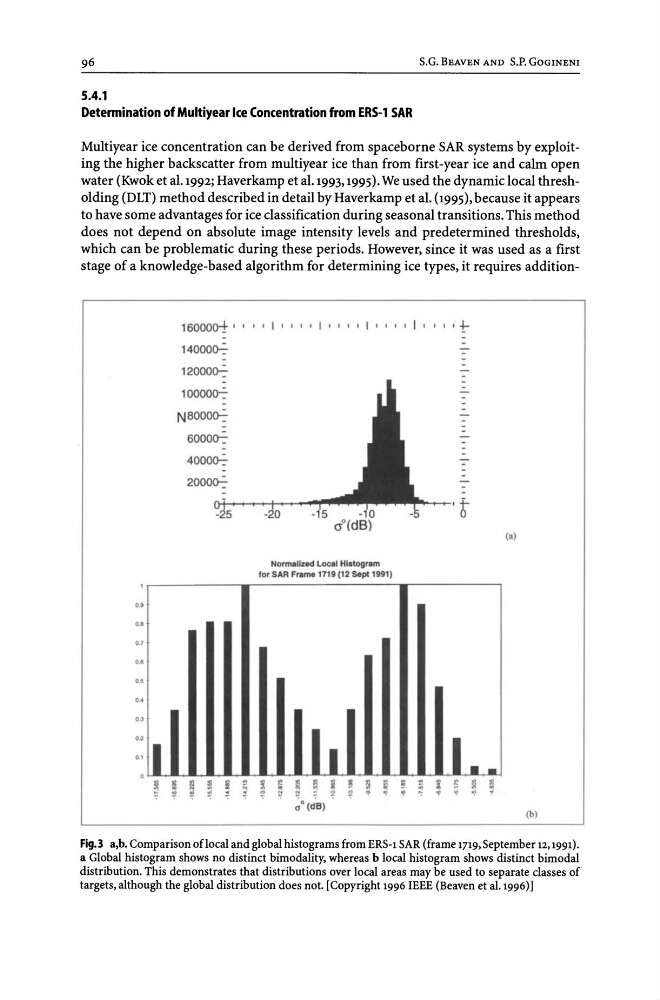
Fig.3 a,b. Comparison oflocal and global histograms from ERS-l SAR (frame 1719, September 12, 1991).
a Global histogram shows no distinct bimodality, whereas b local histogram shows distinct bimodal
distribution. This demonstrates that distributions over local areas may be used to separate classes of
targets, although the global distribution does not. [Copyright 1996 IEEE (Beaven et al. 1996) I
5.4.1
Determination of Multiyear Ice Concentration from ERS-1 SAR
Multiyear ice concentration can be derived from spaceborne SAR systems by exploiting the higher backscatter from multiyear ice than from first-year ice and calm open
water (Kwok et al.1992; Haverkamp et al.1993, 1995). We used the dynamic local thresholding (DLT) method described in detail by Haverkamp et al. (1995), because it appears
to have some advantages for ice classification during seasonal transitions. This method
does not depend on absolute image intensity levels and predetermined thresholds,
which can be problematic during these periods. However, since it was used as a first
stage of a knowledge-based algorithm for determining ice types, it requires addition160000+ I
I
I I I 1 I I I I I • I I I • I I I I I I I 1+
1400007
- -
-
60000-:400007
- -
It
(a)
Normalized Locol HI"09nom
for SAR Fl'llme 1719 (12 Sept 1991)
.0
.0
.,
.0
.. .
..
. ,
.,
I
I
I. _
~
~ ~ ~ ~ i ~ ~ ~ ~ ~ ~ ! ~ ~ ~ ~ ! ~
i:l !I
., ,
,,' (dB)
(b)
Fig.3 a,b. Comparison oflocal and global histograms from ERS-l SAR (frame 1719, September 12, 1991).
a Global histogram shows no distinct bimodality, whereas b local histogram shows distinct bimodal
distribution. This demonstrates that distributions over local areas may be used to separate classes of
targets, although the global distribution does not. [Copyright 1996 IEEE (Beaven et al. 1996) I