

5 Fusion of Satellite SAR with Passive Microwave Data for Sea Ice Remote Sensing
95
dated with the use of constants as tie points for defining each of the surface types: multiyear ice, first-year ice, and open water (Thomas 1993).
A detailed summary of the performance of the algorithm and the validation of
derived ice classification for SSM!I data are given in the literature (Cavalieri et al.1991;
Steffen and Schweiger 1991). The 25-km ice concentration algorithm is also described
in detail in the SSM!I brightness temperature grid user's guide (NSIDC 1992). Since the
algorithm is explained in several of the references cited above, it is not repeated here.
5.4
Fusion Approach for Sea Ice Classification
When sensors differ widely in resolution it is impossible to merge the data at the pixellevel. In this case the most likely level to merge the data is at the decision level (Waltz
and Llinas 1990; Collins 1992). One possible approach that may allow for fusing data
from sensors with different resolutions is to enhance or improve the resolution of the
lower-resolution sensor and combine the data at the data level. When the resolution
scales differ greatly, as in the case of satellite SAR and SSM!I data, an alternative is to
develop a fusion technique that uses features or products derived from the high resolution sensor data with the data from the low resolution sensor. This solution may be
considered a multilevel, or hybrid fusion approach, since the SAR data are used at the
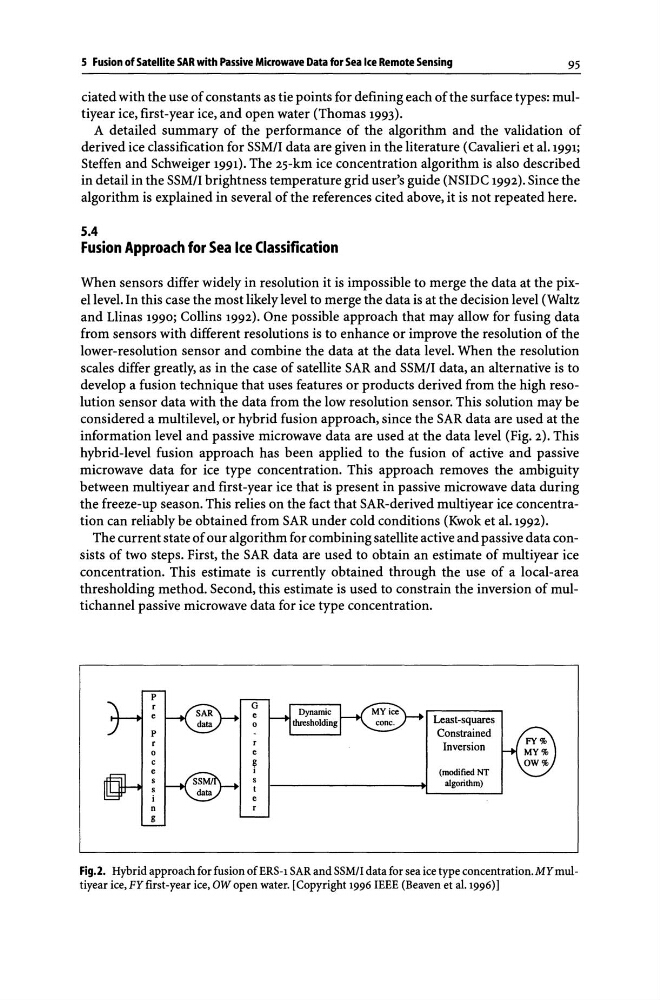
information level and passive microwave data are used at the data level (Fig. 2). This
hybrid-level fusion approach has been applied to the fusion of active and passive
microwave data for ice type concentration. This approach removes the ambiguity
between multiyear and first-year ice that is present in passive microwave data during
the freeze-up season. This relies on the fact that SAR-derived multiyear ice concentration can reliably be obtained from SAR under cold conditions (Kwok et al. 1992).
The current state of our algorithm for combining satellite active and passive data consists of two steps. First, the SAR data are used to obtain an estimate of multiyear ice
concentration. This estimate is currently obtained through the use of a local-area
thresholding method. Second, this estimate is used to constrain the inversion of multichannel passive microwave data for ice type concentration.
Fig.2. Hybrid approach for fusion ofERS-1 SAR and SSM!I data for sea ice type concentration. MY multiyear ice, FY first-year ice, OW open water. [Copyright 1996 IEEE (Beaven et al.1996) 1
95
dated with the use of constants as tie points for defining each of the surface types: multiyear ice, first-year ice, and open water (Thomas 1993).
A detailed summary of the performance of the algorithm and the validation of
derived ice classification for SSM!I data are given in the literature (Cavalieri et al.1991;
Steffen and Schweiger 1991). The 25-km ice concentration algorithm is also described
in detail in the SSM!I brightness temperature grid user's guide (NSIDC 1992). Since the
algorithm is explained in several of the references cited above, it is not repeated here.
5.4
Fusion Approach for Sea Ice Classification
When sensors differ widely in resolution it is impossible to merge the data at the pixellevel. In this case the most likely level to merge the data is at the decision level (Waltz
and Llinas 1990; Collins 1992). One possible approach that may allow for fusing data
from sensors with different resolutions is to enhance or improve the resolution of the
lower-resolution sensor and combine the data at the data level. When the resolution
scales differ greatly, as in the case of satellite SAR and SSM!I data, an alternative is to
develop a fusion technique that uses features or products derived from the high resolution sensor data with the data from the low resolution sensor. This solution may be
considered a multilevel, or hybrid fusion approach, since the SAR data are used at the
information level and passive microwave data are used at the data level (Fig. 2). This
hybrid-level fusion approach has been applied to the fusion of active and passive
microwave data for ice type concentration. This approach removes the ambiguity
between multiyear and first-year ice that is present in passive microwave data during
the freeze-up season. This relies on the fact that SAR-derived multiyear ice concentration can reliably be obtained from SAR under cold conditions (Kwok et al. 1992).
The current state of our algorithm for combining satellite active and passive data consists of two steps. First, the SAR data are used to obtain an estimate of multiyear ice
concentration. This estimate is currently obtained through the use of a local-area
thresholding method. Second, this estimate is used to constrain the inversion of multichannel passive microwave data for ice type concentration.
Fig.2. Hybrid approach for fusion ofERS-1 SAR and SSM!I data for sea ice type concentration. MY multiyear ice, FY first-year ice, OW open water. [Copyright 1996 IEEE (Beaven et al.1996) 1