

4.1 Non-Linear Energy Transfer in Wind Wave Spectrum
85
the source function uncertainties and wind speed errors, but it did seem to
be accurate for studying the finer effects of non-linear wave dynamics.
It should be noted that two advanced methods of calculating the collision
integral are now known. The first one was suggested by Resio and Perrie
(1991) with scaling and symmetry being used for calculating the integral.
The second method was proposed by Snyder et al. (1993) using a hybrid integration scheme for the algorithm described by Hasselmann & Hasselmann
(1981) and Hasselmann et al. (1985). This scheme uses the improvements
of the earlier calculation method in combination with the advantages of the
EXACT-NL model calculation (Ocean Wave Modeling, 1985) and allows increasing the calculation speed by an order of magnitude.
However, in spite of the obvious success, the problem of the calculation
accuracy and its optimal algorithm is still of great interest. That is why an
attempt to achieve some progress in this direction is made in this monograph.
The results of the present study are of interest not only in terms of decreasing
the computing time and providing guaranteed accuracy, but in obtaining
more stable estimations of the non-linear energy transfer in the wind wave
spectrum.
4.1.2 Optimal Algorithm of Computation
of Non-linear Energy Transfer
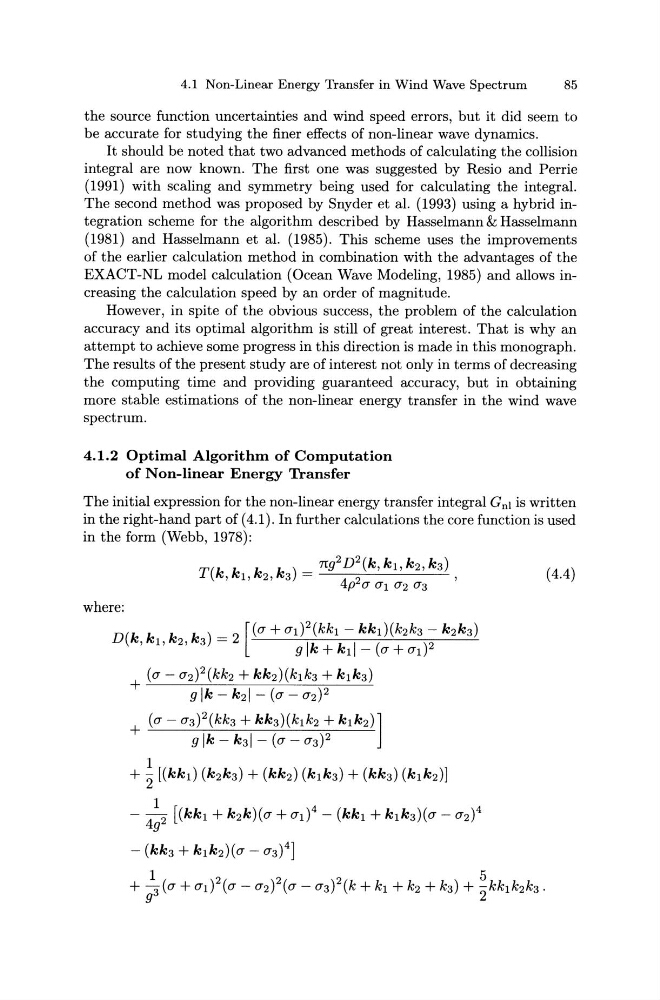
The initial expression for the non-linear energy transfer integral Gnl is written
in the right-hand part of (4.1). In further calculations the core function is used
in the form (Webb, 1978):
T(k k k k ) = ng 2 D 2 (k, k1, k2, k3)
' 1, 2, 3
4 2
'
p (J (Jl 0'2 0'3
where:
D(k k k k ) = 2 [(u + u1) 2 (kk1- kk1)(k2k3- k 2k 3)
' 1 ' 2 ' 3
glk+k1l-(u+u1) 2
(u- u2) 2 (kk2 + kk2)(k1k3 + k1k3)
+~--~~~~--~~~~~~
g lk- k2l- (u- u2) 2
+ (u- u3) 2 (kk3 + kk3)(k1k2 + k1k2)]
g lk- k31- (u- u3) 2
1
+ 2 [(kkl) (k2k3) + (kk2) (klk3) + (kk3) (klk2)]
1 [
4
4
- 4 g 2 (kk1 + k2k)(u + u1) - (kk1 + k1k3)(u- u2)
- (kk3 + k1k2)(u- u3) 4 )
1
2
2
2
5
+ g 3 (u + u1) (u- u2) (u- u3) (k + k1 + k2 + k3) + 2kk1k2k3.
(4.4)
85
the source function uncertainties and wind speed errors, but it did seem to
be accurate for studying the finer effects of non-linear wave dynamics.
It should be noted that two advanced methods of calculating the collision
integral are now known. The first one was suggested by Resio and Perrie
(1991) with scaling and symmetry being used for calculating the integral.
The second method was proposed by Snyder et al. (1993) using a hybrid integration scheme for the algorithm described by Hasselmann & Hasselmann
(1981) and Hasselmann et al. (1985). This scheme uses the improvements
of the earlier calculation method in combination with the advantages of the
EXACT-NL model calculation (Ocean Wave Modeling, 1985) and allows increasing the calculation speed by an order of magnitude.
However, in spite of the obvious success, the problem of the calculation
accuracy and its optimal algorithm is still of great interest. That is why an
attempt to achieve some progress in this direction is made in this monograph.
The results of the present study are of interest not only in terms of decreasing
the computing time and providing guaranteed accuracy, but in obtaining
more stable estimations of the non-linear energy transfer in the wind wave
spectrum.
4.1.2 Optimal Algorithm of Computation
of Non-linear Energy Transfer
The initial expression for the non-linear energy transfer integral Gnl is written
in the right-hand part of (4.1). In further calculations the core function is used
in the form (Webb, 1978):
T(k k k k ) = ng 2 D 2 (k, k1, k2, k3)
' 1, 2, 3
4 2
'
p (J (Jl 0'2 0'3
where:
D(k k k k ) = 2 [(u + u1) 2 (kk1- kk1)(k2k3- k 2k 3)
' 1 ' 2 ' 3
glk+k1l-(u+u1) 2
(u- u2) 2 (kk2 + kk2)(k1k3 + k1k3)
+~--~~~~--~~~~~~
g lk- k2l- (u- u2) 2
+ (u- u3) 2 (kk3 + kk3)(k1k2 + k1k2)]
g lk- k31- (u- u3) 2
1
+ 2 [(kkl) (k2k3) + (kk2) (klk3) + (kk3) (klk2)]
1 [
4
4
- 4 g 2 (kk1 + k2k)(u + u1) - (kk1 + k1k3)(u- u2)
- (kk3 + k1k2)(u- u3) 4 )
1
2
2
2
5
+ g 3 (u + u1) (u- u2) (u- u3) (k + k1 + k2 + k3) + 2kk1k2k3.
(4.4)