

3.8 Conclusions
79
used in the WAM model can lead to significant numerical errors in calculating
the wave energy propagation. The interpolation-ray method is proposed as
an alternative numerical one.
There is a major difference between the WAM model numerical scheme
and the interpolation-ray method. The former is based on using the finitedifference approximation of the wave energy balance equation. The stability
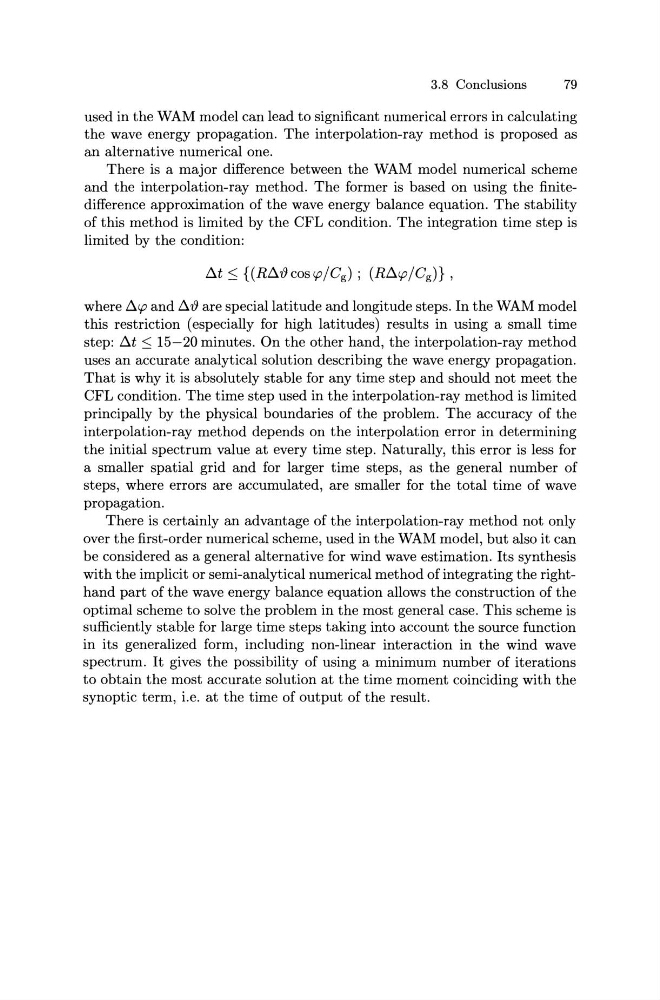
of this method is limited by the CFL condition. The integration time step is
limited by the condition:
where !::ir.p and f::l.{) are special latitude and longitude steps. In the WAM model
this restriction (especially for high latitudes) results in using a small time
step: !::it :<:::; 15-20 minutes. On the other hand, the interpolation-ray method
uses an accurate analytical solution describing the wave energy propagation.
That is why it is absolutely stable for any time step and should not meet the
CFL condition. The time step used in the interpolation-ray method is limited
principally by the physical boundaries of the problem. The accuracy of the
interpolation-ray method depends on the interpolation error in determining
the initial spectrum value at every time step. Naturally, this error is less for
a smaller spatial grid and for larger time steps, as the general number of
steps, where errors are accumulated, are smaller for the total time of wave
propagation.
There is certainly an advantage of the interpolation-ray method not only
over the first-order numerical scheme, used in the WAM model, but also it can
be considered as a general alternative for wind wave estimation. Its synthesis
with the implicit or semi-analytical numerical method of integrating the righthand part of the wave energy balance equation allows the construction of the
optimal scheme to solve the problem in the most general case. This scheme is
sufficiently stable for large time steps taking into account the source function
in its generalized form, including non-linear interaction in the wind wave
spectrum. It gives the possibility of using a minimum number of iterations
to obtain the most accurate solution at the time moment coinciding with the
synoptic term, i.e. at the time of output of the result.
79
used in the WAM model can lead to significant numerical errors in calculating
the wave energy propagation. The interpolation-ray method is proposed as
an alternative numerical one.
There is a major difference between the WAM model numerical scheme
and the interpolation-ray method. The former is based on using the finitedifference approximation of the wave energy balance equation. The stability
of this method is limited by the CFL condition. The integration time step is
limited by the condition:
where !::ir.p and f::l.{) are special latitude and longitude steps. In the WAM model
this restriction (especially for high latitudes) results in using a small time
step: !::it :<:::; 15-20 minutes. On the other hand, the interpolation-ray method
uses an accurate analytical solution describing the wave energy propagation.
That is why it is absolutely stable for any time step and should not meet the
CFL condition. The time step used in the interpolation-ray method is limited
principally by the physical boundaries of the problem. The accuracy of the
interpolation-ray method depends on the interpolation error in determining
the initial spectrum value at every time step. Naturally, this error is less for
a smaller spatial grid and for larger time steps, as the general number of
steps, where errors are accumulated, are smaller for the total time of wave
propagation.
There is certainly an advantage of the interpolation-ray method not only
over the first-order numerical scheme, used in the WAM model, but also it can
be considered as a general alternative for wind wave estimation. Its synthesis
with the implicit or semi-analytical numerical method of integrating the righthand part of the wave energy balance equation allows the construction of the
optimal scheme to solve the problem in the most general case. This scheme is
sufficiently stable for large time steps taking into account the source function
in its generalized form, including non-linear interaction in the wind wave
spectrum. It gives the possibility of using a minimum number of iterations
to obtain the most accurate solution at the time moment coinciding with the
synoptic term, i.e. at the time of output of the result.