

76
3 Numerical Implementation of the Wave Energy Balance Equation
5
4
3
_,
__.._ - 2
-+- - 3
2
-a- - 4
-e- -5
2
3
4
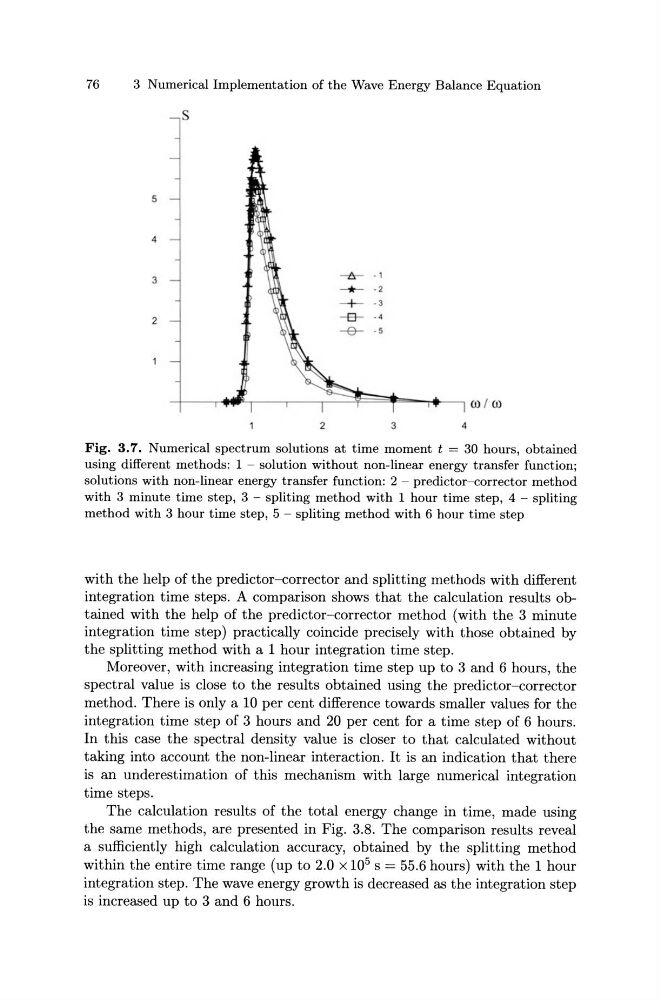
Fig. 3.7. Numerical spectrum solutions at time moment t = 30 hours, obtained
using different methods: 1 - solution without non-linear energy transfer function;
solutions with non-linear energy transfer function: 2 - predictor-corrector method
with 3 minute t ime step, 3 - spliting method with 1 hour time step, 4 - spliting
method with 3 hour time step, 5 - spliting method with 6 hour time step
with the help of the predictor-corrector and splitting methods with different
integration time steps. A comparison shows that t he calculat ion results obtained with the help of the predictor-corrector method (with the 3 minute
integration t ime step) practically coincide precisely with those obtained by
the splitt ing method with a 1 hour integration t ime step.
Moreover, with increasing integration time step up to 3 and 6 hours, the
spectral value is close to the results obtained using the predictor-corrector
method. There is only a 10 per cent difference towards smaller values for the
integration time step of 3 hours and 20 per cent for a time step of 6 hours.
In this case t he spectral density value is closer to t hat calculated without
taking into account the non-linear interaction. It is an indication t hat t here
is an underestimation of this mechanism wit h large numerical integration
time steps.
The calculation results of the total energy change in time, made using
the same methods, are presented in Fig. 3.8. The comparison results reveal
a sufficiently high calculation accuracy, obtained by the splitting method
within the entire time range (up to 2.0 x 10 5 s = 55.6 hours) with the 1 hour
integration step. The wave energy growth is decreased as t he int egration step
is increased up to 3 and 6 hours.
3 Numerical Implementation of the Wave Energy Balance Equation
5
4
3
_,
__.._ - 2
-+- - 3
2
-a- - 4
-e- -5
2
3
4
Fig. 3.7. Numerical spectrum solutions at time moment t = 30 hours, obtained
using different methods: 1 - solution without non-linear energy transfer function;
solutions with non-linear energy transfer function: 2 - predictor-corrector method
with 3 minute t ime step, 3 - spliting method with 1 hour time step, 4 - spliting
method with 3 hour time step, 5 - spliting method with 6 hour time step
with the help of the predictor-corrector and splitting methods with different
integration time steps. A comparison shows that t he calculat ion results obtained with the help of the predictor-corrector method (with the 3 minute
integration t ime step) practically coincide precisely with those obtained by
the splitt ing method with a 1 hour integration t ime step.
Moreover, with increasing integration time step up to 3 and 6 hours, the
spectral value is close to the results obtained using the predictor-corrector
method. There is only a 10 per cent difference towards smaller values for the
integration time step of 3 hours and 20 per cent for a time step of 6 hours.
In this case t he spectral density value is closer to t hat calculated without
taking into account the non-linear interaction. It is an indication t hat t here
is an underestimation of this mechanism wit h large numerical integration
time steps.
The calculation results of the total energy change in time, made using
the same methods, are presented in Fig. 3.8. The comparison results reveal
a sufficiently high calculation accuracy, obtained by the splitting method
within the entire time range (up to 2.0 x 10 5 s = 55.6 hours) with the 1 hour
integration step. The wave energy growth is decreased as t he int egration step
is increased up to 3 and 6 hours.