

3.4 Elimination of the "Garden Sprinkler Effect"
57
order of several hundred kilometres. Using the results of Booij and Holtuijsen
(1987), it can be shown that:
a( cos f3S)
1 a(sin f3S) "' R aS
a
(3.15)
The factor (Rj .C) is the order of 10 for a typical spatial sea scale, and it
is about 1 for an ocean.
With an exception of the ocean subpolar areas, it can be assumed that
the correcting term in the second square brackets of (3.13) is an order larger
than the other ones. Keeping the main correction in (3.13), this is written as
follows:
where
.
.
aS+ _1_a((pcos
af3 -
R af3 2 '
A=R/.C-tan(
J = J(1 + c/2), j3 = /3(1- c/2).
(3.16)
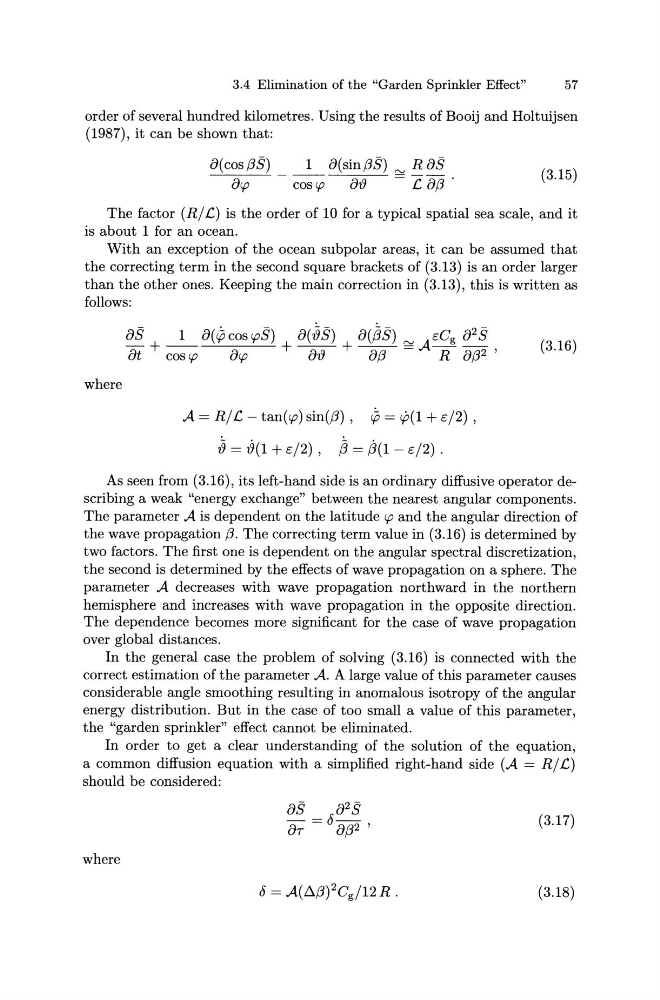
As seen from (3.16), its left-hand side is an ordinary diffusive operator describing a weak "energy exchange" between the nearest angular components.
The parameter A is dependent on the latitude the wave propagation {3. The correcting term value in (3.16) is determined by
two factors. The first one is dependent on the angular spectral discretization,
the second is determined by the effects of wave propagation on a sphere. The
parameter A decreases with wave propagation northward in the northern
hemisphere and increases with wave propagation in the opposite direction.
The dependence becomes more significant for the case of wave propagation
over global distances.
In the general case the problem of solving (3.16) is connected with the
correct estimation of the parameter A. A large value of this parameter causes
considerable angle smoothing resulting in anomalous isotropy of the angular
energy distribution. But in the case of too small a value of this parameter,
the "garden sprinkler" effect cannot be eliminated.
In order to get a clear understanding of the solution of the equation,
a common diffusion equation with a simplified right-hand side (A = R/ .C)
should be considered:
as
a 2 S
aT = J af32 '
(3.17)
where
(3.18)
57
order of several hundred kilometres. Using the results of Booij and Holtuijsen
(1987), it can be shown that:
a( cos f3S)
1 a(sin f3S) "' R aS
a
(3.15)
The factor (Rj .C) is the order of 10 for a typical spatial sea scale, and it
is about 1 for an ocean.
With an exception of the ocean subpolar areas, it can be assumed that
the correcting term in the second square brackets of (3.13) is an order larger
than the other ones. Keeping the main correction in (3.13), this is written as
follows:
where
.
.
aS+ _1_a((pcos
af3 -
R af3 2 '
A=R/.C-tan(
(3.16)
As seen from (3.16), its left-hand side is an ordinary diffusive operator describing a weak "energy exchange" between the nearest angular components.
The parameter A is dependent on the latitude the wave propagation {3. The correcting term value in (3.16) is determined by
two factors. The first one is dependent on the angular spectral discretization,
the second is determined by the effects of wave propagation on a sphere. The
parameter A decreases with wave propagation northward in the northern
hemisphere and increases with wave propagation in the opposite direction.
The dependence becomes more significant for the case of wave propagation
over global distances.
In the general case the problem of solving (3.16) is connected with the
correct estimation of the parameter A. A large value of this parameter causes
considerable angle smoothing resulting in anomalous isotropy of the angular
energy distribution. But in the case of too small a value of this parameter,
the "garden sprinkler" effect cannot be eliminated.
In order to get a clear understanding of the solution of the equation,
a common diffusion equation with a simplified right-hand side (A = R/ .C)
should be considered:
as
a 2 S
aT = J af32 '
(3.17)
where
(3.18)