

2.3 Swell Propagation Simulation by Characteristics Method
39
question arises: how to make the optimal choice of the sphere projection onto
the plane under the conditions of the problem.
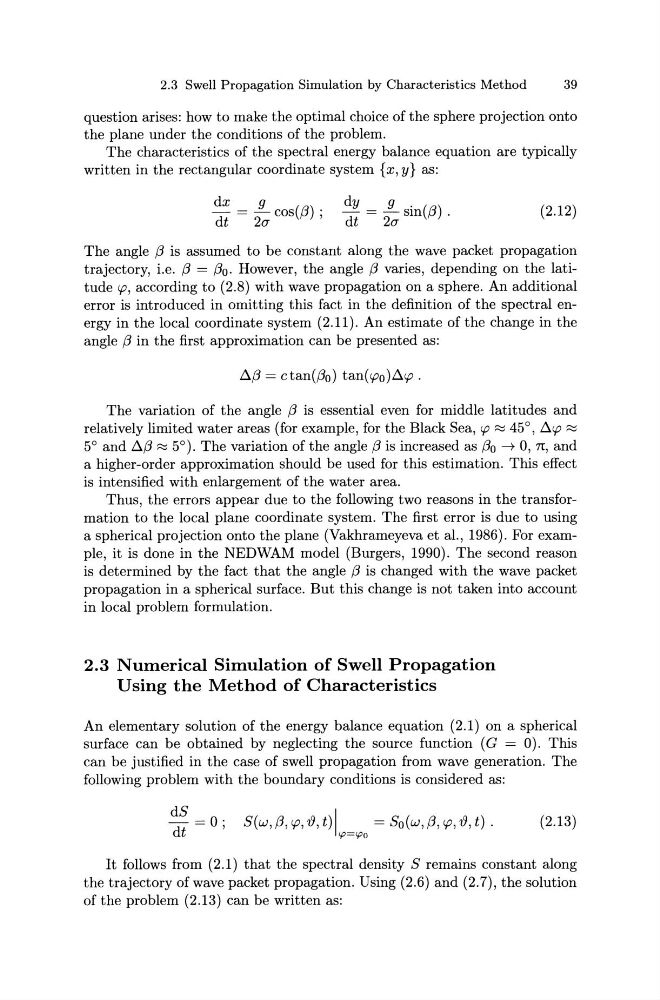
The characteristics of the spectral energy balance equation are typically
written in the rectangular coordinate system { x, y} as:
dx
g
dt = 2a cos(;J) ;
dy
g .
- = -sm(;J).
dt
2a
(2.12)
The angle ;3 is assumed to be constant along the wave packet propagation
trajectory, i.e. ;3 = ;30 . However, the angle ;3 varies, depending on the latitude cp, according to (2.8) with wave propagation on a sphere. An additional
error is introduced in omitting this fact in the definition of the spectral energy in the local coordinate system (2.11). An estimate of the change in the
angle ;3 in the first approximation can be presented as:
D..;J = ctan(;Jo) tan(cpo)D..cp.
The variation of the angle ;3 is essential even for middle latitudes and
relatively limited water areas (for example, for the Black Sea, cp ~ 45°, D..cp ~
5° and D..;J ~5°). The variation of the angle ;3 is increased as ;30 -+ 0, n, and
a higher-order approximation should be used for this estimation. This effect
is intensified with enlargement of the water area.
Thus, the errors appear due to the following two reasons in the transformation to the local plane coordinate system. The first error is due to using
a spherical projection onto the plane (Vakhrameyeva et al., 1986). For example, it is done in the NEDWAM model (Burgers, 1990). The second reason
is determined by the fact that the angle ;3 is changed with the wave packet
propagation in a spherical surface. But this change is not taken into account
in local problem formulation.
2.3 Numerical Simulation of Swell Propagation
Using the Method of Characteristics
An elementary solution of the energy balance equation (2.1) on a spherical
surface can be obtained by neglecting the source function (G = 0). This
can be justified in the case of swell propagation from wave generation. The
following problem with the boundary conditions is considered as:
dS
I
dt = 0; S(w,;J,cp,iJ,t)
It follows from (2.1) that the spectral density S remains constant along
the trajectory of wave packet propagation. Using (2.6) and (2.7), the solution
of the problem (2.13) can be written as:
39
question arises: how to make the optimal choice of the sphere projection onto
the plane under the conditions of the problem.
The characteristics of the spectral energy balance equation are typically
written in the rectangular coordinate system { x, y} as:
dx
g
dt = 2a cos(;J) ;
dy
g .
- = -sm(;J).
dt
2a
(2.12)
The angle ;3 is assumed to be constant along the wave packet propagation
trajectory, i.e. ;3 = ;30 . However, the angle ;3 varies, depending on the latitude cp, according to (2.8) with wave propagation on a sphere. An additional
error is introduced in omitting this fact in the definition of the spectral energy in the local coordinate system (2.11). An estimate of the change in the
angle ;3 in the first approximation can be presented as:
D..;J = ctan(;Jo) tan(cpo)D..cp.
The variation of the angle ;3 is essential even for middle latitudes and
relatively limited water areas (for example, for the Black Sea, cp ~ 45°, D..cp ~
5° and D..;J ~5°). The variation of the angle ;3 is increased as ;30 -+ 0, n, and
a higher-order approximation should be used for this estimation. This effect
is intensified with enlargement of the water area.
Thus, the errors appear due to the following two reasons in the transformation to the local plane coordinate system. The first error is due to using
a spherical projection onto the plane (Vakhrameyeva et al., 1986). For example, it is done in the NEDWAM model (Burgers, 1990). The second reason
is determined by the fact that the angle ;3 is changed with the wave packet
propagation in a spherical surface. But this change is not taken into account
in local problem formulation.
2.3 Numerical Simulation of Swell Propagation
Using the Method of Characteristics
An elementary solution of the energy balance equation (2.1) on a spherical
surface can be obtained by neglecting the source function (G = 0). This
can be justified in the case of swell propagation from wave generation. The
following problem with the boundary conditions is considered as:
dS
I
dt = 0; S(w,;J,cp,iJ,t)
It follows from (2.1) that the spectral density S remains constant along
the trajectory of wave packet propagation. Using (2.6) and (2.7), the solution
of the problem (2.13) can be written as: