

2.1 Wind Wave Modelling Using Spherical Variables
37
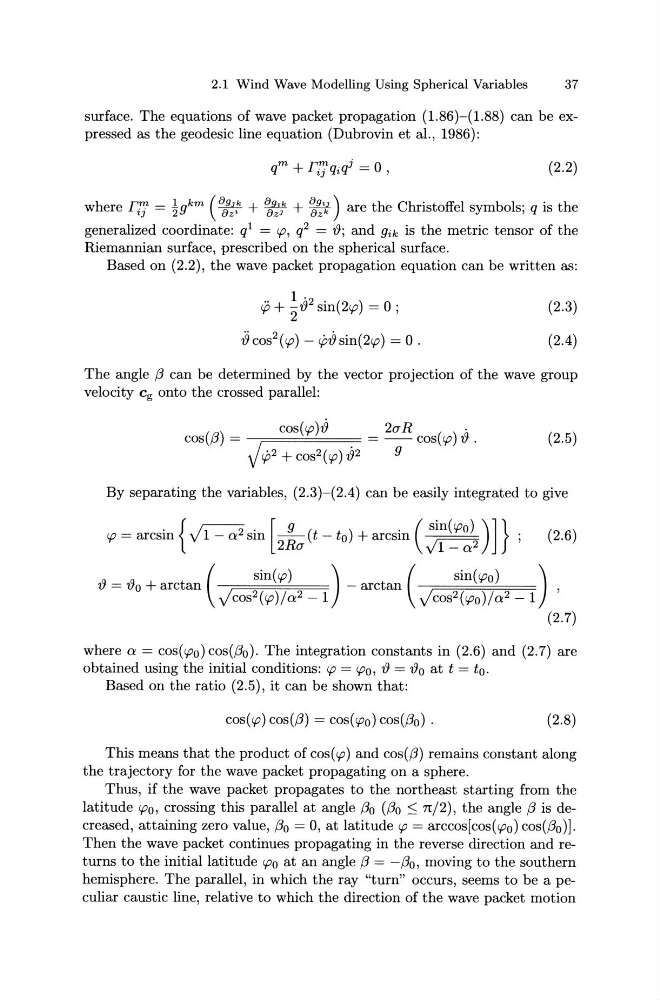
surface. The equations of wave packet propagation (1.86)-(1.88) can be expressed as the geodesic line equation (Dubrovin et al., 1986):
m+rm j_o
q
ij qiq -
'
(2.2)
where Frn = lgkm ( 891 k + 89 •k + ~) are the Christoffel symbols· q is the
t]
2
oz'
[}z1
[}zk
'
generalized coordinate: q 1 = r.p, q 2 = {); and 9ik is the metric tensor of the
Riemannian surface, prescribed on the spherical surface.
Based on (2.2), the wave packet propagation equation can be written as:
1 .2
rp + 2 {) sin(2r.p) = 0;
{jcos 2 (r.p)- cpJsin(2r.p) = 0.
(2.3)
(2.4)
The angle f3 can be determined by the vector projection of the wave group
velocity cg onto the crossed parallel:
cos(/3) =
cos(r.p)J
= 2aR cos(r.p) J.
V cp2 + cos2 ( r.p) J2 g
(2.5)
By separating the variables, (2.3)-(2.4) can be easily integrated to give
. { ~ . [ g
. ( sin( r.po) ) ] }
r.p = arcsm y 1 - o: 2 sm 2 Ra ( t - t0 ) + arcsm .Jf=Q2
;
(2.6)
{) = {)0 + arctan
- arctan
,
(
sin(r.p)
)
(
sin(r.p0 )
)
Jcos 2 (r.p)/o: 2 - 1
Jcos 2 (r.p0 )/o: 2 - 1
(2.7)
where a= cos(r.p0 ) cos(/30 ). The integration constants in (2.6) and (2.7) are
obtained using the initial conditions: r.p = r.p0 , {) = {)0 at t = t0 .
Based on the ratio (2.5), it can be shown that:
cos( r.p) cos(/3) = cos( r.p0 ) cos(f3o) .
(2.8)
This means that the product of cos( r.p) and cos(/3) remains constant along
the trajectory for the wave packet propagating on a sphere.
Thus, if the wave packet propagates to the northeast starting from the
latitude r.p0 , crossing this parallel at angle f3o (/30 ::; n/2), the angle f3 is decreased, attaining zero value, (30 = 0, at latitude r.p = arccos[cos(r.p0 ) cos(/30 )].
Then the wave packet continues propagating in the reverse direction and returns to the initial latitude r.p0 at an angle f3 = -(30 , moving to the southern
hemisphere. The parallel, in which the ray "turn" occurs, seems to be a peculiar caustic line, relative to which the direction of the wave packet motion
37
surface. The equations of wave packet propagation (1.86)-(1.88) can be expressed as the geodesic line equation (Dubrovin et al., 1986):
m+rm j_o
q
ij qiq -
'
(2.2)
where Frn = lgkm ( 891 k + 89 •k + ~) are the Christoffel symbols· q is the
t]
2
oz'
[}z1
[}zk
'
generalized coordinate: q 1 = r.p, q 2 = {); and 9ik is the metric tensor of the
Riemannian surface, prescribed on the spherical surface.
Based on (2.2), the wave packet propagation equation can be written as:
1 .2
rp + 2 {) sin(2r.p) = 0;
{jcos 2 (r.p)- cpJsin(2r.p) = 0.
(2.3)
(2.4)
The angle f3 can be determined by the vector projection of the wave group
velocity cg onto the crossed parallel:
cos(/3) =
cos(r.p)J
= 2aR cos(r.p) J.
V cp2 + cos2 ( r.p) J2 g
(2.5)
By separating the variables, (2.3)-(2.4) can be easily integrated to give
. { ~ . [ g
. ( sin( r.po) ) ] }
r.p = arcsm y 1 - o: 2 sm 2 Ra ( t - t0 ) + arcsm .Jf=Q2
;
(2.6)
{) = {)0 + arctan
- arctan
,
(
sin(r.p)
)
(
sin(r.p0 )
)
Jcos 2 (r.p)/o: 2 - 1
Jcos 2 (r.p0 )/o: 2 - 1
(2.7)
where a= cos(r.p0 ) cos(/30 ). The integration constants in (2.6) and (2.7) are
obtained using the initial conditions: r.p = r.p0 , {) = {)0 at t = t0 .
Based on the ratio (2.5), it can be shown that:
cos( r.p) cos(/3) = cos( r.p0 ) cos(f3o) .
(2.8)
This means that the product of cos( r.p) and cos(/3) remains constant along
the trajectory for the wave packet propagating on a sphere.
Thus, if the wave packet propagates to the northeast starting from the
latitude r.p0 , crossing this parallel at angle f3o (/30 ::; n/2), the angle f3 is decreased, attaining zero value, (30 = 0, at latitude r.p = arccos[cos(r.p0 ) cos(/30 )].
Then the wave packet continues propagating in the reverse direction and returns to the initial latitude r.p0 at an angle f3 = -(30 , moving to the southern
hemisphere. The parallel, in which the ray "turn" occurs, seems to be a peculiar caustic line, relative to which the direction of the wave packet motion