

1.6 General Problem Formulation
31
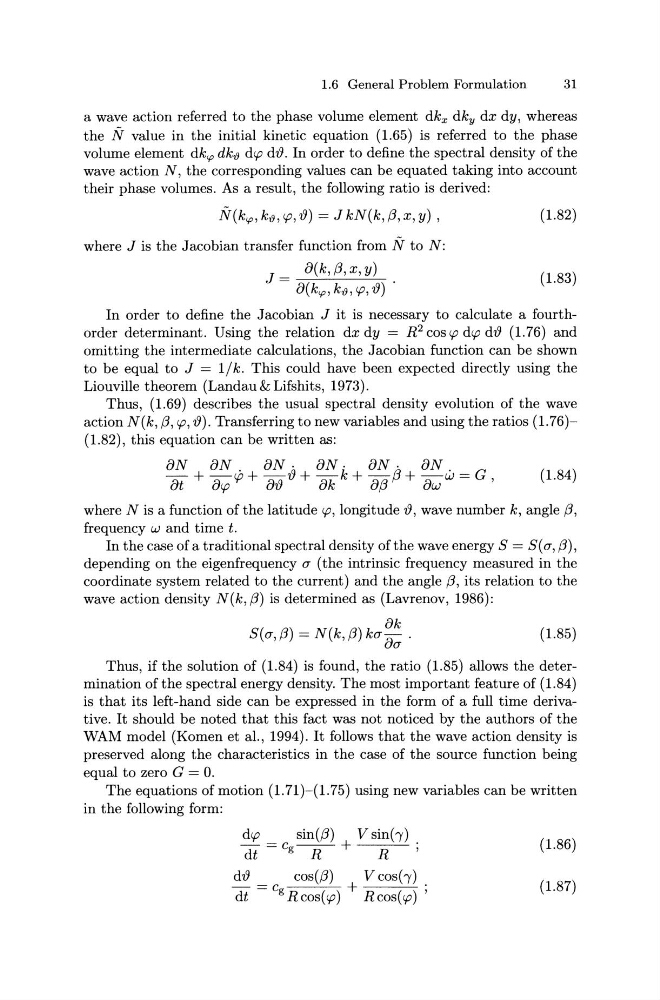
a wave action referred to the phase volume element dkx dky dx dy, whereas
the N value in the initial kinetic equation (1.65) is referred to the phase
volume element dkc,o dk1'J d wave action N, the corresponding values can be equated taking into account
their phase volumes. As a result, the following ratio is derived:
N(kc,o, k.0 ,
J= a(k,{J,x,y)
a(kc,o, k.a,
(1.83)
In order to define the Jacobian J it is necessary to calculate a fourthorder determinant. Using the relation dx dy = R 2 cos omitting the intermediate calculations, the Jacobian function can be shown
to be equal to J = 1/ k. This could have been expected directly using the
Liouville theorem (Landau & Lifshits, 1973).
Thus, (1.69) describes the usual spectral density evolution of the wave
action N(k, {3,
aN
aN . aN · aN . aN
at + a (1.84)
where N is a function of the latitude
In the case of a traditional spectral density of the wave energy S = S (a, {3),
depending on the eigenfrequency a (the intrinsic frequency measured in the
coordinate system related to the current) and the angle {3, its relation to the
wave action density N(k, {3) is determined as (Lavrenov, 1986):
ak
S(a, {3) = N(k, {3) ka aa .
(1.85)
Thus, if the solution of (1.84) is found, the ratio (1.85) allows the determination of the spectral energy density. The most important feature of (1.84)
is that its left-hand side can be expressed in the form of a full time derivative. It should be noted that this fact was not noticed by the authors of the
WAM model (Komen et al., 1994). It follows that the wave action density is
preserved along the characteristics in the case of the source function being
equal to zero G = 0.
The equations of motion (1.71)-(1.75) using new variables can be written
in the following form:
d
V sin( 'Y)
dt=Cg~+
R
;
(1.86)
d'!9
cos({J)
V cos("!)
- = c
+--.:...:....:...
dt
g Rcos(
31
a wave action referred to the phase volume element dkx dky dx dy, whereas
the N value in the initial kinetic equation (1.65) is referred to the phase
volume element dkc,o dk1'J d wave action N, the corresponding values can be equated taking into account
their phase volumes. As a result, the following ratio is derived:
N(kc,o, k.0 ,
J= a(k,{J,x,y)
a(kc,o, k.a,
(1.83)
In order to define the Jacobian J it is necessary to calculate a fourthorder determinant. Using the relation dx dy = R 2 cos omitting the intermediate calculations, the Jacobian function can be shown
to be equal to J = 1/ k. This could have been expected directly using the
Liouville theorem (Landau & Lifshits, 1973).
Thus, (1.69) describes the usual spectral density evolution of the wave
action N(k, {3,
aN
aN . aN · aN . aN
at + a (1.84)
where N is a function of the latitude
In the case of a traditional spectral density of the wave energy S = S (a, {3),
depending on the eigenfrequency a (the intrinsic frequency measured in the
coordinate system related to the current) and the angle {3, its relation to the
wave action density N(k, {3) is determined as (Lavrenov, 1986):
ak
S(a, {3) = N(k, {3) ka aa .
(1.85)
Thus, if the solution of (1.84) is found, the ratio (1.85) allows the determination of the spectral energy density. The most important feature of (1.84)
is that its left-hand side can be expressed in the form of a full time derivative. It should be noted that this fact was not noticed by the authors of the
WAM model (Komen et al., 1994). It follows that the wave action density is
preserved along the characteristics in the case of the source function being
equal to zero G = 0.
The equations of motion (1.71)-(1.75) using new variables can be written
in the following form:
d
V sin( 'Y)
dt=Cg~+
R
;
(1.86)
d'!9
cos({J)
V cos("!)
- = c
+--.:...:....:...
dt
g Rcos(