

332
7 Wave Transformation in Ice-Covered Water
v;(l)
= "' [v,w,a
- vw,a
]
0,1,2,3
.L.....t 1,2,~0,3
-0,1,2,3 '
w,a
v;(2)
= " ' [vw,a
+ v;w,a
- vw,a
0,1,2,3
6
-0,-1,2,3
2,3,-0,-1
-0,2,-1,3
w,a
- vw,a
- vw,a
- vw,a
]
-1,2,-0,3
-0,3,-1,2
-1,3,-0,2 '
v;(4)
= 2 " ' v;w,a
0,1,2,3
6
0,1,2,3 .
w,a
(7.66)
(7.67)
(7.68)
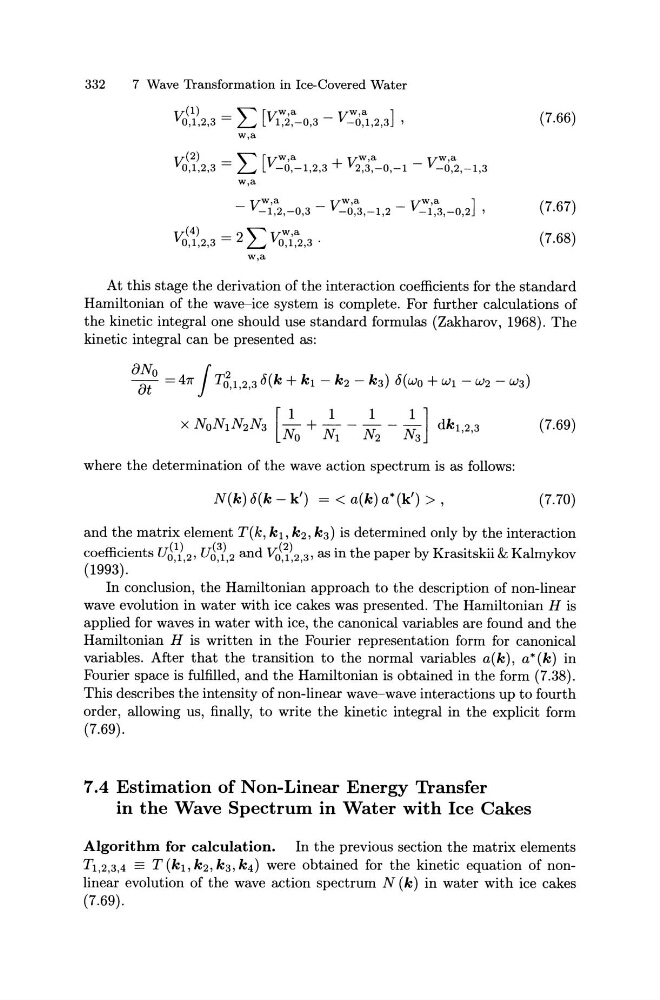
At this stage the derivation of the interaction coefficients for the standard
Hamiltonian of the wave-ice system is complete. For further calculations of
the kinetic integral one should use standard formulas (Zakharov, 1968). The
kinetic integral can be presented as:
(7.69)
where the determination of the wave action spectrum is as follows:
N(k) o(k- k') = < a(k) a*(k') >,
(7. 70)
and the matrix element T(k, k 1 , k2 , k 3 ) is determined only by the interaction
coefficients U~ 1 { 2 , U~ 3 { 2 and V 0 (~) 2 3 , as in the paper by Krasitskii & Kalmykov
(1993).
, ,
, ,
, , ,.
In conclusion, the Hamiltonian approach to the description of non-linear
wave evolution in water with ice cakes was presented. The Hamiltonian H is
applied for waves in water with ice, the canonical variables are found and the
Hamiltonian H is written in the Fourier representation form for canonical
variables. After that the transition to the normal variables a(k), a*(k) in
Fourier space is fulfilled, and the Hamiltonian is obtained in the form (7.38).
This describes the intensity of non-linear wave-wave interactions up to fourth
order, allowing us, finally, to write the kinetic integral in the explicit form
(7.69).
7.4 Estimation of Non-Linear Energy Transfer
in the Wave Spectrum in Water with Ice Cakes
Algorithm for calculation. In the previous section the matrix elements
T1,2,3,4 = T (k1, k2, k3, k4) were obtained for the kinetic equation of nonlinear evolution of the wave action spectrum N (k) in water with ice cakes
(7.69).
7 Wave Transformation in Ice-Covered Water
v;(l)
= "' [v,w,a
- vw,a
]
0,1,2,3
.L.....t 1,2,~0,3
-0,1,2,3 '
w,a
v;(2)
= " ' [vw,a
+ v;w,a
- vw,a
0,1,2,3
6
-0,-1,2,3
2,3,-0,-1
-0,2,-1,3
w,a
- vw,a
- vw,a
- vw,a
]
-1,2,-0,3
-0,3,-1,2
-1,3,-0,2 '
v;(4)
= 2 " ' v;w,a
0,1,2,3
6
0,1,2,3 .
w,a
(7.66)
(7.67)
(7.68)
At this stage the derivation of the interaction coefficients for the standard
Hamiltonian of the wave-ice system is complete. For further calculations of
the kinetic integral one should use standard formulas (Zakharov, 1968). The
kinetic integral can be presented as:
(7.69)
where the determination of the wave action spectrum is as follows:
N(k) o(k- k') = < a(k) a*(k') >,
(7. 70)
and the matrix element T(k, k 1 , k2 , k 3 ) is determined only by the interaction
coefficients U~ 1 { 2 , U~ 3 { 2 and V 0 (~) 2 3 , as in the paper by Krasitskii & Kalmykov
(1993).
, ,
, ,
, , ,.
In conclusion, the Hamiltonian approach to the description of non-linear
wave evolution in water with ice cakes was presented. The Hamiltonian H is
applied for waves in water with ice, the canonical variables are found and the
Hamiltonian H is written in the Fourier representation form for canonical
variables. After that the transition to the normal variables a(k), a*(k) in
Fourier space is fulfilled, and the Hamiltonian is obtained in the form (7.38).
This describes the intensity of non-linear wave-wave interactions up to fourth
order, allowing us, finally, to write the kinetic integral in the explicit form
(7.69).
7.4 Estimation of Non-Linear Energy Transfer
in the Wave Spectrum in Water with Ice Cakes
Algorithm for calculation. In the previous section the matrix elements
T1,2,3,4 = T (k1, k2, k3, k4) were obtained for the kinetic equation of nonlinear evolution of the wave action spectrum N (k) in water with ice cakes
(7.69).