

330
7 Wave Transformation in Ice-Covered Water
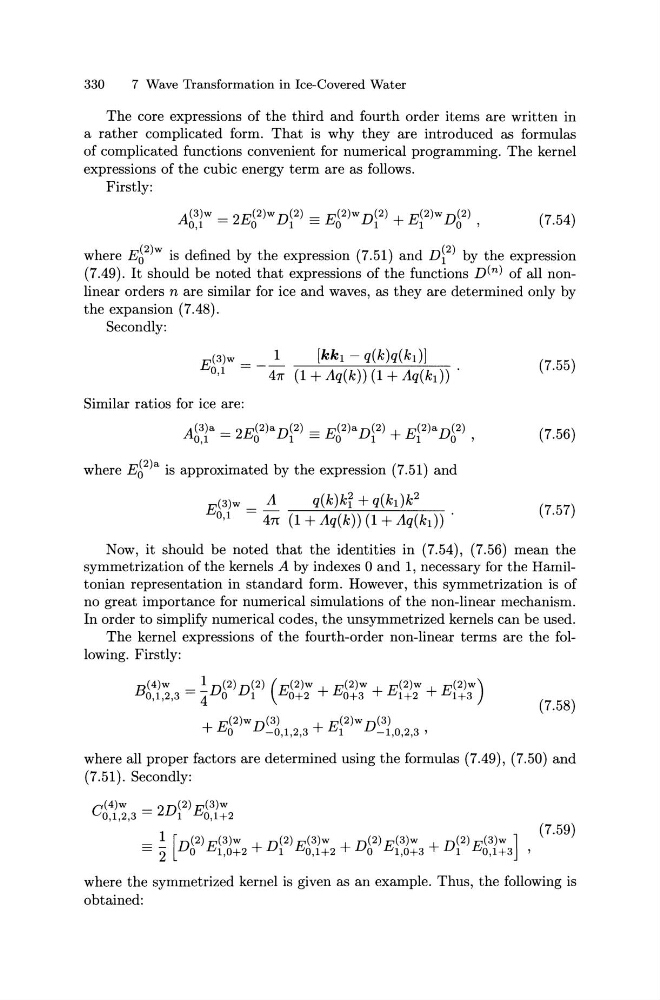
The core expressions of the third and fourth order items are written in
a rather complicated form. That is why they are introduced as formulas
of complicated functions convenient for numerical programming. The kernel
expressions of the cubic energy term are as follows.
Firstly:
A (3)w _ 2 E(2)w D(2) = E(2)w D(2) + E(2)w D(2)
0,1 -
0
1 -
0
1
1
0 '
(7.54)
where E~ 2 )w is defined by the expression (7.51) and Di 2 ) by the expression
(7.49). It should be noted that expressions of the functions D(n) of all nonlinear orders n are similar for ice and waves, as they are determined only by
the expansion (7.48).
Secondly:
E(3)w __ __!:__
[kk1- q(k)q(ki)]
0 ' 1 -
4n (1 + Aq(k))(1 + Aq(k1)) .
(7.55)
Similar ratios for ice are:
A (3)a _ 2 E(2)a D(2) = E(2)a D(2) + E(2)a D(2)
0,1 -
0
1 -
0
1
1
0 '
(7.56)
where E~ 2 )a is approximated by the expression (7.51) and
E(3)w _ ..::!_
q(k)ki + q(ki)k 2
0 ' 1 - 4n (1 + Aq(k)) (1 + Aq(k1)) .
(7.57)
Now, it should be noted that the identities in (7.54), (7.56) mean the
symmetrization of the kernels A by indexes 0 and 1, necessary for the Hamiltonian representation in standard form. However, this symmetrization is of
no great importance for numerical simulations of the non-linear mechanism.
In order to simplify numerical codes, the unsymmetrized kernels can be used.
The kernel expressions of the fourth-order non-linear terms are the following. Firstly:
B(4)w _ !v(2) v{2) (E(2)w + E(2)w + E(2)w + E(2)w)
0,1,2,3 - 4 0
1
0+2
0+3
1+2
1+3
(7.58)
+ E(2)w v(3)
+ E(2)w v(3)
0
-0,1,2,3
1
-1,0,2,3 '
where all proper factors are determined using the formulas (7.49), (7.50) and
(7.51). Secondly:
d4)w _ 2 D(2) E(3)w
0,1,2,3 -
1
0,1+2
= ! [v(2) E(3)w + D(2) E(3)w + D(2) E(3)w + D(2) E(3)w ]
- 2
0
1,0+2
1
0,1+2
0
1,0+3
1
0,1+3 '
(7.59)
where the symmetrized kernel is given as an example. Thus, the following is
obtained:
7 Wave Transformation in Ice-Covered Water
The core expressions of the third and fourth order items are written in
a rather complicated form. That is why they are introduced as formulas
of complicated functions convenient for numerical programming. The kernel
expressions of the cubic energy term are as follows.
Firstly:
A (3)w _ 2 E(2)w D(2) = E(2)w D(2) + E(2)w D(2)
0,1 -
0
1 -
0
1
1
0 '
(7.54)
where E~ 2 )w is defined by the expression (7.51) and Di 2 ) by the expression
(7.49). It should be noted that expressions of the functions D(n) of all nonlinear orders n are similar for ice and waves, as they are determined only by
the expansion (7.48).
Secondly:
E(3)w __ __!:__
[kk1- q(k)q(ki)]
0 ' 1 -
4n (1 + Aq(k))(1 + Aq(k1)) .
(7.55)
Similar ratios for ice are:
A (3)a _ 2 E(2)a D(2) = E(2)a D(2) + E(2)a D(2)
0,1 -
0
1 -
0
1
1
0 '
(7.56)
where E~ 2 )a is approximated by the expression (7.51) and
E(3)w _ ..::!_
q(k)ki + q(ki)k 2
0 ' 1 - 4n (1 + Aq(k)) (1 + Aq(k1)) .
(7.57)
Now, it should be noted that the identities in (7.54), (7.56) mean the
symmetrization of the kernels A by indexes 0 and 1, necessary for the Hamiltonian representation in standard form. However, this symmetrization is of
no great importance for numerical simulations of the non-linear mechanism.
In order to simplify numerical codes, the unsymmetrized kernels can be used.
The kernel expressions of the fourth-order non-linear terms are the following. Firstly:
B(4)w _ !v(2) v{2) (E(2)w + E(2)w + E(2)w + E(2)w)
0,1,2,3 - 4 0
1
0+2
0+3
1+2
1+3
(7.58)
+ E(2)w v(3)
+ E(2)w v(3)
0
-0,1,2,3
1
-1,0,2,3 '
where all proper factors are determined using the formulas (7.49), (7.50) and
(7.51). Secondly:
d4)w _ 2 D(2) E(3)w
0,1,2,3 -
1
0,1+2
= ! [v(2) E(3)w + D(2) E(3)w + D(2) E(3)w + D(2) E(3)w ]
- 2
0
1,0+2
1
0,1+2
0
1,0+3
1
0,1+3 '
(7.59)
where the symmetrized kernel is given as an example. Thus, the following is
obtained: