

6.5 Numerical Model of Wind Wave Transformation in a Coastal Area
295
I". c-.---:::::;,
········"' ················.·.·.·.·.·.·.·.·.· .. · ....... ·.·.·.·.·.· .· ... •· ...• ' ··· ... , ··· ........... , ..
10
a
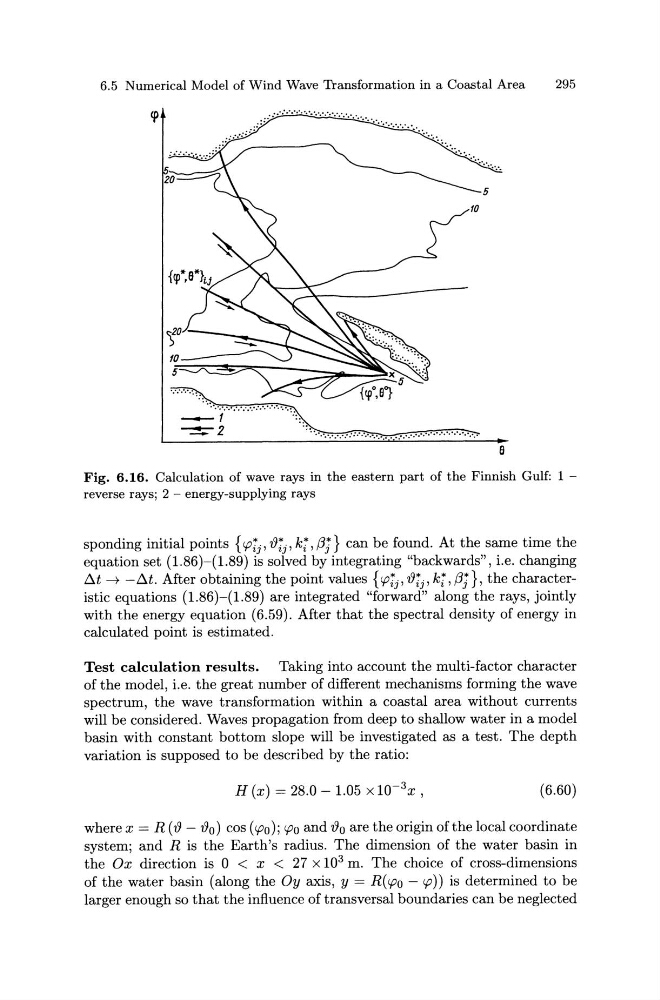
Fig. 6.16. Calculation of wave rays in the eastern part of the Finnish Gulf: 1 -
reverse rays; 2 - energy-supplying rays
sponding initial points { cpij, 79ij, ki, f3j} can be found. At the same time the
equation set (1.86)-(1.89) is solved by integrating "backwards", i.e. changing
flt -+ - !lt. After obtaining the point values { cpi 1 , 79ij, ki, f3j}, the characteristic equations (1.86)-(1.89) are integrated "forward" along the rays, jointly
with the energy equation (6.59). After that the spectral density of energy in
calculated point is estimated.
Test calculation results. Taking into account the multi-factor character
of the model, i.e. the great number of different mechanisms forming the wave
spectrum, the wave transformation within a coastal area without currents
will be considered. Waves propagation from deep to shallow water in a model
basin with constant bottom slope will be investigated as a test. The depth
variation is supposed to be described by the ratio:
H (x) = 28.0- 1.05 x 10- 3 x,
(6.60)
where x = R ( 79 - 790 ) cos ( cpo); cp0 and 790 are the origin of the local coordinate
system; and R is the Earth's radius. The dimension of the water basin in
the Ox direction is 0 < x < 27 x 10 3 m. The choice of cross-dimensions
of the water basin (along the Oy axis, y = R( cp0 - cp)) is determined to be
larger enough so that the influence of transversal boundaries can be neglected
295
I". c-.---:::::;,
········"' ················.·.·.·.·.·.·.·.·.· .. · ....... ·.·.·.·.·.· .· ... •· ...• ' ··· ... , ··· ........... , ..
10
a
Fig. 6.16. Calculation of wave rays in the eastern part of the Finnish Gulf: 1 -
reverse rays; 2 - energy-supplying rays
sponding initial points { cpij, 79ij, ki, f3j} can be found. At the same time the
equation set (1.86)-(1.89) is solved by integrating "backwards", i.e. changing
flt -+ - !lt. After obtaining the point values { cpi 1 , 79ij, ki, f3j}, the characteristic equations (1.86)-(1.89) are integrated "forward" along the rays, jointly
with the energy equation (6.59). After that the spectral density of energy in
calculated point is estimated.
Test calculation results. Taking into account the multi-factor character
of the model, i.e. the great number of different mechanisms forming the wave
spectrum, the wave transformation within a coastal area without currents
will be considered. Waves propagation from deep to shallow water in a model
basin with constant bottom slope will be investigated as a test. The depth
variation is supposed to be described by the ratio:
H (x) = 28.0- 1.05 x 10- 3 x,
(6.60)
where x = R ( 79 - 790 ) cos ( cpo); cp0 and 790 are the origin of the local coordinate
system; and R is the Earth's radius. The dimension of the water basin in
the Ox direction is 0 < x < 27 x 10 3 m. The choice of cross-dimensions
of the water basin (along the Oy axis, y = R( cp0 - cp)) is determined to be
larger enough so that the influence of transversal boundaries can be neglected