

20
1 General Problem Formulation
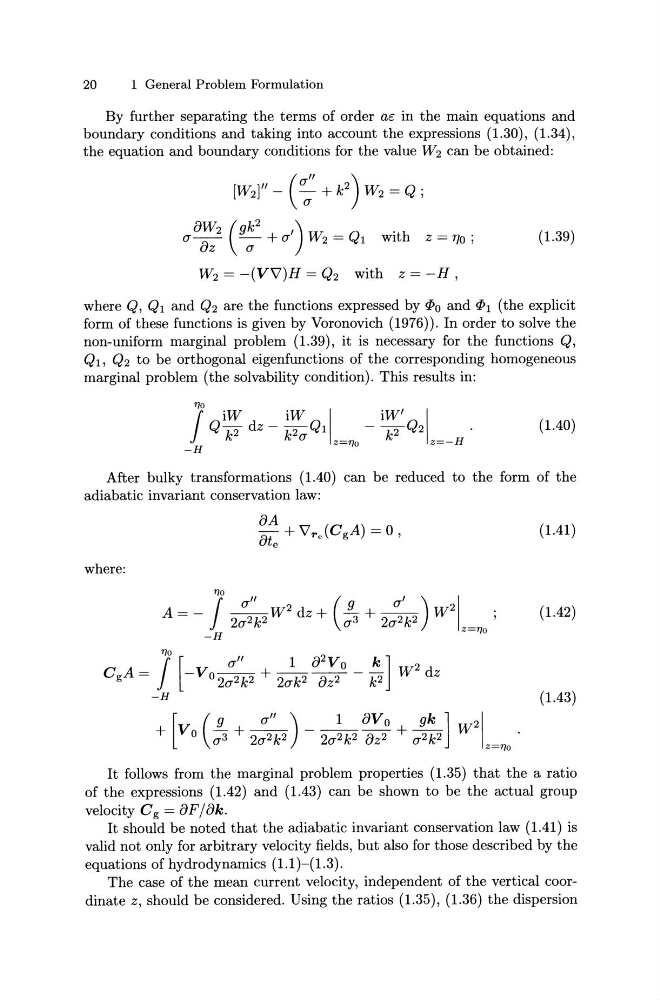
By further separating the terms of order ac: in the main equations and
boundary conditions and taking into account the expressions (1.30), (1.34),
the equation and boundary conditions for the value W 2 can be obtained:
with z = ry0 ;
(1.39)
W2 = -(V\7)H = Q2 with z = -H,
where Q, Q1 and Q2 are the functions expressed by
non-uniform marginal problem (1.39), it is necessary for the functions Q,
Q1 , Q2 to be orthogonal eigenfunctions of the corresponding homogeneous
marginal problem (the solvability condition). This results in:
J
'T/O
iW
iW
I
iW'
I
Qk2 dz- k2a Ql z='TJo - ~Q2 z=-H •
-H
(1.40)
After bulky transformations (1.40) can be reduced to the form of the
adiabatic invariant conservation law:
(1.41)
where:
J
'T/o
a"
( g
a' )
I
A=2a2k2 w2 dz + a3 + 2a2k2 w2 Z='TJo
-H
(1.42)
(1.43)
[
( g
a" )
1 aVo
gk J I
+ Vo a 3 + 2a2k2 - 2a2k2 az2 + a2k2 W
2
Z='TJo
It follows from the marginal problem properties (1.35) that the a ratio
of the expressions (1.42) and (1.43) can be shown to be the actual group
velocity Cg = 8Fjak.
It should be noted that the adiabatic invariant conservation law (1.41) is
valid not only for arbitrary velocity fields, but also for those described by the
equations of hydrodynamics (1.1)-(1.3).
The case of the mean current velocity, independent of the vertical coordinate z, should be considered. Using the ratios (1.35), (1.36) the dispersion
1 General Problem Formulation
By further separating the terms of order ac: in the main equations and
boundary conditions and taking into account the expressions (1.30), (1.34),
the equation and boundary conditions for the value W 2 can be obtained:
with z = ry0 ;
(1.39)
W2 = -(V\7)H = Q2 with z = -H,
where Q, Q1 and Q2 are the functions expressed by
non-uniform marginal problem (1.39), it is necessary for the functions Q,
Q1 , Q2 to be orthogonal eigenfunctions of the corresponding homogeneous
marginal problem (the solvability condition). This results in:
J
'T/O
iW
iW
I
iW'
I
Qk2 dz- k2a Ql z='TJo - ~Q2 z=-H •
-H
(1.40)
After bulky transformations (1.40) can be reduced to the form of the
adiabatic invariant conservation law:
(1.41)
where:
J
'T/o
a"
( g
a' )
I
A=2a2k2 w2 dz + a3 + 2a2k2 w2 Z='TJo
-H
(1.42)
(1.43)
[
( g
a" )
1 aVo
gk J I
+ Vo a 3 + 2a2k2 - 2a2k2 az2 + a2k2 W
2
Z='TJo
It follows from the marginal problem properties (1.35) that the a ratio
of the expressions (1.42) and (1.43) can be shown to be the actual group
velocity Cg = 8Fjak.
It should be noted that the adiabatic invariant conservation law (1.41) is
valid not only for arbitrary velocity fields, but also for those described by the
equations of hydrodynamics (1.1)-(1.3).
The case of the mean current velocity, independent of the vertical coordinate z, should be considered. Using the ratios (1.35), (1.36) the dispersion