

282
6 Wave Transformation in Shallow Water
Direction
of initial wave
a)
propagation
b)
I
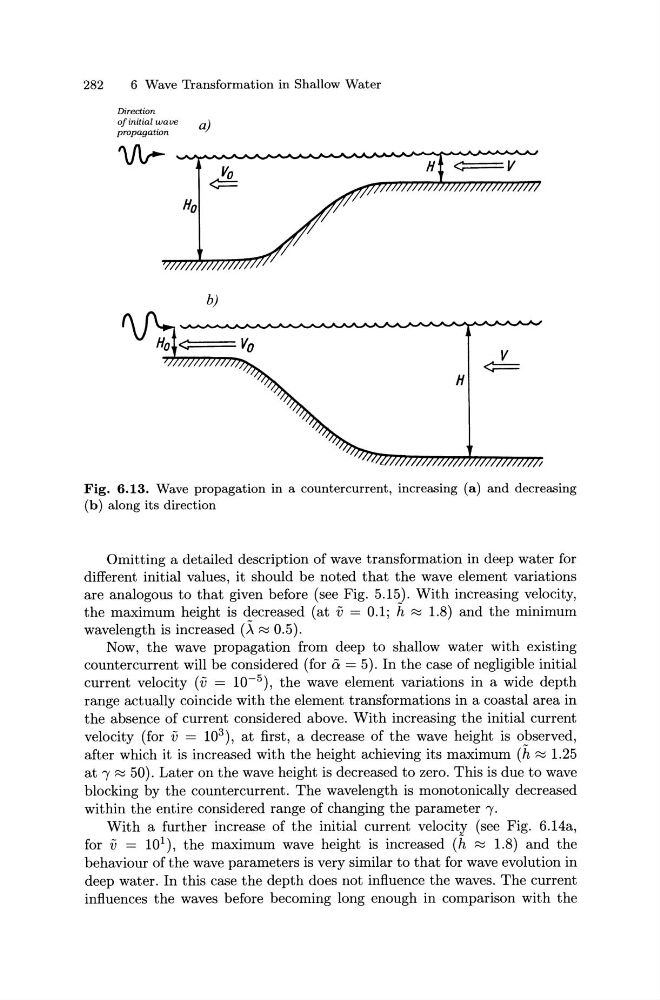
Fig. 6.13. Wave propagation in a countercurrent, increasing (a) and decreasing
(b) along its direction
Omitting a detailed description of wave transformation in deep water for
different initial values, it should be noted that the wave element variations
are analogous to that given before (see Fig. 5.15). With increasing velocity,
the maximum height is decreased (at v = 0.1; h ~ 1.8) and the minimum
wavelength is increased (.:\ ~ 0.5).
Now, the wave propagation from deep to shallow water with existing
countercurrent will be considered (for a = 5). In the case of negligible initial
current velocity (v = 10- 5 ), the wave element variations in a wide depth
range actually coincide with the element transformations in a coastal area in
the absence of current considered above. With increasing the initial current
velocity (for v = 10 3 ), at first, a decrease of the wave height is observed,
after which it is increased with the height achieving its maximum (h ~ 1.25
at 1 ~50). Later on the wave height is decreased to zero. This is due to wave
blocking by the countercurrent. The wavelength is monotonically decreased
within the entire considered range of changing the parameter I·
With a further increase of the initial current velocity (see Fig. 6.14a,
for v = 10 1 ), the maximum wave height is increased (h ~ 1.8) and the
behaviour of the wave parameters is very similar to that for wave evolution in
deep water. In this case the depth does not influence the waves. The current
influences the waves before becoming long enough in comparison with the
6 Wave Transformation in Shallow Water
Direction
of initial wave
a)
propagation
b)
I
Fig. 6.13. Wave propagation in a countercurrent, increasing (a) and decreasing
(b) along its direction
Omitting a detailed description of wave transformation in deep water for
different initial values, it should be noted that the wave element variations
are analogous to that given before (see Fig. 5.15). With increasing velocity,
the maximum height is decreased (at v = 0.1; h ~ 1.8) and the minimum
wavelength is increased (.:\ ~ 0.5).
Now, the wave propagation from deep to shallow water with existing
countercurrent will be considered (for a = 5). In the case of negligible initial
current velocity (v = 10- 5 ), the wave element variations in a wide depth
range actually coincide with the element transformations in a coastal area in
the absence of current considered above. With increasing the initial current
velocity (for v = 10 3 ), at first, a decrease of the wave height is observed,
after which it is increased with the height achieving its maximum (h ~ 1.25
at 1 ~50). Later on the wave height is decreased to zero. This is due to wave
blocking by the countercurrent. The wavelength is monotonically decreased
within the entire considered range of changing the parameter I·
With a further increase of the initial current velocity (see Fig. 6.14a,
for v = 10 1 ), the maximum wave height is increased (h ~ 1.8) and the
behaviour of the wave parameters is very similar to that for wave evolution in
deep water. In this case the depth does not influence the waves. The current
influences the waves before becoming long enough in comparison with the