

270
6 Wave Transformation in Shallow Water
as the current velocity V and depth H are only dependent on the x coordinate (without depending on they coordinate and timet). These terms can
be rewritten in the following form:
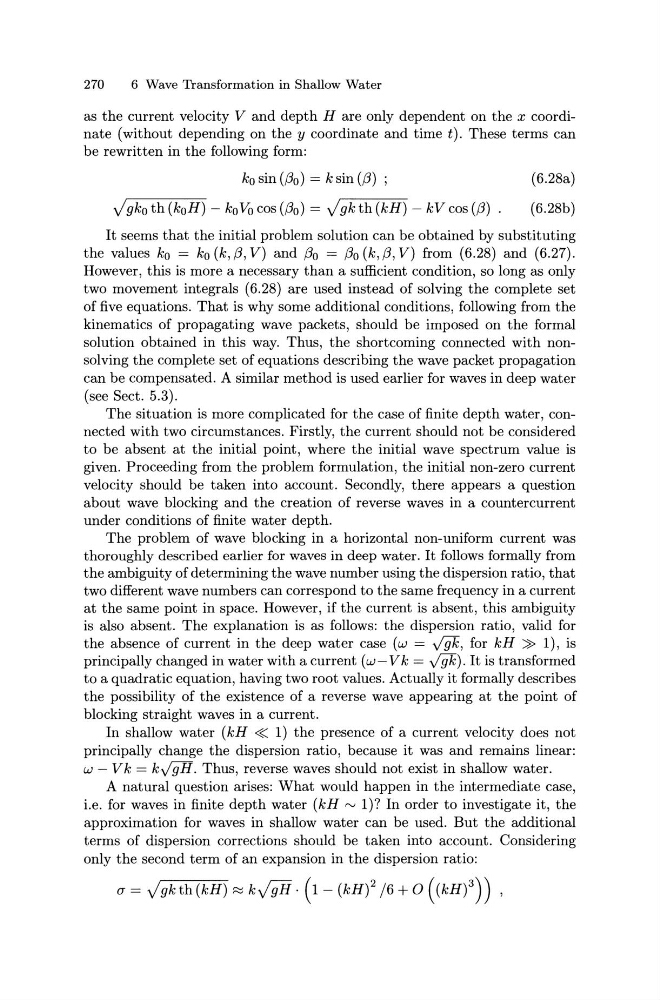
kosin (f3o) = k sin ([3) ;
y' gko th (koH) - ko Vo cos (f3o) = y' gk th (kH) - kV cos ([3)
(6.28a)
(6.28b)
It seems that the initial problem solution can be obtained by substituting
the values ko = ko (k,[3, V) and f3o = [30 (k,[3, V) from (6.28) and (6.27).
However, this is more a necessary than a sufficient condition, so long as only
two movement integrals (6.28) are used instead of solving the complete set
of five equations. That is why some additional conditions, following from the
kinematics of propagating wave packets, should be imposed on the formal
solution obtained in this way. Thus, the shortcoming connected with nonsolving the complete set of equations describing the wave packet propagation
can be compensated. A similar method is used earlier for waves in deep water
(see Sect. 5.3).
The situation is more complicated for the case of finite depth water, connected with two circumstances. Firstly, the current should not be considered
to be absent at the initial point, where the initial wave spectrum value is
given. Proceeding from the problem formulation, the initial non-zero current
velocity should be taken into account. Secondly, there appears a question
about wave blocking and the creation of reverse waves in a countercurrent
under conditions of finite water depth.
The problem of wave blocking in a horizontal non-uniform current was
thoroughly described earlier for waves in deep water. It follows formally from
the ambiguity of determining the wave number using the dispersion ratio, that
two different wave numbers can correspond to the same frequency in a current
at the same point in space. However, if the current is absent, this ambiguity
is also absent. The explanation is as follows: the dispersion ratio, valid for
the absence of current in the deep water case (w = y'g/C, for kH » 1), is
principally changed in water with a current (w- Vk = y'g/C). It is transformed
to a quadratic equation, having two root values. Actually it formally describes
the possibility of the existence of a reverse wave appearing at the point of
blocking straight waves in a current.
In shallow water (kH « 1) the presence of a current velocity does not
principally change the dispersion ratio, because it was and remains linear:
w- Vk = ky'gH. Thus, reverse waves should not exist in shallow water.
A natural question arises: What would happen in the intermediate case,
i.e. for waves in finite depth water (kH "' 1)? In order to investigate it, the
approximation for waves in shallow water can be used. But the additional
terms of dispersion corrections should be taken into account. Considering
only the second term of an expansion in the dispersion ratio:
a= y'gkth(kH) ~ ky'9ii · (1- (kH) 2 /6 + 0 ((kH) 3 )) ,
6 Wave Transformation in Shallow Water
as the current velocity V and depth H are only dependent on the x coordinate (without depending on they coordinate and timet). These terms can
be rewritten in the following form:
kosin (f3o) = k sin ([3) ;
y' gko th (koH) - ko Vo cos (f3o) = y' gk th (kH) - kV cos ([3)
(6.28a)
(6.28b)
It seems that the initial problem solution can be obtained by substituting
the values ko = ko (k,[3, V) and f3o = [30 (k,[3, V) from (6.28) and (6.27).
However, this is more a necessary than a sufficient condition, so long as only
two movement integrals (6.28) are used instead of solving the complete set
of five equations. That is why some additional conditions, following from the
kinematics of propagating wave packets, should be imposed on the formal
solution obtained in this way. Thus, the shortcoming connected with nonsolving the complete set of equations describing the wave packet propagation
can be compensated. A similar method is used earlier for waves in deep water
(see Sect. 5.3).
The situation is more complicated for the case of finite depth water, connected with two circumstances. Firstly, the current should not be considered
to be absent at the initial point, where the initial wave spectrum value is
given. Proceeding from the problem formulation, the initial non-zero current
velocity should be taken into account. Secondly, there appears a question
about wave blocking and the creation of reverse waves in a countercurrent
under conditions of finite water depth.
The problem of wave blocking in a horizontal non-uniform current was
thoroughly described earlier for waves in deep water. It follows formally from
the ambiguity of determining the wave number using the dispersion ratio, that
two different wave numbers can correspond to the same frequency in a current
at the same point in space. However, if the current is absent, this ambiguity
is also absent. The explanation is as follows: the dispersion ratio, valid for
the absence of current in the deep water case (w = y'g/C, for kH » 1), is
principally changed in water with a current (w- Vk = y'g/C). It is transformed
to a quadratic equation, having two root values. Actually it formally describes
the possibility of the existence of a reverse wave appearing at the point of
blocking straight waves in a current.
In shallow water (kH « 1) the presence of a current velocity does not
principally change the dispersion ratio, because it was and remains linear:
w- Vk = ky'gH. Thus, reverse waves should not exist in shallow water.
A natural question arises: What would happen in the intermediate case,
i.e. for waves in finite depth water (kH "' 1)? In order to investigate it, the
approximation for waves in shallow water can be used. But the additional
terms of dispersion corrections should be taken into account. Considering
only the second term of an expansion in the dispersion ratio:
a= y'gkth(kH) ~ ky'9ii · (1- (kH) 2 /6 + 0 ((kH) 3 )) ,