

6.2 Weak Non-Linear Wave Interaction in Shallow Water
263
Wmax are determined for the time moment tn. At the second stage, nondimensional values for the right-hand side of (6.17) are calculated. The values
of the core function T are not calculated at every time step, because they
are calculated at the preprocessing stage. The dimensional value is obtained
by multiplying the calculated value G by S!axw;;ax/ g 4 . Then the evolution
equation (6.17) is solved with the help of a first-order numerical scheme.
The spectrum maximum is chosen using spectral values obtained at this step
S(w;,(3j,tn), and the next step of solving the problem is made.
It should be noted that the arguments w, (3 occurring in the integrands do
not coincide with the grid point values w;, (3j in the numerical solution changing constantly. The spectrum at these points is determined by interpolating
its value using the four nearest grid points.
A significant increase of the processing speed is obtained by choosing
the most considerable area from the full three-dimensional calculation space,
making the main contribution. The sizes of the area are determined by the
calculation accuracy prescribed in advance. This reduces the number of calculations. For example, the calculation is decreased by an order of magnitude,
prescribing a 5 per cent calculation error.
The integrating step fit is chosen automatically. It is taken into account
that the spectrum is displaced to the low frequency area due to non-linear
evolution, while the energy transfer intensity is decreased. Meeting the requirement of approximate equality of the relative spectrum variations at each
step, the following uniformity ratio can be obtained:
fit =fit
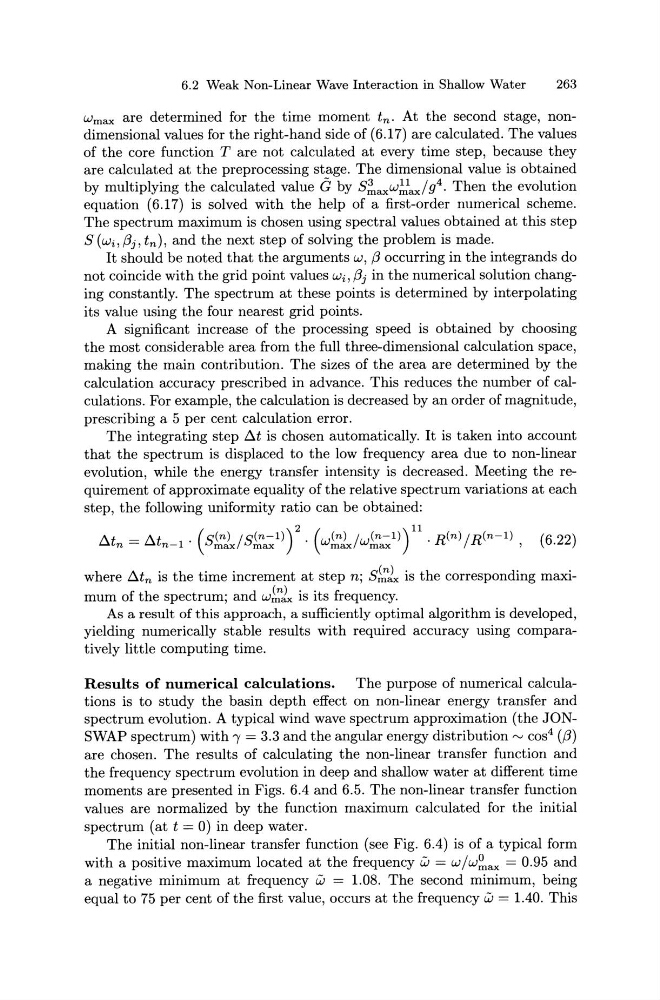
. (s(n) /S(n-1))2. (w(n) /w(n-1))11. R(n)/R(n-1)
n
n-1
max
max
max
max
'
(6.22)
where fitn is the time increment at step n; s~lx is the corresponding maximum of the spectrum; and w~"lx is its frequency.
As a result of this approach, a sufficiently optimal algorithm is developed,
yielding numerically stable results with required accuracy using comparatively little computing time.
Results of numerical calculations.
The purpose of numerical calculations is to study the basin depth effect on non-linear energy transfer and
spectrum evolution. A typical wind wave spectrum approximation (the JONSWAP spectrum) with"/= 3.3 and the angular energy distribution rv cos 4 ((3)
are chosen. The results of calculating the non-linear transfer function and
the frequency spectrum evolution in deep and shallow water at different time
moments are presented in Figs. 6.4 and 6.5. The non-linear transfer function
values are normalized by the function maximum calculated for the initial
spectrum (at t = 0) in deep water.
The initial non-linear transfer function (see Fig. 6.4) is of a typical form
with a positive maximum located at the frequency w = w/w~ax = 0.95 and
a negative minimum at frequency w = 1.08. The second minimum, being
equal to 75 per cent of the first value, occurs at the frequency w = 1.40. This
263
Wmax are determined for the time moment tn. At the second stage, nondimensional values for the right-hand side of (6.17) are calculated. The values
of the core function T are not calculated at every time step, because they
are calculated at the preprocessing stage. The dimensional value is obtained
by multiplying the calculated value G by S!axw;;ax/ g 4 . Then the evolution
equation (6.17) is solved with the help of a first-order numerical scheme.
The spectrum maximum is chosen using spectral values obtained at this step
S(w;,(3j,tn), and the next step of solving the problem is made.
It should be noted that the arguments w, (3 occurring in the integrands do
not coincide with the grid point values w;, (3j in the numerical solution changing constantly. The spectrum at these points is determined by interpolating
its value using the four nearest grid points.
A significant increase of the processing speed is obtained by choosing
the most considerable area from the full three-dimensional calculation space,
making the main contribution. The sizes of the area are determined by the
calculation accuracy prescribed in advance. This reduces the number of calculations. For example, the calculation is decreased by an order of magnitude,
prescribing a 5 per cent calculation error.
The integrating step fit is chosen automatically. It is taken into account
that the spectrum is displaced to the low frequency area due to non-linear
evolution, while the energy transfer intensity is decreased. Meeting the requirement of approximate equality of the relative spectrum variations at each
step, the following uniformity ratio can be obtained:
fit =fit
. (s(n) /S(n-1))2. (w(n) /w(n-1))11. R(n)/R(n-1)
n
n-1
max
max
max
max
'
(6.22)
where fitn is the time increment at step n; s~lx is the corresponding maximum of the spectrum; and w~"lx is its frequency.
As a result of this approach, a sufficiently optimal algorithm is developed,
yielding numerically stable results with required accuracy using comparatively little computing time.
Results of numerical calculations.
The purpose of numerical calculations is to study the basin depth effect on non-linear energy transfer and
spectrum evolution. A typical wind wave spectrum approximation (the JONSWAP spectrum) with"/= 3.3 and the angular energy distribution rv cos 4 ((3)
are chosen. The results of calculating the non-linear transfer function and
the frequency spectrum evolution in deep and shallow water at different time
moments are presented in Figs. 6.4 and 6.5. The non-linear transfer function
values are normalized by the function maximum calculated for the initial
spectrum (at t = 0) in deep water.
The initial non-linear transfer function (see Fig. 6.4) is of a typical form
with a positive maximum located at the frequency w = w/w~ax = 0.95 and
a negative minimum at frequency w = 1.08. The second minimum, being
equal to 75 per cent of the first value, occurs at the frequency w = 1.40. This