

5.11 Recommendations for Current Influence Estimation
249
- 1
- 2
---3
II
2.0
Ill
'--- --- --O.lf
--~o.-6----~o.-5----o.~"-----~o.J-----o.~2-----~aL.t--~o----~o.-t---o.~~----~a-3--~4-v
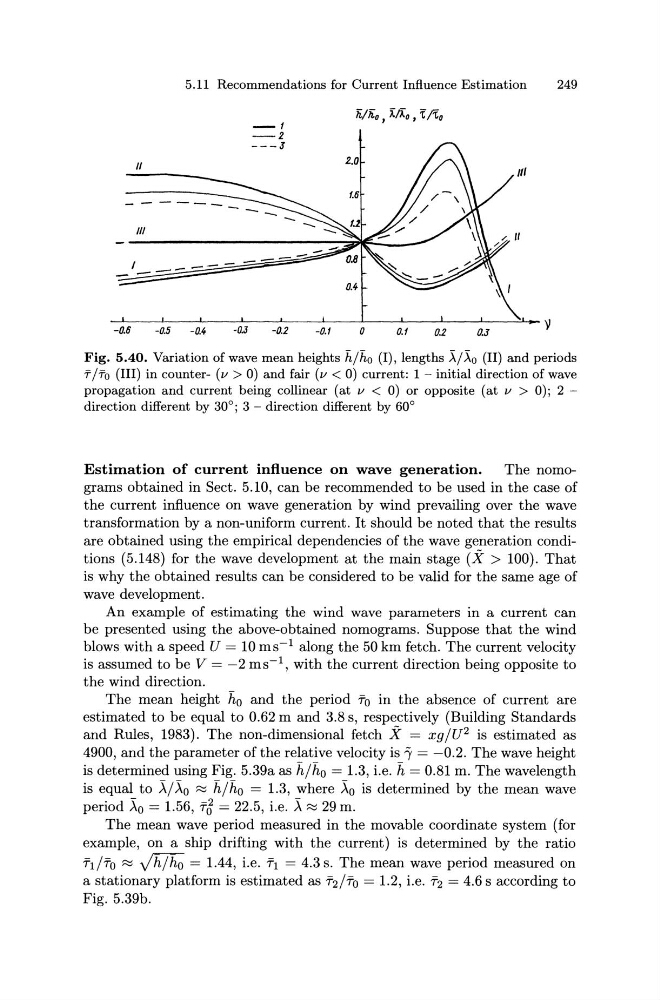
Fig. 5.40. Variation of wave mean heights h/ho (I), lengths >..;>..o (II) and periods
r /ro (III) in counter- (v > 0) and fair (v < 0) current: 1 - initial direction of wave
propagation and current being collinear (at v < 0) or opposite (at v > 0); 2 -
direction different by 30°; 3 - direction different by 60°
Estimation of current influence on wave generation.
The nomograms obtained in Sect. 5.10, can be recommended to be used in the case of
the current influence on wave generation by wind prevailing over the wave
transformation by a non-uniform current. It should be noted that the results
are obtained using the empirical dependencies of the wave generation conditions (5.148) for the wave development at the main stage (X > 100). That
is why the obtained results can be considered to be valid for the same age of
wave development.
An example of estimating the wind wave parameters in a current can
be presented using the above-obtained nomograms. Suppose that the wind
blows with a speed U = 10 ms- 1 along the 50 km fetch. The current velocity
is assumed to be V = -2 ms- 1 , with the current direction being opposite to
the wind direction.
The mean height li0 and the period 70 in the absence of current are
estimated to be equal to 0.62 m and 3.8 s, respectively (Building Standards
and Rules, 1983). The non-dimensional fetch X = xgjU 2 is estimated as
4900, and the parameter of the relative velocity is i = -0.2. The wave height
is determined using Fig. 5.39a as lijli0 = 1.3, i.e. li = 0.81 m. The wavelength
is equal to X/5..o ~ lijli0 = 1.3, where >.0 is determined by the mean wave
period >.0 = 1.56, 7J = 22.5, i.e. >. ~ 29m.
The mean wave period measured in the movable coordinate system (for
example, on a ship drifting with the current) is determined by the ratio
7I/7o ~ VhJ"ho = 1.44, i.e. 71 = 4.3 s. The mean wave period measured on
a stationary platform is estimated as 72/70 = 1.2, i.e. 7' 2 = 4.6 s according to
Fig. 5.39b.
249
- 1
- 2
---3
II
2.0
Ill
'--- --- --O.lf
--~o.-6----~o.-5----o.~"-----~o.J-----o.~2-----~aL.t--~o----~o.-t---o.~~----~a-3--~4-v
Fig. 5.40. Variation of wave mean heights h/ho (I), lengths >..;>..o (II) and periods
r /ro (III) in counter- (v > 0) and fair (v < 0) current: 1 - initial direction of wave
propagation and current being collinear (at v < 0) or opposite (at v > 0); 2 -
direction different by 30°; 3 - direction different by 60°
Estimation of current influence on wave generation.
The nomograms obtained in Sect. 5.10, can be recommended to be used in the case of
the current influence on wave generation by wind prevailing over the wave
transformation by a non-uniform current. It should be noted that the results
are obtained using the empirical dependencies of the wave generation conditions (5.148) for the wave development at the main stage (X > 100). That
is why the obtained results can be considered to be valid for the same age of
wave development.
An example of estimating the wind wave parameters in a current can
be presented using the above-obtained nomograms. Suppose that the wind
blows with a speed U = 10 ms- 1 along the 50 km fetch. The current velocity
is assumed to be V = -2 ms- 1 , with the current direction being opposite to
the wind direction.
The mean height li0 and the period 70 in the absence of current are
estimated to be equal to 0.62 m and 3.8 s, respectively (Building Standards
and Rules, 1983). The non-dimensional fetch X = xgjU 2 is estimated as
4900, and the parameter of the relative velocity is i = -0.2. The wave height
is determined using Fig. 5.39a as lijli0 = 1.3, i.e. li = 0.81 m. The wavelength
is equal to X/5..o ~ lijli0 = 1.3, where >.0 is determined by the mean wave
period >.0 = 1.56, 7J = 22.5, i.e. >. ~ 29m.
The mean wave period measured in the movable coordinate system (for
example, on a ship drifting with the current) is determined by the ratio
7I/7o ~ VhJ"ho = 1.44, i.e. 71 = 4.3 s. The mean wave period measured on
a stationary platform is estimated as 72/70 = 1.2, i.e. 7' 2 = 4.6 s according to
Fig. 5.39b.