

5.10 Wind Wave Generation in a Current
241
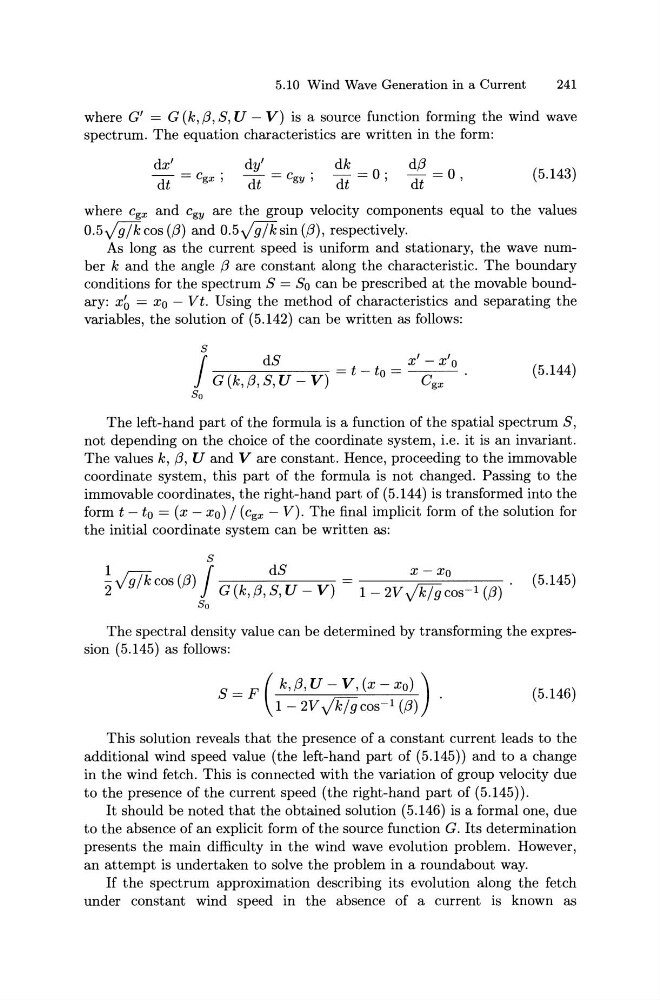
where G' = G (k, (3, S, U- V) is a source function forming the wind wave
spectrum. The equation characteristics are written in the form:
dx'
d t = Cgx;
dy'
dt=Cgy;
dk = 0 0
dt
,
d(3 = 0
dt
,
(5.143)
where Cgx and Cgy are the group velocity components equal to the values
0.5.Jifk cos ((3) and 0.5.Jifk sin ((3), respectively.
As long as the current speed is uniform and stationary, the wave number k and the angle (3 are constant along the characteristic. The boundary
conditions for the spectrum S = 80 can be prescribed at the movable boundary: x~ = x0 - Vt. Using the method of characteristics and separating the
variables, the solution of (5.142) can be written as follows:
s
J
dS
G(k,(3,S,U- V)
So
x' -x'o
=t-to = - - -
Cgx
(5.144)
The left-hand part of the formula is a function of the spatial spectrum S,
not depending on the choice of the coordinate system, i.e. it is an invariant.
The values k, (3, U and V are constant. Hence, proceeding to the immovable
coordinate system, this part of the formula is not changed. Passing to the
immovable coordinates, the right-hand part of (5.144) is transformed into the
form t- t 0 = (x- x0 ) / (cgx- V). The final implicit form of the solution for
the initial coordinate system can be written as:
s
~..;gjkcos ((3) j
dS
=
x- xo
. (5.145)
2
G (k, (3, S, U - V)
1 - 2V Jk79 cos-1 ((3)
So
The spectral density value can be determined by transforming the expression (5.145) as follows:
8 = F ( k, (3, U- V, (x- xo) )
1- 2V Jk79cos-1 ((3)
(5.146)
This solution reveals that the presence of a constant current leads to the
additional wind speed value (the left-hand part of (5.145)) and to a change
in the wind fetch. This is connected with the variation of group velocity due
to the presence of the current speed (the right-hand part of (5.145)).
It should be noted that the obtained solution (5.146) is a formal one, due
to the absence of an explicit form of the source function G. Its determination
presents the main difficulty in the wind wave evolution problem. However,
an attempt is undertaken to solve the problem in a roundabout way.
If the spectrum approximation describing its evolution along the fetch
under constant wind speed in the absence of a current is known as
241
where G' = G (k, (3, S, U- V) is a source function forming the wind wave
spectrum. The equation characteristics are written in the form:
dx'
d t = Cgx;
dy'
dt=Cgy;
dk = 0 0
dt
,
d(3 = 0
dt
,
(5.143)
where Cgx and Cgy are the group velocity components equal to the values
0.5.Jifk cos ((3) and 0.5.Jifk sin ((3), respectively.
As long as the current speed is uniform and stationary, the wave number k and the angle (3 are constant along the characteristic. The boundary
conditions for the spectrum S = 80 can be prescribed at the movable boundary: x~ = x0 - Vt. Using the method of characteristics and separating the
variables, the solution of (5.142) can be written as follows:
s
J
dS
G(k,(3,S,U- V)
So
x' -x'o
=t-to = - - -
Cgx
(5.144)
The left-hand part of the formula is a function of the spatial spectrum S,
not depending on the choice of the coordinate system, i.e. it is an invariant.
The values k, (3, U and V are constant. Hence, proceeding to the immovable
coordinate system, this part of the formula is not changed. Passing to the
immovable coordinates, the right-hand part of (5.144) is transformed into the
form t- t 0 = (x- x0 ) / (cgx- V). The final implicit form of the solution for
the initial coordinate system can be written as:
s
~..;gjkcos ((3) j
dS
=
x- xo
. (5.145)
2
G (k, (3, S, U - V)
1 - 2V Jk79 cos-1 ((3)
So
The spectral density value can be determined by transforming the expression (5.145) as follows:
8 = F ( k, (3, U- V, (x- xo) )
1- 2V Jk79cos-1 ((3)
(5.146)
This solution reveals that the presence of a constant current leads to the
additional wind speed value (the left-hand part of (5.145)) and to a change
in the wind fetch. This is connected with the variation of group velocity due
to the presence of the current speed (the right-hand part of (5.145)).
It should be noted that the obtained solution (5.146) is a formal one, due
to the absence of an explicit form of the source function G. Its determination
presents the main difficulty in the wind wave evolution problem. However,
an attempt is undertaken to solve the problem in a roundabout way.
If the spectrum approximation describing its evolution along the fetch
under constant wind speed in the absence of a current is known as