

5.10 Wind Wave Generation in a Current
239
(
)
-0.354
u:p = o.939 g~t
(5.140)
g S = 0 0222 g elf
h
( X )0.669
u; ·
u;
'
(5.141)
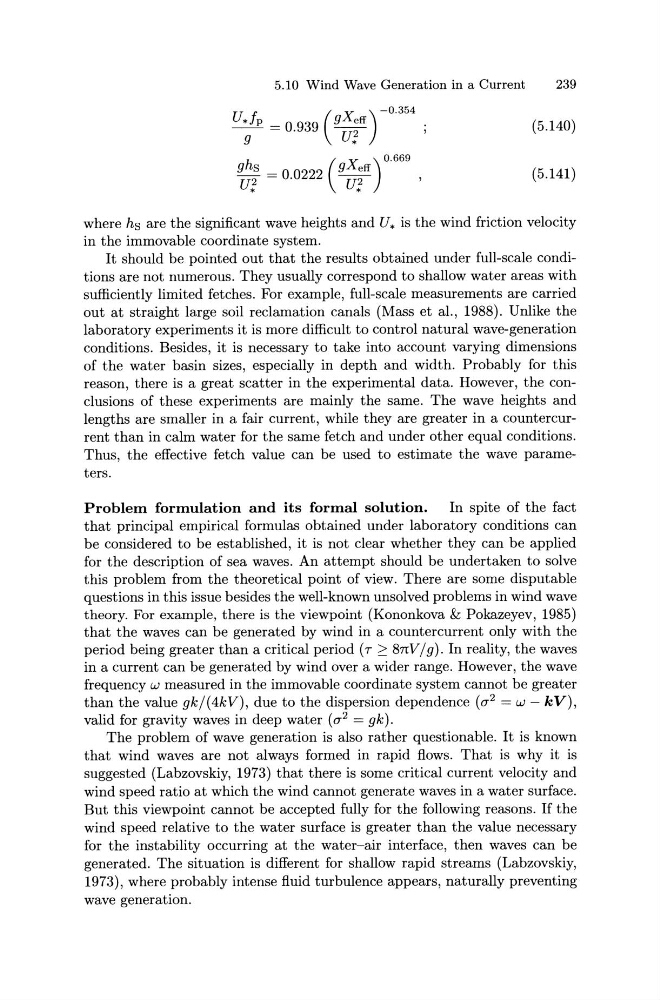
where hs are the significant wave heights and U* is the wind friction velocity
in the immovable coordinate system.
It should be pointed out that the results obtained under full-scale conditions are not numerous. They usually correspond to shallow water areas with
sufficiently limited fetches. For example, full-scale measurements are carried
out at straight large soil reclamation canals (Mass et al., 1988). Unlike the
laboratory experiments it is more difficult to control natural wave-generation
conditions. Besides, it is necessary to take into account varying dimensions
of the water basin sizes, especially in depth and width. Probably for this
reason, there is a great scatter in the experimental data. However, the conclusions of these experiments are mainly the same. The wave heights and
lengths are smaller in a fair current, while they are greater in a countercurrent than in calm water for the same fetch and under other equal conditions.
Thus, the effective fetch value can be used to estimate the wave parameters.
Problem formulation and its formal solution.
In spite of the fact
that principal empirical formulas obtained under laboratory conditions can
be considered to be established, it is not clear whether they can be applied
for the description of sea waves. An attempt should be undertaken to solve
this problem from the theoretical point of view. There are some disputable
questions in this issue besides the well-known unsolved problems in wind wave
theory. For example, there is the viewpoint (Kononkova & Pokazeyev, 1985)
that the waves can be generated by wind in a countercurrent only with the
period being greater than a critical period ( T 2: 8nV /g). In reality, the waves
in a current can be generated by wind over a wider range. However, the wave
frequency w measured in the immovable coordinate system cannot be greater
than the value gk/(4kV), due to the dispersion dependence (a 2 = w- kV),
valid for gravity waves in deep water (a 2 = gk).
The problem of wave generation is also rather questionable. It is known
that wind waves are not always formed in rapid flows. That is why it is
suggested (Labzovskiy, 1973) that there is some critical current velocity and
wind speed ratio at which the wind cannot generate waves in a water surface.
But this viewpoint cannot be accepted fully for the following reasons. If the
wind speed relative to the water surface is greater than the value necessary
for the instability occurring at the water-air interface, then waves can be
generated. The situation is different for shallow rapid streams (Labzovskiy,
1973), where probably intense fluid turbulence appears, naturally preventing
wave generation.
239
(
)
-0.354
u:p = o.939 g~t
(5.140)
g S = 0 0222 g elf
h
( X )0.669
u; ·
u;
'
(5.141)
where hs are the significant wave heights and U* is the wind friction velocity
in the immovable coordinate system.
It should be pointed out that the results obtained under full-scale conditions are not numerous. They usually correspond to shallow water areas with
sufficiently limited fetches. For example, full-scale measurements are carried
out at straight large soil reclamation canals (Mass et al., 1988). Unlike the
laboratory experiments it is more difficult to control natural wave-generation
conditions. Besides, it is necessary to take into account varying dimensions
of the water basin sizes, especially in depth and width. Probably for this
reason, there is a great scatter in the experimental data. However, the conclusions of these experiments are mainly the same. The wave heights and
lengths are smaller in a fair current, while they are greater in a countercurrent than in calm water for the same fetch and under other equal conditions.
Thus, the effective fetch value can be used to estimate the wave parameters.
Problem formulation and its formal solution.
In spite of the fact
that principal empirical formulas obtained under laboratory conditions can
be considered to be established, it is not clear whether they can be applied
for the description of sea waves. An attempt should be undertaken to solve
this problem from the theoretical point of view. There are some disputable
questions in this issue besides the well-known unsolved problems in wind wave
theory. For example, there is the viewpoint (Kononkova & Pokazeyev, 1985)
that the waves can be generated by wind in a countercurrent only with the
period being greater than a critical period ( T 2: 8nV /g). In reality, the waves
in a current can be generated by wind over a wider range. However, the wave
frequency w measured in the immovable coordinate system cannot be greater
than the value gk/(4kV), due to the dispersion dependence (a 2 = w- kV),
valid for gravity waves in deep water (a 2 = gk).
The problem of wave generation is also rather questionable. It is known
that wind waves are not always formed in rapid flows. That is why it is
suggested (Labzovskiy, 1973) that there is some critical current velocity and
wind speed ratio at which the wind cannot generate waves in a water surface.
But this viewpoint cannot be accepted fully for the following reasons. If the
wind speed relative to the water surface is greater than the value necessary
for the instability occurring at the water-air interface, then waves can be
generated. The situation is different for shallow rapid streams (Labzovskiy,
1973), where probably intense fluid turbulence appears, naturally preventing
wave generation.